
Manufacturing organizations rarely struggle because they lack ideas.
More often, they struggle because complexity gradually overtakes clarity. As priorities multiply, decision-making slows, communication becomes fragmented, and improvement efforts compete for attention instead of reinforcing one another. Even experienced leadership teams can find themselves spending more time responding to daily challenges than shaping the direction of the business.
For Eduardo Pagani, these patterns are rarely the result of a single operational problem. They are leadership challenges that become visible in how an organization functions every day.
“Most companies do not struggle because people are not working hard,” Pagani says. “They struggle because too many people are working hard on too many disconnected priorities.”
That belief has shaped Pagani’s more than 30 years of international manufacturing leadership. His experience spans senior operating roles, business turnarounds, Lean transformation, regulated manufacturing, and global teams across the United States, Brazil, Mexico, Italy, Germany, England, Costa Rica, the Netherlands, Sweden, India, and Russia.
Across different countries, cultures, and operating environments, Pagani has found that organizations capable of sustaining improvement usually share one characteristic: leaders who create clarity before adding complexity.
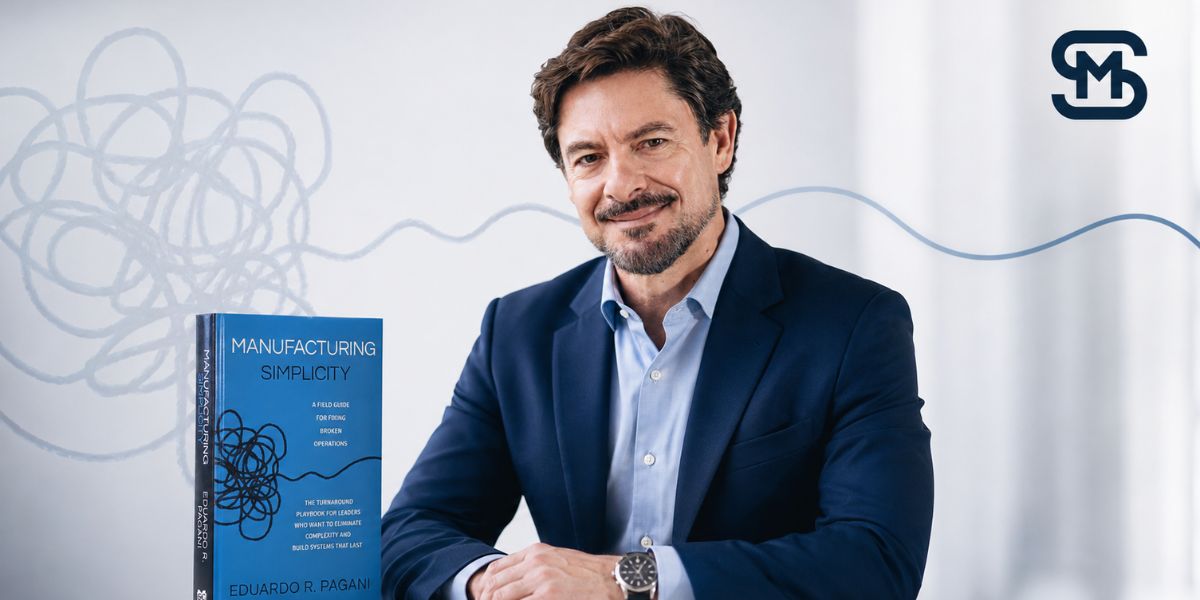
That philosophy continues to shape his work through Manufacturing Simplicity, LLC and his Amazon bestselling book, Manufacturing Simplicity: A Field Guide for Fixing Broken Operations.
Complexity Often Builds Gradually
Operational complexity rarely arrives all at once.
It accumulates through competing priorities, disconnected initiatives, inconsistent communication, and well-intentioned decisions that gradually pull organizations in different directions. Individually, those decisions may appear reasonable. Collectively, they can leave teams uncertain about what deserves attention and how success should be measured.
Pagani believes this is where leadership becomes most influential.
When leaders consistently communicate priorities, reinforce accountability, and stay connected to the realities of daily operations, they create the conditions for improvement to take hold. Without that clarity, even well-designed initiatives can lose momentum.
For Pagani, simplifying an organization is not about reducing ambition. It is about removing unnecessary complexity so people can focus their energy on work that creates meaningful value.
“Simplicity is not about doing less because expectations are lower,” he says. “It is about focusing the organization so people can execute better.”
Global Experience Reveals Common Leadership Challenges
Leading manufacturing organizations across multiple countries reinforced a lesson that transcends geography.
Markets differed. Cultures varied. Operational challenges often looked different on the surface. Yet the leadership issues underneath were remarkably consistent. Organizations performed more effectively when leaders established clear expectations, encouraged collaboration, and built environments where employees understood both the purpose of their work and their role in improving it.
Those experiences shaped Pagani’s perspective on organizational improvement.
Rather than viewing operational excellence as a collection of isolated tools or projects, he sees it as the outcome of consistent leadership decisions made over time. Sustainable improvement depends less on introducing new initiatives than on strengthening the everyday practices that help organizations remain focused, aligned, and accountable.
Leadership Creates the Conditions for Improvement
Throughout his career, Pagani has observed that organizations often respond to recurring problems by introducing additional processes, meetings, or initiatives. While each effort may be well-intentioned, they can unintentionally increase complexity when leaders have not first established shared priorities.
In contrast, organizations that sustain improvement tend to operate with greater discipline around a smaller number of objectives. Communication remains consistent. Accountability is understood rather than enforced. Employees are encouraged to solve problems within a structure that supports learning, follow-through, and daily execution.
This perspective has become central to Pagani’s leadership philosophy.
Rather than asking organizations to do more, he encourages leaders to become more deliberate about what deserves attention, what creates unnecessary friction, and what enables teams to perform at their best over time.
Simplicity Is a Leadership Discipline
In Manufacturing Simplicity, Pagani expands on many of the lessons shaped through decades of executive leadership and global manufacturing experience.
The book is not simply another explanation of Lean tools. Instead, it helps leaders assess their business, identify the right priorities, simplify operations, build accountability, and engage employees in improvement work that matters.
Pagani’s view is that tools alone do not transform a business. Leaders must first understand what is limiting performance, then focus the organization around the right problems, the right behaviors, and the right operating rhythm.
The broader message, however, extends beyond manufacturing.
As organizations continue navigating changing technologies, evolving workforce expectations, and increasingly complex operating environments, Pagani believes leadership will become less about introducing additional complexity and more about creating the clarity that allows people and organizations to perform consistently over time.
Explore / Learn More
Eduardo Pagani is a global operations executive, founder of Manufacturing Simplicity, LLC, and the Amazon bestselling author of Manufacturing Simplicity: A Field Guide for Fixing Broken Operations. Drawing on more than three decades of international manufacturing leadership, he advises organizations on operational excellence, leadership development, and continuous improvement.
Website: https://manufacturingsimplicity.com/book.html
LinkedIn: www.linkedin.com/in/eduardopagani
Facebook: https://www.facebook.com/eduardo.pagani.3
Instagram: @edupagani_
TikTok: @eduardopagani959