
By: Ali Raza
Search this question, and you will get 10 articles listing 15 CRMs each, ranked by nothing more specific than “popularity” or “editor’s choice.” None of them actually answer the question for the business asking it. A 5-person team with a limited budget, no dedicated ops person, and a genuine need to close more deals without adding more software complexity.
So let’s answer it properly.
The Quick Answer
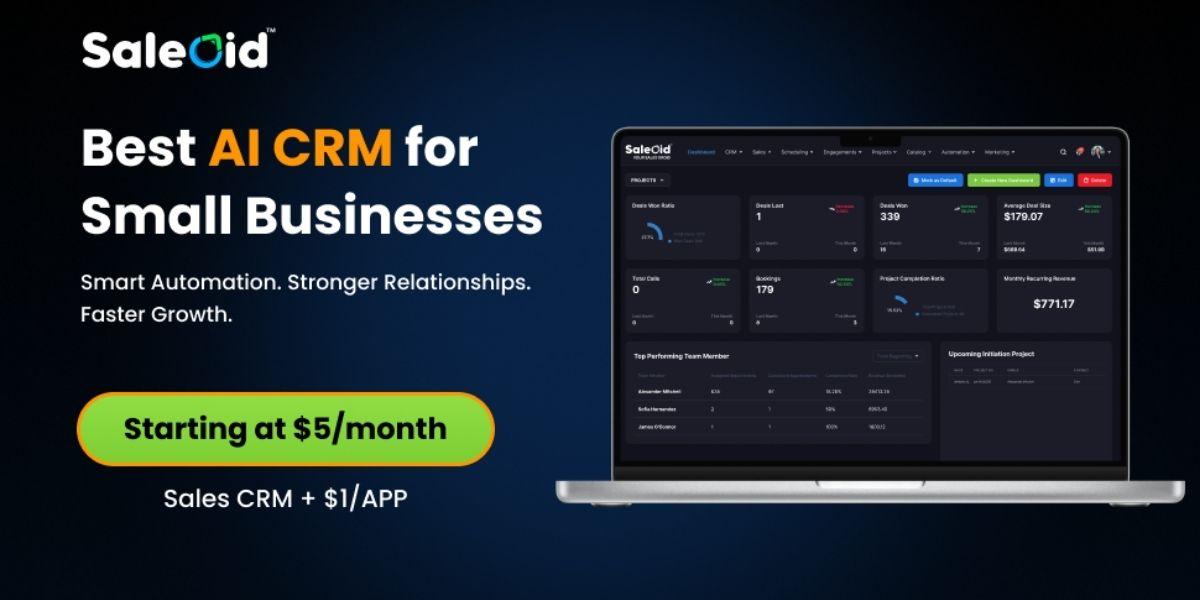
The best AI CRM for small businesses is not the one with the longest feature list. It is the one with flat, affordable pricing, AI functionality that actually works at small-team scale, and no cost penalty for growing your headcount. Judged against those 3 criteria, Saleoid’s $5 AI CRM is built specifically to fit that description, and it is one of the more direct answers currently available for small teams comparing options.
Below is why that answer holds up, and what to check before you take anyone’s word for it, including this one.
Why Generic “Best CRM” Lists Fail Small Businesses
Most CRM comparison articles rank tools the same way regardless of who is reading them. A solo consultant and a 50-person sales floor get the same list, in the same order, with the same top 3 names.
That approach breaks down fast once pricing and complexity enter the picture. A CRM that is genuinely excellent for a large sales team, with dedicated admins and a 6-figure software budget, can be completely wrong for a small business trying to keep monthly costs under a few hundred dollars total.
“Best” only means something once you define best for whom. For a small business, that definition needs to include cost per user, setup time, and whether the AI features actually function with a smaller contact list, not just enterprise-scale data.
What “Best” Actually Needs to Mean for a Small Business
Strip away the marketing, and a genuinely good AI CRM software for a small team needs to deliver on 4 specific things.
● Affordable, predictable pricing: Costs should not multiply every time you hire someone. A flat monthly rate, or at minimum a transparent per-seat cost with no hidden tiers, is the baseline requirement.
● AI that works at your actual scale: Predictive lead scoring and automated follow-ups need to function well with a hundred contacts, not require ten thousand data points before they become useful.
● Fast setup without a dedicated admin: If getting the CRM running requires a consultant or a week of configuration, that cost belongs in the price comparison too, even if it is not on the invoice.
● No feature-gating on the basics: Contact management, automation, and reporting should be included from day one, not locked behind a “Professional” tier that costs three times more.
Any CRM claiming to be the best option for small businesses should be measured against these four points before anything else, including brand recognition.
The All-in-One Agency Platform Question About Best AI CRM
A lot of the confusion around “best AI CRM” traces back to one category of tool, which is large, all-in-one platform originally built for marketing agencies managing several client accounts at once.
These platforms bundle a CRM together with marketing automation, funnel builders, and white-label controls, which makes sense for an agency reselling software under its own brand to a dozen different clients. For a single small business that just needs a straightforward way to manage its own leads, that same bundle often brings a level of setup and complexity that outweighs the benefit.
This mismatch is why small businesses often end up searching for GoHighLevel alternatives. It is less about any one platform falling short and more about small, single-team businesses looking for something built around their situation specifically, rather than an agency’s.
What to Look for in Any Popular CRM Alternative
If you are a small business rather than an agency managing multiple client accounts, a genuine alternative should simplify what other popular CRMs make complex, not just replicate it at a lower price.
Look specifically for:
● A single-business setup rather than a multi-client, white-label structure
● Pricing built around one team’s usage, not resale margins
● AI features focused on your own pipeline, not client management tooling
● A shorter learning curve, since you likely do not have a dedicated platform administrator
A tool that checks these boxes tends to serve a small business better than a scaled-down agency platform, simply because it was never trying to solve the agency problem to begin with.
Where Saleoid Fits Into This CRM Comparison
Saleoid was built directly around the four criteria above, rather than as a smaller version of an enterprise or agency-focused platform.
The ideal AI CRM for small business starts at a flat, transparent monthly rate, with core AI features, including lead scoring and automated follow-ups, included from the first plan rather than gated behind a premium tier. Setup is designed to take minutes rather than requiring outside help, which matters for a business without a dedicated CRM administrator.
This does not mean Saleoid is automatically the right fit for every single small business reading this. It means that judged against the actual criteria that matter for a small team, rather than a generic feature checklist, it answers the question directly instead of dodging it with a long list of alternatives.
How to Actually Test Which AI CRM Is Best for You
Rather than taking any single recommendation at face value, including this one, run a short, practical test before committing.
● Check the real monthly cost at your team size: Ask directly what the price becomes if you add two more users next year, not just today’s rate.
● Test the AI features with your real contact list: A short trial should reveal whether lead scoring and follow-up suggestions actually make sense with your current pipeline size.
● Time your own setup: If getting fully operational takes more than a day without external help, factor that into your decision.
● Confirm nothing important sits behind a higher tier: Automation and reporting should be available immediately, not as an upsell three months in.
A CRM that performs well across all four of these checks is doing more to earn the “best” label than any ranked list ever could.
The Real Answer on the Best AI CRM for Small Businesses
There is no single CRM that is objectively best for every small business on earth, and any article claiming otherwise is oversimplifying the question. But there is a clear, testable definition of what “best” should mean for a small team specifically: affordable and predictable pricing, AI that works at your actual scale, fast setup, and no feature-gating on the essentials.
Measured against that definition, Saleoid’s $5 AI CRM is one of the more direct answers currently available, particularly for small businesses that found other popular CRMs like GoHighLevel, HubSpot, and Zoho CRM too complex for a single-team setup. Whether it is the right fit for your specific business is worth confirming with a short trial rather than a ranked list, but the criteria above should make that decision considerably faster.