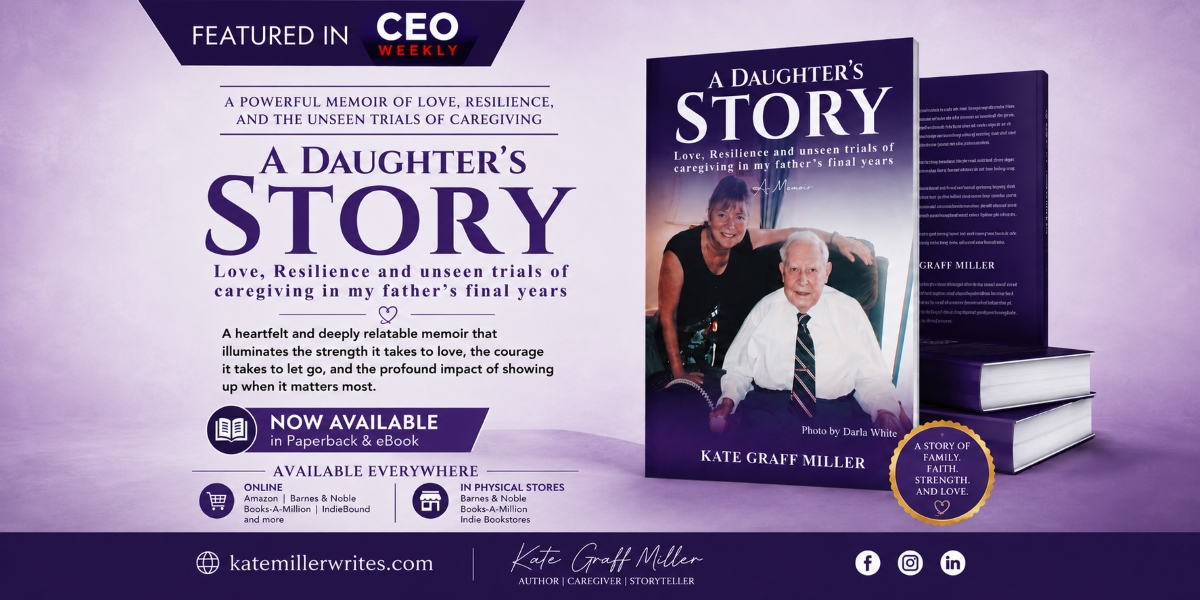

Great memoirs accomplish something rare. They begin with one person’s experience but ultimately tell a story that belongs to many. Kate Graff Miller’s A Daughter’s Story is a perfect example of that transition.
What started as a deeply personal account of caring for her aging father has evolved into a memoir that resonates with readers across generations. Its appearance in Amazon Best Sellers categories reflects not only the quality of the writing but also the universal power of its message. The path to publication was anything but conventional. She did not set out to write a bestselling memoir. She was not pursuing literary recognition or commercial success. Instead, she was trying to navigate one of life’s most emotionally demanding experiences. Caring for a parent in his final years.
Her father, Stewart Graff, was a remarkable man whose decline unfolded gradually over several years. As she became increasingly involved in his care, she found herself documenting the experience. She observed conversations, preserved memories, and reflected on the emotional complexities of caregiving. Initially, those writings served a personal purpose.
Writing helped her process uncertainty, grief, frustration, and love. It provided structure during a period when life often felt unpredictable. What she could not have known at the time was that these reflections would eventually form the foundation of a memoir capable of touching thousands of readers. One reason A Daughter’s Story stands apart from many caregiving memoirs is its commitment to emotional honesty.
Kate does not portray herself as a heroic figure who effortlessly handles every challenge. Instead, she allows readers to see the contradictions that define real caregiving experiences. She loves her father deeply. She also becomes exhausted. She treasures their time together. She simultaneously longs for freedom and normalcy.
Rather than hiding these feelings, she embraces them. The result is a narrative that feels authentic because it reflects genuine human experience.
Another reason readers have connected so strongly with the memoir is its extraordinary attention to detail. Kate understands that life is often remembered through small moments rather than major milestones. A conversation in a hospital room. A favorite family ritual. A joke shared during a difficult day. These details bring the story to life and create an emotional connection between author and reader. Her literary voice also deserves recognition.
Although she grew up observing her mother, Polly Anne Colver, build a successful writing career, she developed a distinctly personal style. Her prose is warm, conversational, insightful, and deeply observant. She writes with the perspective of someone who has lived every word on the page.
As readers move through the memoir, they encounter more than a caregiving story. They discover reflections on aging, family, identity, resilience, friendship, and memory. The book speaks not only to caregivers but also to anyone who has loved a parent, experienced loss, or struggled with changing family roles. This broad emotional appeal helps explain why the memoir found such a strong audience and achieved Amazon Best Seller recognition. Readers see themselves in Kate’s story.
They recognize familiar fears, familiar hopes, and familiar relationships. Her experiences may be specific, but the emotions behind them are universal. Ultimately, A Daughter’s Story demonstrates the remarkable power of memoir. By sharing her most personal experiences, Kate Graff Miller created something more than an autobiography. She gave readers a story that reminds us all why family, despite its complexities, remains one of life’s most enduring sources of love and purpose.
Read the memoir that has touched readers nationwide and earned its place among Amazon Best Sellers. A Daughter’s Story is a heartfelt journey through family, caregiving, and the enduring bonds that shape our lives.