

Fractional leadership offers growing firms a way to address executive capacity, but only when authority and accountability are properly designed and aligned with business priorities.
Growth can expose a difficult leadership problem. A founder who once approved every important decision may become the person everyone waits for. Sales expand, new employees arrive and operational choices multiply. The company needs more executive attention, strategic direction, and management oversight, but a full-time chief executive may still be financially difficult to justify.
That tension is the subject of Fractional CEO Architecture, a 2026 conceptual paper in Strategy & Leadership by Nyasha Mapolisa and Dr. Imo Enang. The authors examine how resource-constrained businesses can obtain senior leadership capacity through a structured arrangement without assuming that a conventional permanent appointment is the only viable option.
Executive bandwidth
Their central idea is executive bandwidth: the time and capability available to interpret information, make consequential decisions, coordinate teams and sustain organisational confidence. In a small business, the founder often supplies much of that bandwidth personally. When the business becomes more complex, decisions may slow even while demand remains strong, creating pressure on leadership capacity and operational continuity.
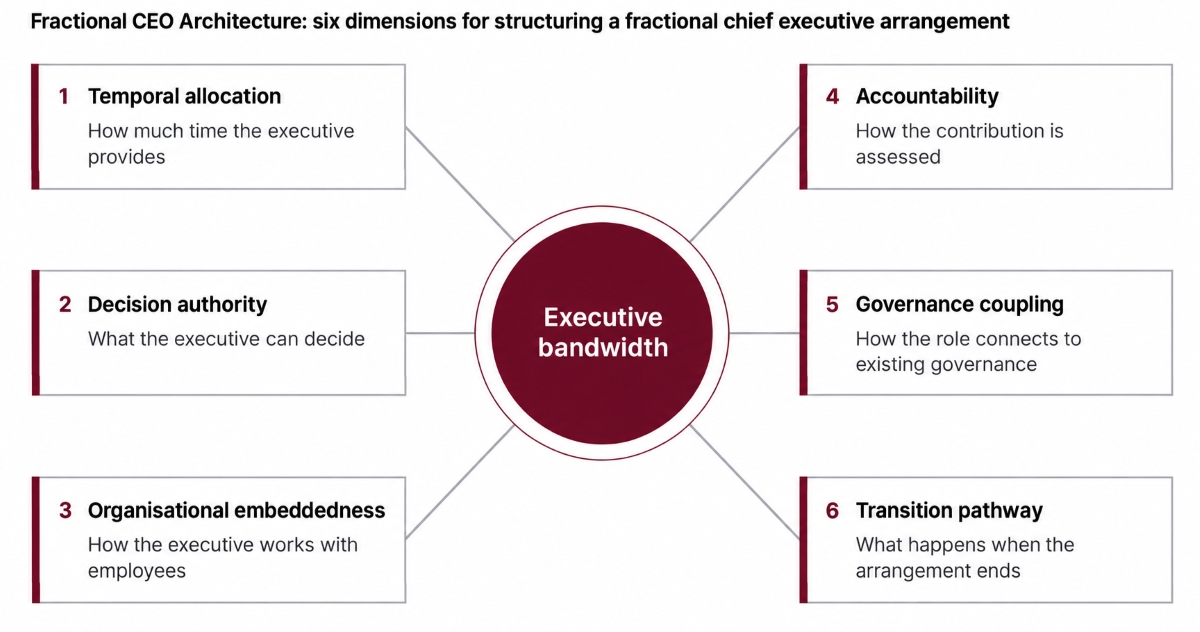
The proposed architecture has six dimensions: temporal allocation, decision authority, organisational embeddedness, accountability, governance coupling and transition pathway. In ordinary terms, these address how much time an executive provides, what they can decide, how they work with employees, how their contribution is assessed, how they connect to existing governance and what happens when the arrangement ends. Together, these elements help define a clearer and more sustainable leadership structure.
Fractional CEO Architecture: six dimensions for structuring a fractional chief executive arrangement
Where the bottleneck sits
Consider a business with rising revenue but delayed supplier approvals, inconsistent priorities and little clarity about cash commitments. Adding another sales employee may help generate orders. It may not resolve the absence of an executive who can reconcile commercial ambition with financial capacity and operational delivery.
A fractional CEO could take responsibility for agreed decisions on a defined schedule. Yet the title alone solves nothing. If the founder still signs off every operational choice, the business has acquired another adviser without addressing the decision bottleneck. Clear delegated authority, access to reliable information and regular reviews are essential.
Other arrangements may be more suitable in particular circumstances: an interim leader during a transition, a specialist finance director or an advisory board providing independent challenge. The relevant question is which capability is missing and whether the proposed arrangement gives someone the authority to act.
Enang, whose professional background includes more than a decade at Procter & Gamble and subsequent transformation and entrepreneurial work, approaches the issue as one of organisational design. The paper is conceptual; it does not claim that fractional chief executives have been shown to increase profits. Its value lies in giving founders a disciplined way to examine an increasingly common leadership choice.
If the founder still signs off on every operational choice, the business has acquired another adviser without addressing the decision bottleneck.
Before hiring
Before hiring, founders can identify their three most persistent decision delays, document the decisions they are willing to delegate and specify the results they expect over the next quarter. That exercise may reveal whether the business needs a new executive, clearer governance or both.
RESEARCH
Mapolisa, N. and Enang, I. (2026). Fractional CEO architecture: executive bandwidth, strategic coherence and confidence in resource-constrained firms. Strategy & Leadership.
https://doi.org/10.1108/SL-05-2026-0225
Dr Imo Enang is a scholar-practitioner, Senior Lecturer and Programme Lead, MSc Project Management (Online), at the University of Greenwich and Founder and CEO of VLV Group, which comprises Ambidexters, ImpactCity and SkillHubs. Further information: imoenang.com.