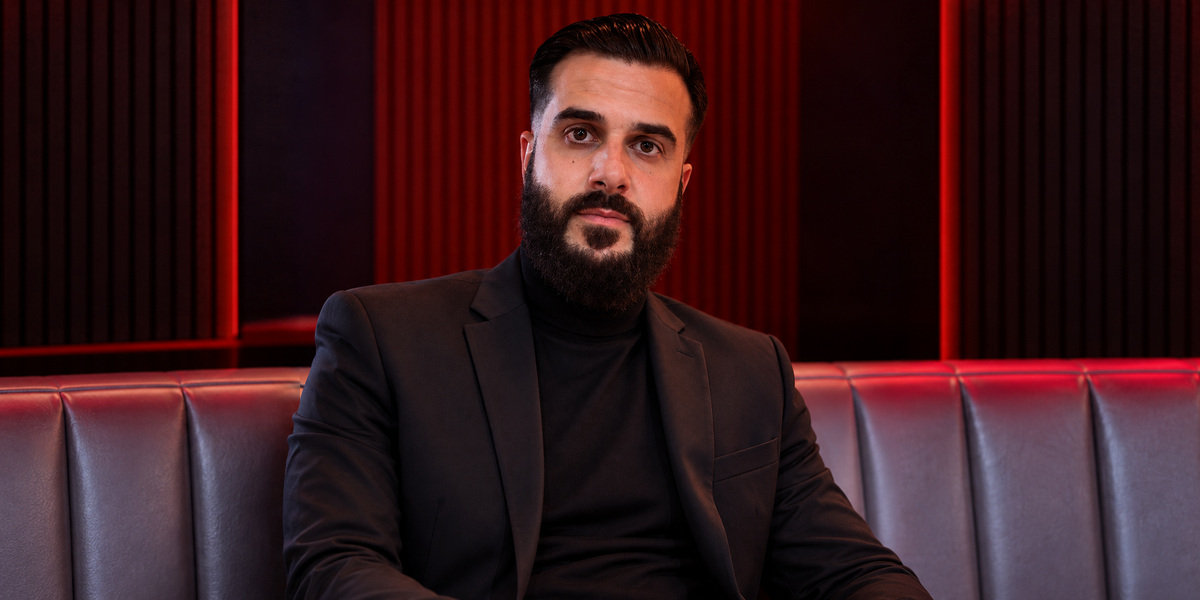

By Edward DuCoin, Co-Founder of Orpical Technology Solutions & Professor at Montclair State University.
Imagine walking into a college business class in New Jersey and on the first day finding the professor lecturing in Dutch. The lecture is brilliant. The synthesis is masterful. The professor speaks with passion and clarity, and the material, let us say it is marketing strategy, or corporate finance, or organizational behavior, is exactly what the catalog promised. The only problem is that no one in the room speaks Dutch.
How much will the students learn? Nothing. Not because they are stupid, and not because the professor is incompetent. Because language is the precondition. Before the ideas can land, the words that the ideas are made of must be intelligible.
This is what education does to many of its students (here in the US). The professors are not speaking Dutch. They are speaking English. But they are speaking a professional dialect that many of their students do not yet know.

I teach business classes at Montclair State University. The students who arrive in my classroom are smart, ambitious, and, in some cases, the first in their families to enter the white-collar professional world. They have done the reading. They know the theory. Many of them know the academic content of business better than I did at their age. And when they sit in on a real business meeting, many of them cannot follow what is happening. It is like a whole new language.
I know this because I make them. With my employees’ permission, and with clients who have agreed in advance, I bring students into actual video calls. They come out wide-eyed, telling me they had no idea what most of the conversation meant. Not because the topics were over their heads, but the topics were ones they had studied. It was the vocabulary. ROI. P&L. COGS. KPI. Burn rate. Runway. Margin. Pipeline. The words flew by faster than they could capture them, and by the time they had worked out one term, four more had passed.
Many of these students are juniors and seniors. They know the theories of business; however, I have discovered that most have not been taught the language of business.
Call it the inherited language. If you grew up in a household where someone talked about quarterly numbers, or burn rate, or margin pressure, you absorbed the vocabulary before you knew you were absorbing it. By the time you reached college, you had the words. The classroom layered theory on top of a foundation of language you did not have to be taught, because you had been overhearing it for eighteen years.
If you did not grow up in that household, you arrive at college with the same intellectual capacity but no linguistic inheritance. You take the same classes. You read the same books. You sit through the same lectures. And then you walk into your first internship and discover that the part of being a professional that no one ever taught you is the part that determines whether you can participate.
The classroom is supposed to be the place where the inheritance stops mattering, where what your parents knew, or did not know, recedes behind what the institution teaches you. That is the implicit bargain American higher education has made with families for generations.
It is not always a bargain the institution keeps. When the classroom teaches the subject without teaching the language, the inheritance keeps doing its work. The students who arrive with the words walk into the professional world fluent. The students who did not stand outside it, sometimes for years, picking up the vocabulary the long way, through being the one in the meeting who has to look up an acronym afterward.
Most of higher education has decided this is not its problem. Vocabulary, the thinking goes, is something students will pick up on the job. The “soft skills” of professional presence, including how to speak in a meeting, how to listen, and how to ask a question that lands, are not the proper domain of a serious university. The university teaches the discipline. The rest is left for the students to figure out.
I think this is a mistake. And I think recent changes have made it indefensible.
For most of the university’s modern history, what we did better than anyone else was the structured transfer of knowledge. We had the books, the experts, the curricula, the credentials. A student who wanted to learn about marketing, economics, or corporate finance had to come to us. That was the value proposition. We delivered the content. The rest was up to them.
That value proposition is gone. A student today, with access to a capable AI, can get an introductory explanation of any business concept, any framework, any case study, in less than a minute. This can all be achieved, as it is calibrated to her level of background, available at 3 in the morning, and with infinite patience for follow-up. The knowledge transfer that universities once monopolized is now a commodity available to anyone with an internet connection and a willingness to ask.
This sounds catastrophic for higher education. I do not think it is. It is clarifying because it tells us what our actual job is now, and what it is not.
Our job is not content delivery. AI does that. Our job is everything that most content delivery never covers: the true vocabulary, the delivery, the presence, the ability to sit in a room with other humans and contribute to a conversation. The ability to take research, which AI can now perform better than any undergraduate, and present it in a way that produces a decision. The ability to listen to a follow-up question and answer it in real time, in front of a room, without help.
These are not soft skills. The phrase is itself part of the problem; it implies they are the optional, secondary, less rigorous part of an education. They are not. They are what AI has not commoditized and is unlikely to commoditize soon, the part that determines whether all the knowledge a student has acquired can be put to use in a room full of clients, bosses, and peers.
And they are the parts that most universities do not teach.
What would it look like to teach them? It begins with definitions. Every time I use a piece of business vocabulary in class, I define it, the first time, the second time, the fifth time. I make a point of asking what an acronym stands for, in a tone that signals there is no embarrassment in not knowing. The point is to make explicit the words other people have been letting their children pick up by osmosis.
Oftentimes, I will stop mid-sentence and ask my students, “Honestly, who did not understand some of the words that I just used?” My students are taught to be courageous, so often 30% to 50% of the hands raise. During the mentioned video calls with employees or clients, I often pause the dialogue and ask the same question. The response is the same because my students know their classroom, our classroom, is a safe environment.
The video calls I bring students into are not a stunt. They are the only way to let students hear vocabulary in motion, to discover that we’ll circle back on the KPI concerns after we sort out the sales pipeline issues, that a particular professional context is a normal English sentence, and that the rhythm of the sentence is itself something they must acclimate to. We debrief afterward, unpacking what was said and translating the dialect into the standard English they already know.
And it extends to delivery, which is the part most professors find hardest to teach because it requires crossing a long-standing professional line. Academic identity is built around expertise in a subject; everything else is treated as the student’s private problem. I treat it as the curriculum. How to sit up in a meeting. How to speak at the volume the room requires. How to make a point in a sentence rather than a paragraph. How to ask a question without first apologizing for asking it. How to listen in a way that is visible to the person speaking. How to follow up on what someone just said with a question that builds on it rather than ignores it.
These are teachable. They are not personality. They are practices, and like all practices, they get better when someone tells you what you are doing wrong, in front of other people, and you adjust. Remember, I insist on a safe classroom environment that rewards courage.
I understand why, overall, this is uncomfortable territory for professors. Telling a colleague that you teach your students how to sit, how to listen, how to use a piece of vocabulary in context can feel like an admission that you are doing something other than the real work. It is the real work. It is more real work than the subject is at this point.
For the students who arrive with the vocabulary inheritance, the classroom is supplementary; they will be fine either way. For the students who do not, the classroom is the only place this happens, and when the classroom declines, the cost is paid on the job, several years in, after a missed promotion or a meeting that did not go well.
I do not think this is the role most professors imagined for themselves or particularly want. But it is the role the moment has handed us. The content has become free. What remains, what only we can still offer, is initiation. Initiation into a way of speaking, a way of being in professional space, and a clear understanding of the vocabulary of their profession.
Most professors got their PhD to be professors. What students need now more than anything else is an academic, life, and overall performance coach.
Edward DuCoin teaches business at Montclair State University and is co-founder of Orpical Technology Solutions. You can connect with him on LinkedIn.