
Big events rarely fall apart because of one mistake. They run late because of a dozen small ones that add up: hair took longer than planned, the photos ran over, the main moment started fifteen minutes behind, and suddenly dinner is an hour late, and the music is watching the clock. A realistic day-of timeline is the best defense against that kind of cascade, and it’s much easier to build once you understand the logic behind it.
Below, you’ll see how to build a schedule by working backward from the moments that can’t move, how much time each stage typically needs, and where to add buffers. The worked examples use a wedding, since that’s the event where these questions come up most, but the logic carries over to almost any celebration.
Why a Timeline Matters More Than You Think
A timeline isn’t just for you. It’s the shared script for everyone who touches your wedding: the photographer, the caterer, the DJ, the florist, the venue coordinator, your wedding party, and the family members who need to be in the right place at the right time. When everyone is working from the same schedule, small delays get absorbed instead of rippling through the day.
A good timeline also protects the things you care about. If you want a long cocktail hour, an unhurried first look, or time to eat your own dinner, those things need to be scheduled, or they’ll be the first thing squeezed when the day runs behind.
Start With the Anchors
Before you fill in the details, identify the “fixed points,” the moments you can’t move.
• The ceremony start time. This is usually your biggest anchor, often dictated by the venue, officiant, or religious tradition.
• Sunset or golden hour. If you want portraits in beautiful light, find out when the sun sets on your wedding date and plan around it.
• Venue restrictions. Many venues have a hard end time, noise ordinances, or time windows for vendor access. These constrain everything else.
• Vendor commitments. Your photographer’s coverage hours, the band’s set length, and the caterer’s service schedule all have limits.
Write these down first. Everything else will be arranged around them.
Work Backward From the Ceremony
The most reliable way to build a timeline is to start with the ceremony and count backward. Here are the stages, roughly in reverse order, with typical time allowances. These are guidelines; adjust for your own situation.
Ceremony start. Plan for guests to be seated about fifteen to thirty minutes before the ceremony begins, with the ceremony itself typically running somewhere between twenty and forty-five minutes depending on readings, music, and religious elements.
Final preparations. Allow thirty to sixty minutes before guests arrive for final touches, any private moments with family or your partner, and a last check in the mirror.
First look and portraits. If you’re doing a first look, the photographer will need time to capture the moment and then continue with couple and wedding-party portraits. A common allowance is around thirty to ninety minutes in total, depending on the number of groupings.
Getting dressed. Allow at least an hour for dressing, longer if your outfit has many buttons, a corset back, or layered pieces.
Hair and makeup. This is the most commonly underestimated stage. Hair and makeup for a bride can take one to two hours each, and the number of people being styled multiplies the total. Check with your stylists for their estimate, then add a margin.
Getting-ready photos. If you want detail shots of the dress, rings, shoes, and invitations, plan time before or during hair and makeup.
Counting backward from the ceremony gives you a clear idea of when the day needs to start. For many weddings, that’s earlier than people expect.
Plan the Ceremony-To-Reception Transition
Once the ceremony ends, the next window is often where timelines go off the rails.
Receiving line or greeting guests. If you plan to greet guests, allow fifteen to thirty minutes, depending on guest count. Some couples skip this and mingle during cocktail hour instead.
Family and group photos. Formal family portraits usually take about thirty to forty-five minutes, depending on the number of combinations. A written shot list shared with your photographer keeps this efficient, since it spares everyone from improvising who needs to stand with whom.
Cocktail hour. Typically around sixty minutes, and it gives guests a chance to relax while you take photos or catch your breath.
Transition to the reception room. Allow time for guests to move into the reception space and find their seats.
If you’re doing all your photos before the ceremony (with a first look), you can join your cocktail hour instead of missing it.
The Reception Schedule
A typical reception flows through a handful of segments. Consider the pacing of each.
• Grand entrance. Short and sweet, a few minutes.
• First dance. Usually three to five minutes.
• Welcome and toasts. Plan time for speeches. A good rule of thumb is two to three minutes per speaker, and an overall speech block of around fifteen to twenty minutes.
• Dinner service. A plated dinner typically takes forty-five to ninety minutes. A buffet takes longer to serve but can feel more relaxed.
• Cake cutting. A few minutes, usually scheduled before or after dinner.
• Parent dances. Typically three to five minutes each.
• Dancing and open floor. The heart of the party. Many couples schedule a couple of hours for dancing, with a few planned moments (bouquet toss, send-off) woven in.
• Last dance and send-off. A final song and a grand exit, if you’re having one.
Add Buffers
If there’s one rule to follow, it’s this: build in cushions. Things take longer than they’re supposed to, and a timeline with no slack will fall apart at the first delay.
• Add fifteen minutes to anything involving multiple people. Wedding-party arrival, family photos, and transitions all benefit from extra time.
• Place buffer blocks at key points. Before the ceremony, between the ceremony and photos, and before the reception are the most useful places.
• Don’t schedule yourself end-to-end. Leave small breaks to eat, drink water, and breathe. A tired, hungry couple is a distracted couple.
• Plan for lateness. Guests will arrive late, transportation will hit traffic, and someone will forget something. A small cushion absorbs all of it.
The free Wedding Day Timeline Builder creates a full minute-by-minute schedule from getting ready to the send-off, so you can test different start times and see how the pieces fit together. It’s helpful for catching problems before the day.
Think About Outfit Changes
Costume changes affect your timeline more than most couples realize. A second outfit for the reception, bustling the dress, and changing shoes before dancing all take time and need to be built into the schedule. The free Wedding Day Outfit Timeline Planner maps when to change, bustle, and switch shoes against your ceremony and reception times, which makes it easier to avoid missing a key moment while you’re getting into a different outfit.
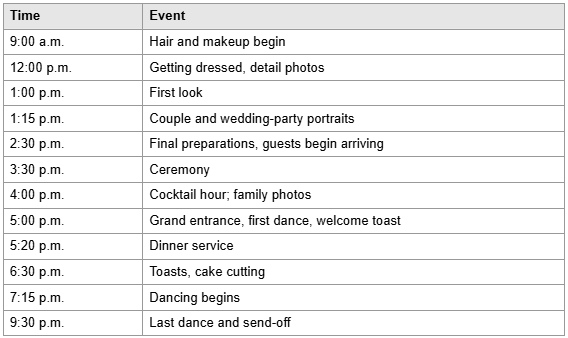
Sample Timeline: Afternoon Ceremony With a First Look
Here’s one example. Adjust the times to fit your own wedding.
Sample Timeline: Evening Ceremony With Portraits After
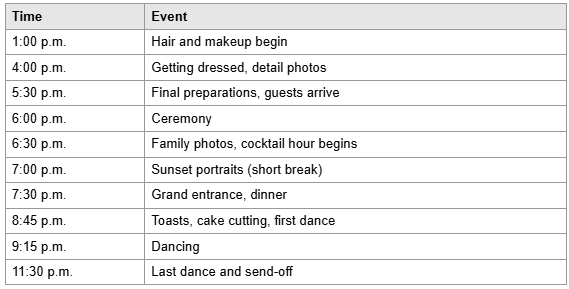
These are templates, not rules. Your venue, culture, and priorities determine the right shape for your day.
Share It With the Right People
A timeline helps only if everyone has it. Distribute a clear version to:
• Your wedding party and immediate family
• Photographer and videographer
• Caterer and venue coordinator
• DJ or band
• Officiant
• Florist, hair, and makeup, and any other vendors with time-specific tasks
Consider creating a short version for guests who need only the key times and a more detailed one for vendors. Designate one person (a day-of coordinator, a friend, or a family member) to keep the schedule on track so you don’t have to.
Frequently Asked Questions
How long does a wedding day usually last? From getting ready to the send-off, many wedding days run eight to twelve hours, though timelines vary by tradition, venue, and format.
How long do wedding photos take? Allow around thirty to ninety minutes for couple and wedding-party portraits, plus thirty to forty-five minutes for formal family photos. A first look and a shot list can reduce the time significantly.
How long should hair and makeup take on a wedding day? Bridal hair and makeup often takes one to two hours each, with the total depending on the number of people being styled. Ask your stylists for an estimate and add a buffer.
What’s the best time of day for a wedding ceremony? It depends on season, venue, and photography preferences. Late afternoon ceremonies often provide beautiful light for portraits, while evening weddings offer a more intimate feel.
Should I do a first look? Many couples like first looks because they allow more relaxed photos before the ceremony and let you enjoy cocktail hour. Others prefer to wait until the ceremony for the traditional reveal. Both are valid choices.
The Takeaway
A reliable timeline starts with the anchors, counts backward from the ceremony, and builds in generous buffers. It doesn’t need to be rigid. It needs to be realistic. Build it early, share it widely, and appoint someone to keep it moving. For more free tools covering every stage of planning, you can explore Wedding Serenity Club’s full planning tools collection.
About the author: This article was written in partnership with Wedding Serenity Club, home to dozens of free interactive tools, from wedding planning calculators and checklists to numerology, astrology, and archetype readings for the engaged.