

“Best” depends on who is on the other side of the table. A trucking firm with one shipper, a staffing agency with forty clients, and a parts maker selling to a national retailer can each be well served by a completely different kind of company. So instead of a leaderboard, this guide gives you a map. Factoring providers fall into four broad types, and the type usually predicts the price, the paperwork, and the experience your customers will have.
The Map at a Glance
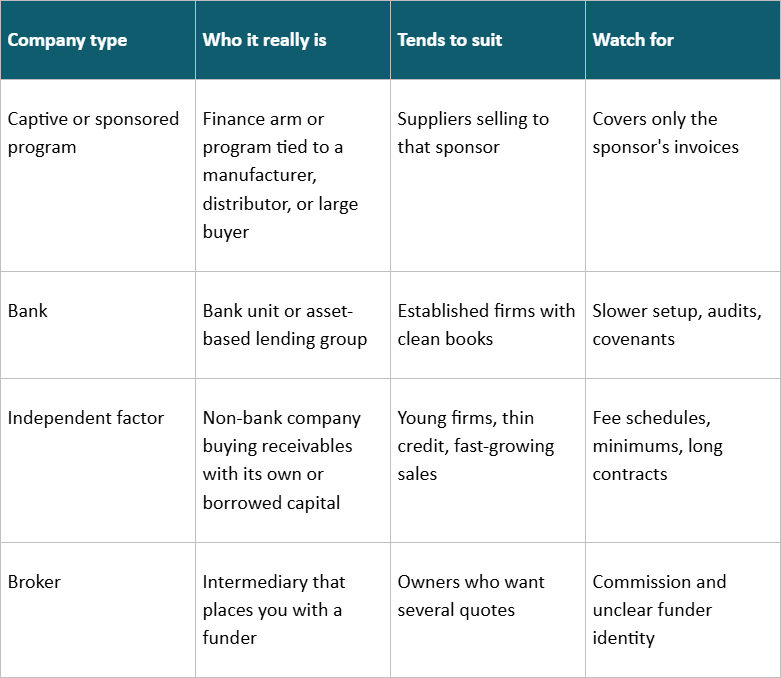
Keep one principle in mind as you read: factoring underwriting leans heavily on your customer’s ability to pay. That is why a young company can sometimes qualify where a loan would be out of reach.
Door One: Captive and Sponsored Programs
A captive finance company exists to help its parent sell more. In receivables, the closest versions are distributor finance arms and buyer-sponsored early-payment programs, sometimes called supply chain finance or reverse factoring. A large customer arranges for a funder to pay your approved invoice early, and pricing may reflect the customer’s strong credit rather than yours.
Who suits this door: A supplier with a big share of its sales going to a sponsor that already runs such a program.
Who doesn’t: Anyone with a varied customer list. The program generally won’t touch invoices owed by anyone else, and you can’t pick which customers offer one.
First move: Ask your largest customer’s accounts payable team whether an early-payment option exists.
Door Two: Banks
Some banks factor directly, while many offer a close cousin: an asset-based line of credit secured by receivables. You keep collecting from customers, and the bank lends against a borrowing base that it recalculates regularly.
Who suits this door: Businesses with a few years of financial statements, reasonable profits, and receivables large enough to justify field audits.
Who doesn’t: Startups, owners with recent credit trouble, and anyone who needs cash this month. Setup commonly takes weeks.
First move: Start with the bank that already holds your operating account, since it can see your deposit history.
Door Three: Independent Factors
This is the largest and most varied group. Some independents specialize by industry, such as freight, staffing, or government contracting. Others are generalists. They typically verify invoices directly with your customers, and they may be willing to look past a short history when the customers are solid. A provider page such as Fundivi receivables factoring options shows how this kind of product may be presented, and it’s a helpful reference for the questions you’ll want answered in writing.
Who suits this door: Young or fast-growing B2B companies with creditworthy customers and invoices on 30-to-90-day terms.
Who doesn’t: Consumer-facing businesses, firms with disputed or progress-billed invoices, and owners who don’t want a third party contacting their customers.
First move: Ask whether the contract is spot or whole-ledger, and whether it’s recourse or non-recourse. Those two answers shape nearly everything else.
Door Four: Brokers
A broker doesn’t buy your invoices. It takes your application and shops it to factors, usually earning a commission from the funder. A good one knows which factor handles your industry and can save you a week of calls. A poor one sends your file everywhere and pushes whichever deal pays best.
Who suits this door: Owners in an unusual niche, or those too busy to collect quotes themselves.
Who doesn’t: Anyone unwilling to ask direct questions about commissions.
First move: Ask, “Which funder will own these invoices, and how are you paid?” Then learn what the market looks like on your own, using a resource like SameDayBusinessLoansOnline.com factoring comparisons, so you can tell whether what you’re hearing is reasonable.
One Invoice, Four Doors
Here’s an illustrative comparison. Marlow Linen Service, a fictional supplier, has a $60,000 invoice that its customer pays on day 47. All terms below are examples, not quotes.
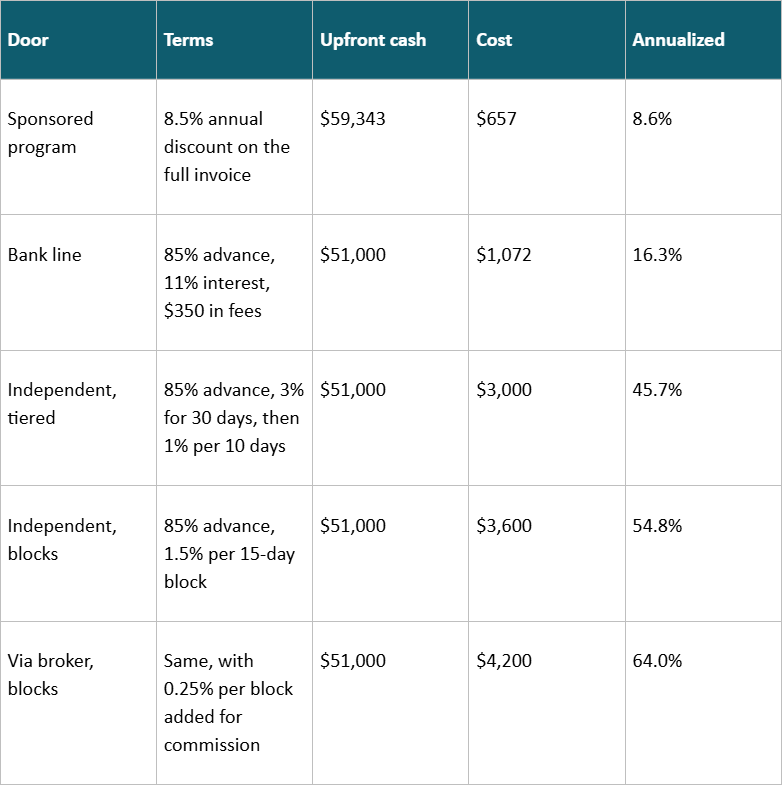
The annualized column divides the cost by cash received and scales it from 47 days to a year. Notice two things. First, the two independent offers look alike in a sales conversation, yet the block schedule costs $600 more, because a payment on day 47 is billed for four full blocks, through day 60. Second, a commission that sounds tiny adds another $600. Not every broker adds cost, but you should ask.
In the block example, the $9,000 reserve comes back less the $3,600 fee, so Marlow receives a final $5,400 once the customer pays.
Where the Lines Blur
Real companies don’t always sit neatly behind one door. A funder might buy some invoices itself and refer others out, and a bank might partner with a non-bank platform. A StreetInsider release on hybrid lending describes a platform combining direct capital with a partner lender network, and models like that make one question especially important: for this specific transaction, who is funding the deal and who will collect from my customer?
The answer belongs in your contract, not just in a phone call. If a different company’s name shows up on the agreement or the notice of assignment, find out why before signing.
Which Door for Which Owner?
- One giant customer that runs a program: Try the sponsored door first. Little else will beat it on price.
- Three or more years of tidy books, no rush: Ask a bank about asset-based lending.
- Under a year old with blue-chip customers: Independents are usually the most realistic option for qualified applicants.
- Specialized industry: Look for an independent that names your sector, or use a broker who can identify one.
- Mixed needs: Factoring may solve only part of the problem. A roundup of flexible funding companies at every growth stage can give you a sense of what else might fill the gap.
Questions to Put to Any Door
Whichever type you lean toward, send the same list to every candidate so the answers can be compared.
☐ What is the advance rate, and when is the reserve released?
☐ How is the fee calculated, and in what time increments?
☐ Is there a monthly minimum volume or minimum fee?
☐ What separate charges apply for wires, credit checks, or setup?
☐ What happens if a customer pays late or doesn’t pay at all?
☐ How long is the term, and what does early termination cost?
☐ Is there a lien on all assets or only on the factored invoices?
☐ How will my customers be contacted, and by whom?
Ask to speak with a current client in your industry as well.
Frequently Asked Questions
How do I know which type of company I’m talking to?
Ask who buys the invoice and whose name goes on the notice of assignment. If the answer is a third company, you’re probably dealing with a broker or a partner arrangement.
Are banks always cheaper than independent factors?
Often, but only for companies that qualify. Audit charges and minimum fees can narrow the gap for smaller borrowers.
Can a new company use a factor?
It may be possible for qualified applicants, since customer credit carries substantial weight. Expect close scrutiny of your invoices.
Does recourse factoring cost less?
It’s commonly priced lower because you bear the risk of non-payment. Read exactly which events non-recourse protection covers.
Will my customers know?
In most factoring, yes, because they are told to pay the factor. Some confidential arrangements exist, usually for larger firms.
What’s the difference between spot and whole-ledger factoring?
Spot factoring lets you sell selected invoices. Whole-ledger agreements generally cover all or most of your receivables, often in return for lower fees.
Can I leave a factor early?
It depends on the agreement. Many contracts include notice windows and termination fees, and the lien has to be released before a new funder can step in.
Should I work with more than one factor?
Usually not on the same receivables, since liens conflict. Competing quotes before you sign are a better use of multiple relationships.