
By: Marley Peters
In a menswear industry racing toward speed, scale, and “good enough,” Daniel George has built a business on something far less convenient: telling clients the truth.
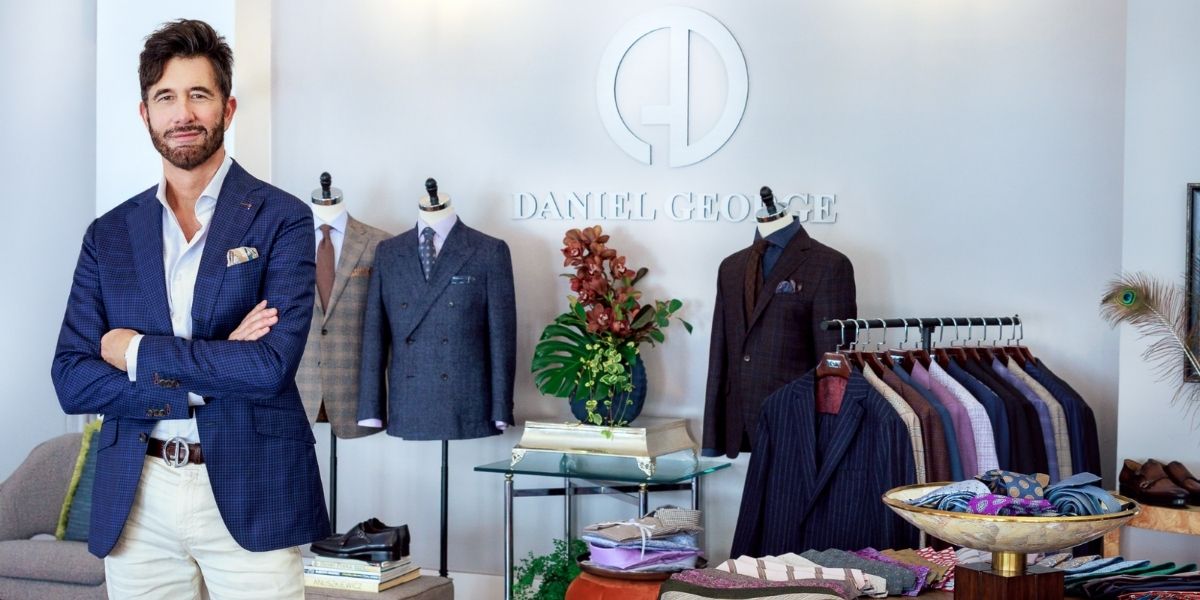
As the founder of Daniel George, a luxury, by appointment custom clothing firm with locations in Chicago, Lake Forest, and San Francisco, Daniel operates with a clear point of view. He is not chasing trends. He is not interested in fast growth. And he is not trying to please everyone. What motivates Daniel is luring an average man away from the ordinary suit and, through a series of fittings, creating a gentleman who becomes very comfortable receiving compliments from perfect strangers.
Daniel often says, “The man who claims to hate wearing a suit doesn’t own a properly tailored one.”
That mindset has shaped everything about the brand. Since launching in 2012, Daniel George has positioned itself at the intersection of traditional European tailoring and a modern, highly personal client experience.
But the real differentiator isn’t the model. It’s the mindset behind it.
Daniel is direct, opinionated, and deeply committed to craftsmanship over convenience. The goal isn’t to give clients exactly what they ask for. It’s to make sure they leave with something better than they imagined.
That perspective started early. He grew up around parents who paid close attention to how they dressed. His father, in particular, carried himself with a precision that didn’t go unnoticed. “Friends would comment on his appearance with a kind of quiet awe,” Daniel recalls.
Those early impressions stuck. Clothing wasn’t just about appearance. It was about intention, proportion, and how something feels when it’s done right. It’s a philosophy that still runs through everything he does today.
The Problem With Modern Menswear
Daniel George is blunt about the current state of the industry. And the numbers explain why he sees it that way.
The global men’s suit market is worth more than $30 billion and growing. But most of that growth is happening in scalable production, not true custom-tailored clothing.
Over the past decade, made-to-measure has quietly become the dominant model across much of the industry. In many tailoring businesses, it accounts for the vast majority of orders, often replacing proper tailoring altogether.
On paper, that sounds like progress. Easy access. Faster turnaround. Lower cost. In essence, it has replaced quality with quantity.
Made-to-measure garments are built from pre-existing patterns, then adjusted. True bespoke garments are drafted from scratch for the individual. That difference is not small. It affects how the suit fits, how it moves, and how it ages over time.
Daniel sees that gap every day. “There’s a race to the bottom,” he says, pointing to brands that market altered, ready-to-wear garments as “custom”.
The issue isn’t made-to-measure itself. There are excellent made-to-measure programs, but far more companies that never make it past the quality-control stage.
As that model scaled, the industry stopped explaining the difference. Customers were given more options, but less understanding. While being sold a “bespoke” model that did not exist to a client who didn’t know the difference.
So most men walk in thinking they’ve experienced custom clothing when they haven’t.
Where Most Brands Sell, Daniel George Pushes Back
If you come in asking for something that doesn’t work, Daniel will tell you. Directly. No soft language, no quiet adjustments behind the scenes. Sometimes the idea evolves into something better. Sometimes it gets killed on the spot.
Because the job isn’t to recreate someone’s Pinterest mood board. The goal is to make the client feel confident and look their best. Collaboration is always part of the process, and clients are encouraged to bring ideas. But at the end of the day, the team knows what works and what doesn’t for a specific person. That’s the craft. That’s the work.
Because most clients aren’t showing up with original ideas. They’re bringing references. Instagram saves, wedding photos, and mannequins that don’t share their proportions. Looks that work on a 6’2”, 160-pound model under perfect lighting, then won’t work on a real person.
Daniel sees it every day. And instead of accommodating it, he corrects it. That’s a very different business model.
In most showrooms, the job is to close the sale. His job is to get the result right, even if that means slowing everything down or pushing back harder than the client expects. The process is less about preference and more about judgment. That’s where craftsmanship comes in, and not in the way most brands talk about it.
A properly made garment doesn’t leave much room for bad decisions. It takes time, costs more, and demands a level of intentionality that fast, templated systems don’t require. You wouldn’t spend months building something just to have it expire with the next trend cycle.
That’s why his timelines don’t bend. A true custom suit takes eight to ten weeks when it’s done properly. If someone needs it faster, his answer is simple. If you’re looking for fast, you’re not looking for custom. The custom suit maker that promises completion within five weeks is likely eliminating what makes a tailored garment great. Imagine how much faster it would be to glue your coat as opposed to hand-sewing it. A hand-sewn canvas, not a fused one, is what you can expect at Daniel George.
In a market that’s been trained to expect everything immediately, that kind of resistance stands out. It’s not convenient. It’s not designed to please everyone.
Once someone understands the difference, it becomes difficult to go back to the typical retail experience of simply being sold something. At that point, what clients tend to value most is honest guidance, clear explanations about fit, construction, and proportion. That kind of transparency can sometimes challenge expectations, but it’s also what allows people to refine their style and make better decisions over time. Without that level of honesty, improvement is difficult, and most people simply end up repeating the same choices.
The Power of Saying No in a Yes-Driven Industry
Spend time with Daniel George, and you get the sense he’s exactly the same person in every setting. There’s no switch that flips when a client walks in, no polished version reserved for the showroom.
He’ll move easily between joking about a jacket he picked up on a whim and breaking down the details that make a garment last for years. The conversation tends to shift quickly, but the throughline is always the same. He cares about how things are made and how they work on the person wearing them.
That consistency shows up in how he works with clients.
If something doesn’t quite make sense, he’ll say so. Not to push back for its own sake, but to achieve a better result. Most of the time, that leads to a conversation that ends somewhere more considered than where it started. Daniel takes the most satisfaction from the moment a new client looks in the mirror, clearly reluctant to take the garment off and hesitant to leave without it.
In a category that often leans on presentation, that kind of clarity feels refreshing. It also shapes who the brand attracts.
Daniel George tends to resonate with clients who are open to that process, people who want to understand what they’re wearing and why it works, not just how it looks in the moment. It’s a smaller audience, but a more engaged one.
That same perspective carries into how the business grows.
There’s a focus on maintaining a certain level of quality and experience, even if that means moving more deliberately. The goal isn’t to make the process faster or easier at all costs, but to make sure the end result holds up, both in how it looks and how it wears over time.
Daniel George could sell more belts by adding belt loops, more waistcoats by flattering every client’s impulse to buy one, and more black suits by insisting everyone needs one. But tailoring isn’t about selling more garments, it’s about guiding men toward the ones that actually serve them.