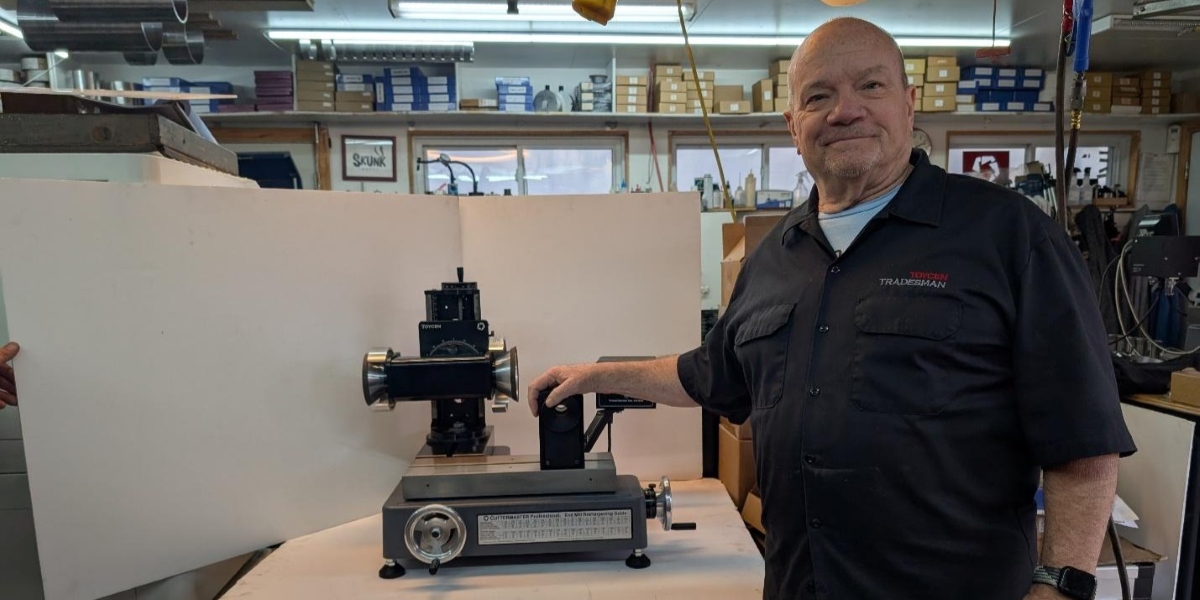

In modern manufacturing, the quality of finished parts may depend on the condition of the manufacturing tools used to create them. Cutting tools used in milling, drilling, and shaping operations gradually deteriorate with repeated use. Instead of discarding the tools after a few cycles, some shops turn to reconditioning systems to restore tool geometry and maintain tolerances. These machines fill a functional but vital role in the aerospace, defense, automotive, research, and fabrication sectors. In this technical setting, Cuttermasters’ systems have been implemented across a variety of industries.
Cuttermasters, established in 2000 by Jeff Elias Toycen, is headquartered in Canada. The company is classified in the machinery and machine tool design industry. Cuttermasters produces tool and cutter grinders, end mill sharpeners, bench grinders, belt grinders, and sharpening systems for other tools. Since the late 1970s, when the original American-made CUTTERMASTER end mill sharpener was patented, an estimated 35,000 Cuttermaster machines have been in use worldwide. About 7,000 of these machines are in the United States, according to company estimates. This number helps explain why the brand name continues to be used in professional shops.
The implementation of CUTTERMASTER systems has been widespread in a variety of industries. In aerospace manufacturing, cutting tools are used to machine aluminum alloys, titanium, and composite materials that demand strict dimensional tolerances. Organizations such as NASA and SpaceX have used Cuttermaster’s machines in their operations. In these settings, tool maintenance is an ongoing process in which milling cutters and drill bits must retain precise geometric tolerances to meet engineering specifications. Tool reconditioning may decrease the need for new purchases and help maintain continuity in production schedules.
The United States Navy has been listed among organizations that have used Cuttermaster’s equipment. Naval and defense-related facilities often maintain internal machine shops to support equipment repair and fabrication. Tool-grinding systems in such settings are typically part of a broader tool-room infrastructure, where the ability to restore cutting edges contributes to operational readiness. The presence of grinding systems within defense institutions reflects practical considerations rather than promotional alignment.
Names like Tesla and Boeing come up in discussions of Cuttermaster’s gear in the world of automotive and high-tech manufacturing. Modern auto plants require parts machined to exacting tolerances, while aerospace players like Boeing operate under tight quality-control standards. Boeing remains among the customers identified by the company, alongside Arnprior Aerospace, an Ontario-based supplier to Boeing’s commercial airplane programs. These relationships have grown as Cuttermasters has continued to refine its grinder designs and broaden its product range.
Research institutions form another part of the company’s client base. The Canadian National Research Council, a federal research organization, has been cited as a user of Cuttermaster’s equipment. Universities and research labs also have prototyping shops and machine shops where tool maintenance is used in experimental fabrication. In such environments, grinders and sharpeners are considered part of a larger technical system rather than individual machines.
Cuttermasters also caters to individual machinists and small to medium-sized shops. Individual machinists often use end mill sharpeners and bench grinders to reduce tooling costs. The CUTTERMASTER Professional line, introduced in 2004, was intended to be an updated version of the original end mill sharpener design, patented in the late 1970s. Starting in 2010, the addition of direct current motor systems and variable-speed controls enabled adjustment of grinding conditions to suit different materials and tools.
Distribution has played a role in extending the company’s reach beyond direct sales. Cuttermaster’s products are distributed through industrial supply networks, including MSC, Grainger, Fastenal, Motion Industries, Travers Tool, and Blackhawk Industrial. These suppliers operate across North America and maintain established procurement relationships with industrial clients. Placement within such distribution channels increases accessibility for workshops that source equipment through centralized purchasing systems.
Operationally, Cuttermasters maintains engineering functions in Ottawa, Ontario, with distribution facilities in Smiths Falls, Ontario, and Ogdensburg, New York. The company designs and assembles its equipment in-house, conducting rapid prototyping and product redesign within its facilities. This structure allows adjustments to motor systems, wheel configurations, and mechanical assemblies in response to user feedback or evolving standards. While privately held, the company’s manufacturing footprint reflects a regional base with cross-border distribution capability.
The breadth of sectors that use CUTTERMASTER systems illustrates the shared technical requirement for tool maintenance across industries. Aerospace engineers, defense technicians, academic researchers, automotive manufacturers, and independent machinists operate under different mandates. Yet, each depends on cutting tools that must be maintained to specification. Grinding systems function as enabling equipment, supporting processes rather than defining them. In this sense, Cuttermaster’s industrial impact lies in its participation in a maintenance cycle common to precision manufacturing.
Since the inception of DC motor-based systems in 1994 under Toycen Industries, through the formation of Cuttermasters in 2000 and the subsequent growth through distribution partnerships, the company’s history has been in tandem with the demand for solutions in tool reconditioning. The fact that there are still around 35,000 machines in use worldwide indicates their integration into workshop environments. With the advancement of manufacturing technology, the use of sharpening and grinding machines remains a constant part of the operations of industries that require precision and repeatability.
In examining the industrial reach of CUTTERMASTER systems under the leadership of Jeff Elias Toycen, it becomes evident that the company’s influence is measured less by public visibility than by routine use in technical environments. Across aerospace facilities, naval workshops, research laboratories, and independent machine shops, the practical function of tool-grinding equipment continues to underpin manufacturing processes that often remain out of public view.