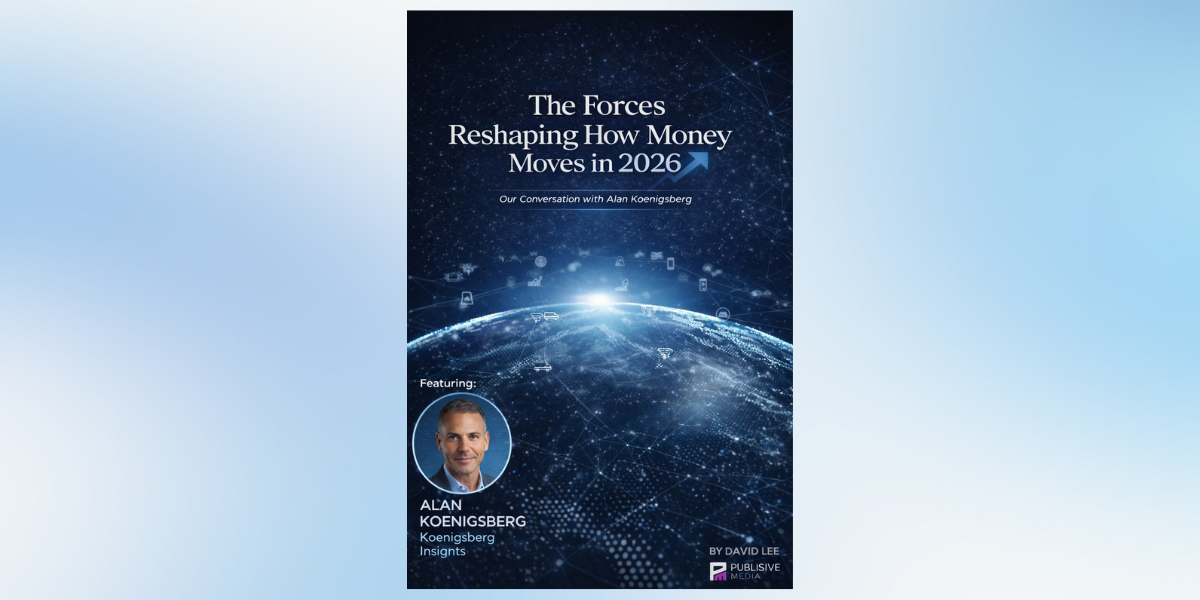

By: David Lee
For more than three decades, Alan Koenigsberg has operated at the epicenter of global payments transformation. From leadership roles within major financial institutions to close collaboration with fintech innovators, he advises organizations across the ecosystem on where the future of money may be shaped, and his vantage point is widely regarded as unique. He does not view payments evolution as linear progress but as a series of significant disruptions that could upend legacy systems, redefine trust, and potentially rewire how value moves through economies.
Today, the industry stands at the edge of another such potential inflection point, faster, broader, and more systemic than any before it. The convergence of real-time payment rails, programmable currencies, tokenized assets, and intelligent automation is likely to compress transformation cycles from years into months. Processes once weighed down by manual intervention and institutional friction appear to be becoming digital, seamless, and continuously available.
Payments have evolved from background infrastructure to the very nucleus of global commerce. They now impact liquidity velocity, operational resilience, market efficiency, and, increasingly, institutional competitiveness. As organizations look ahead to 2026 and beyond, Koenigsberg has identified ten structural forces reshaping how money moves and, by extension, how modern economies could organize around it.
The Philosophy of Responsible Innovation
At the core of Koenigsberg’s thinking is a belief that payment innovation must advance in lockstep with accountability. Payment systems, he argues, are architectures of trust, not simply technical rails for moving funds. Progress must aim to improve efficiency while preserving stability, transparency, and inclusion.
This philosophy, what Koenigsberg often refers to as serving “the greater good,” seeks to bridge technological ambition with operational realism. Whether acting as provider, financier, platform, or end-user, every participant in the value chain is likely to be transformed. Done responsibly, this shift has the potential to empower small businesses globally while strengthening the integrity of the entire ecosystem.
His framework rests on five foundational principles:
- Designing around real friction rather than hypothetical disruption
- Preserving trust through rigorous security, privacy, and compliance
- Executing relentlessly, with purpose and a flexible long-term strategy in place
- Collaborating systemically, recognizing that no institution modernizes alone
- Expanding inclusion as a driver of economic and institutional resilience
…With that foundation as the lens, Koenigsberg turns to the forces redefining money movement itself.
The Ten Forces Reshaping How Money Moves in 2026

1. Stablecoins Mature into Commercial Reality
The stablecoin narrative has shifted decisively, from speculative debate to operational deployment. Corporations are now using these instruments for cross-border settlement and treasury optimization, potentially eliminating time-zone friction and unlocking trapped liquidity. The result is a reconfiguration of correspondent banking economics and working-capital cycles.
“For financial institutions, this evolution goes well beyond crypto,” Koenigsberg notes. “It’s about competing on speed, trust, and interoperability in an increasingly programmable economy, implications that could extend into treasury strategy, risk management, and competitive positioning.”
2. Digital Bank Money Gains Momentum
As some central banks temper retail CBDC ambitions, commercial institutions are moving ahead with tokenized deposits on private, permissioned ledgers. This approach modernizes money while preserving the reliability of regulated bank deposits.
“Tokenized deposits may deliver programmability and transparency without destabilization,” Koenigsberg explains. “They allow banks to evolve infrastructure while maintaining confidence in the deposit base, modernization without revolution.”
3. Real-Time Becomes the Baseline
Instant payments are no longer an innovation; they are an expectation. Funds now move in seconds, continuously and irrevocably, challenging legacy batch-based systems.
“This always-on paradigm requires treasury teams to shift from weekly liquidity prediction to continuous orchestration, with fraud detection, compliance monitoring, and cash visibility operating in real-time. Success may belong to those who integrate velocity with precision, automating oversight synchronously with money movement.”
4. Commercial Payment Margins Face Pressure at Banks and Partners
Traditional commercial payment products, long characterized by significant margins, now confront regulatory pressures, supplier choice expansion, and intensifying pricing competition. Recovery requires transitioning from price-based to insight-driven value propositions.
“Payment data provides unprecedented visibility into working capital optimization and supplier ecosystem dynamics. Market leaders could distinguish themselves by transforming this information into real-time intelligence and actionable insights, evolving from transaction processors to strategic advisors.”
5. Embedded Finance Becomes Business Infrastructure
Software platforms managing business operations are increasingly incorporating financial services directly into workflows, enabling supplier payments, payroll management, credit provision, and cash reconciliation within unified digital environments. This integration shifts distribution power from financial institutions to platforms, with customer interface controllers emerging as dominant forces.
Alan shared, “Banks face critical strategic decisions: power these ecosystems, collaborate within them, or retreat. Embedded finance is transforming financial services into infrastructure and infrastructure into strategic advantage, fundamentally altering competitive dynamics.”
6. AI Transitions from Protection to Orchestration
Artificial intelligence is evolving from transaction protection to transaction orchestration. Machine learning now routes payments, predicts liquidity needs, detects anomalies, and optimizes networks before human intervention becomes necessary.
“This transformation could convert static systems into adaptive ones, enabling instantaneous decision-making rather than periodic review. As automation increases, governance questions become paramount, determining accountability when algorithms direct financial flows. Implementing responsible AI practices becomes essential for establishing real-time oversight and maintaining trust.”
7. Cross-Border Acceleration Meets Complexity
The convergence of ISO 20022 standards, blockchain networks, and real-time connections between national systems is reducing cross-border settlement times while empowering participants across established and emerging markets. However, operational complexity is intensifying alongside speed improvements.
Alan has commented that, “Institutions that effectively integrate compliance, foreign exchange transparency, and reconciliation into streamlined data pipelines will likely manage global liquidity with confidence. Cross-border efficiency encompasses not only speed but visibility, which drives control and competitive advantage.”
8. Credit Discipline Reshapes Buy Now, Pay Later
The rapid expansion of BNPL services has triggered regulatory normalization requiring credit assessments, comprehensive disclosures, and affordability verification across major jurisdictions. Growth has extended beyond consumer markets into small business and middle market segments, necessitating updated models from both bank and non-bank providers.
“Success could require balancing innovation with responsibility, embedding BNPL into broader lending and data frameworks.” Alan remarks, “This represents a market reset where scale and growth favor those prioritizing governance alongside expansion, with all value chain participants accepting appropriate responsibilities.”
9. Identity Becomes the Security Foundation
Authentication is shifting from credential-based to identity-based verification through biometrics, behavioral analysis, and digital identity systems. Security increasingly depends on confidence rather than credentials, requiring organizations to evolve from perimeter defense to identity authentication.
“Investment in digital identity infrastructure reduces fraud rates while fostering trust-based commerce across ecosystems. Identity strength could become a fundamental differentiator, extending throughout entire value chains and establishing competitive moats based on trust.”
10. Payments Ascend to Strategic Priority
Payment systems now impact deposits, liquidity, capital access, and customer experience, all critical components of enterprise resilience. Executive leadership can no longer treat payments as mere infrastructure; modernization must be regarded as a strategic capability directly influencing capital efficiency, risk control, and competitive velocity.
Koenigsberg concludes, “Payments have evolved into a dynamic strategy, interconnected with every commercial decision and financial outcome. Board-level attention and investment reflect this new reality where money movement speed may determine commerce tempo.”
Strategic Imperatives for 2026+
The payments transformation represents structural and cultural change extending far beyond technology. Payment systems now indicate organizational capacity to operate at real-time commerce velocity. While artificial intelligence accelerates many innovations, Koenigsberg emphasizes that technology serves as an enabler, not the primary focus.
The fundamental challenge involves rebuilding the money flow infrastructure and modernizing core systems to enable AI-facilitated automation, decision-making, and efficiency. Success requires readiness for continuous change as technological advancement demands parallel evolution in governance, trust, and risk tolerance.
In 2026 and beyond, successful leaders will likely reframe payments strategy as a growth catalyst rather than a tactical consideration, invest in interoperability connecting banks, fintechs, and platforms within shared innovation frameworks, elevate payment systems to board-level visibility as institutional agility indicators, strengthen governance around digital and financial infrastructure ensuring resilience aligns with velocity, and think systemically about inclusion recognizing financial reach and social equity as strategic stability metrics.
Institutions mastering these disciplines could command leadership in trust, liquidity, and insight, the foundational pillars of competitive strength in business environments where money movement dictates commercial tempo.
The organizations that acknowledge payments as strategic infrastructure rather than operational necessity may define the next era of financial services, creating sustainable competitive advantages through superior money movement capabilities and establishing themselves as leaders in an increasingly digital economy. Institutions that master these disciplines are likely to lead in trust, liquidity, and insight, the pillars of competitive advantage in an economy where money movement defines commercial tempo. Those who see payments as strategic infrastructure, rather than operational necessity, may define the next era of financial services.

About Alan Koenigsberg
Alan Koenigsberg is Founder and CEO of Koenigsberg Insights, where he advises banks, fintechs, networks, and institutional investors on payments strategy, treasury modernization, and financial infrastructure transformation. A recognized authority on the future of digital finance, he regularly speaks and writes on how payments innovation is reshaping global economic architecture. For deeper insights, editorials, and research, visit koenigsberginsights.com or contact info@koenigsberginsights.com.
Disclaimer: The information provided is for informational purposes only and should not be construed as professional advice or guarantees of future events. Predictions regarding market trends, technological innovations, and industry developments are based on current knowledge and projections, which are subject to change. Readers are encouraged to conduct their own research and seek professional guidance before making any decisions based on the content of this article.