
By Julian Hart
The Moment Everything Stops Working
Dr. Timothy N. Liesching has seen this pattern too many times to ignore.
A strong clinician steps into a leadership role. They are capable, respected, and used to solving problems quickly. On paper, it looks like a natural progression.
Then something shifts.
The same habits that made them effective at the bedside start working against them. They stay involved in everything. They move fast. They fix problems themselves. And before long, they feel like they are drowning in a responsibility that never seems to shrink.
It is not a competence issue.
It is a mindset problem.
According to Timothy, the first real shift is uncomfortable because it challenges identity. You are no longer the person who solves every problem. You are the person who builds the environment where problems get solved without you.
That distinction sounds small. It is not.
It changes how you measure your own value.
The Trap of Being the Most Capable Person in the Room
High performers tend to carry a quiet assumption with them.
If something needs to be done well, I should do it.
That works in clinical settings where precision and speed matter. It breaks down in leadership.
Timothy learned that the hard way. Early in his leadership path, he leaned into what he knew best. Stay close to the details. Be the person people rely on. Keep everything moving.
For a while, it worked.
Then it didn’t.
What looked like dedication started creating dependency. The team became slower, not faster. Decisions stacked up. Growth stalled, even though everyone was working hard.
The realization was not dramatic. It was frustrating.
His involvement was the bottleneck.
Stepping back did not feel natural. It felt like losing control. But it opened something that was not possible before. Other people started stepping forward. Ownership spread. The system started working without needing constant input from one person.
That shift became the foundation for how he leads now.
Excellence Without Ego Is Harder Than It Sounds
There is a phrase Timothy uses that sounds clean until you try to apply it.
Excellence without ego.
In high-pressure environments like healthcare, ego often hides behind performance. Being right. Being fast. Being the one people trust when things get complicated.
Removing ego does not mean lowering standards. In fact, Timothy argues the opposite.
Ego narrows the focus to individual performance. Excellence expands it to the system.
When leaders stop protecting their own position, they become more open to feedback. More willing to adjust. Less attached to being the smartest person in the room.
That changes the questions they ask.
Not “Did I get this right?”
But “Are we getting the best outcome possible?”
That subtle shift moves attention away from personal validation and toward collective performance. And that is where real improvement happens.
Where Leadership Quietly Breaks Down
Healthcare does not lack strategy.
It lacks translation.
Timothy points to a gap that shows up across organizations. Big ideas are discussed at the top. Transformation. Innovation. Efficiency. The language sounds right.
But when those ideas hit the ground, they often create more friction than clarity.
Frontline teams are already operating under pressure. Time is limited. Emotional load is high. Systems are complex.
When leadership decisions add layers instead of removing obstacles, trust erodes quickly.
It is not because people resist change.
It is because the change does not make their reality better.
Timothy sees this as one of the most common leadership failures right now. Not understanding how strategy feels when it becomes daily work.
Closing that gap requires more than alignment meetings or updated messaging. It requires leaders to stay connected to the lived experience of the people doing the work.
Otherwise, even the best plans lose credibility.
The Hidden Cost of Control
Control feels productive.
It creates the illusion that everything is being handled. That nothing is slipping through.
But Timothy is direct about what it actually costs.
Scale.
When one person stays involved in too many decisions, the system slows down to match their capacity. Teams hesitate. Initiative drops. People start waiting instead of acting.
Over time, something more subtle happens.
Thinking disappears from the team.
Not because people are not capable, but because they are not expected to be. The culture shifts from ownership to execution.
That is where engagement starts to fade.
Letting go is often framed as a soft skill. In reality, it is structural. It determines whether an organization can grow beyond the limits of a single leader.
Timothy does not position it as stepping back entirely. It is about being precise with where you add value and where you create space for others to lead.
That precision is what unlocks momentum.
Leadership That Actually Scales
One of the more interesting undercurrents in Timothy’s perspective is how he measures success.
It is no longer tied to what he accomplishes directly.
It is tied to what the team can do without him.
That is a difficult metric for many leaders to accept, especially those who built their careers on individual performance.
But it changes the trajectory of an organization.
When people feel trusted, they act differently. They take ownership. They experiment. They improve systems instead of waiting for instructions.
That creates a kind of resilience that cannot be built through oversight alone.
And in environments like healthcare, where pressure is constant and variables are unpredictable, that resilience matters more than control.
A Shift That Goes Beyond Healthcare
While Timothy’s work is rooted in healthcare, the patterns he describes are not limited to it.
The tension between control and scale shows up in every industry.
The gap between strategy and execution is not unique to hospitals.
The challenge of letting go, trusting teams, and redefining personal value as a leader is universal.
What makes his perspective stand out is how directly it confronts those issues without softening them.
There is no suggestion that the transition is easy.
Only that it is necessary.
What Stays With You
At the center of Timothy’s approach is a simple but uncomfortable idea.
Leadership is not about doing more.
It is about creating the conditions where more can happen without you.
That requires a shift in identity, not just behavior.
From being the solution to building the system.
From being needed in every moment to being trusted in your absence.
For clinicians stepping into leadership, that shift can feel like stepping into unfamiliar territory.
But according to Timothy, it is the only way to move from surviving the role to actually growing into it.
And once that shift happens, the feeling of drowning starts to fade, replaced by something far more sustainable.
Clarity.
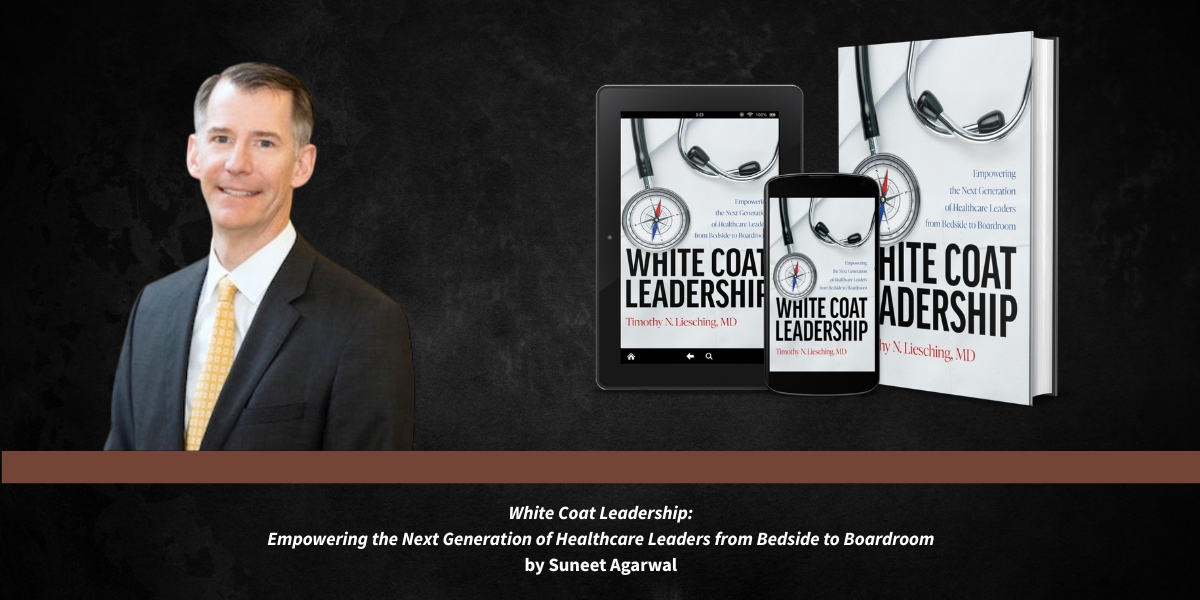
These ideas are explored further in his book, White Coat Leadership, available on Amazon and Barnes & Noble.