

A software audit notice from Microsoft or Oracle is one of the most financially dangerous communications an enterprise can receive, and most CEOs don’t realize it until the settlement number lands on their desk.
Publishers conduct licensing audits to identify compliance gaps and recover revenue. In 2025, DOGE investigators found that GSA alone maintained 37,000 WinZip licenses for 13,000 employees and 11,020 Adobe Acrobat licenses with zero active users, eliminating 114,163 unused licenses and saving $9.6 million annually at a single agency. Flexera’s 2024 State of ITAM Report revealed that 22% of organizations paid over $5 million in audit costs over a three-year period, up from 15% the prior year. The process is technical, adversarial, and designed to favor the auditor. Organizations that enter an audit unprepared routinely face settlements in the millions, depending on their size and the scope of non-compliance.
The good news is that with proper preparation, substantial audit exposure can often be mitigated before the auditor even arrives.
Why Software Audits Are Increasing in 2026
Three factors are driving a surge in publisher audit activity:
- Cloud migration complexity. As organizations move workloads to Azure, AWS, and hybrid environments, licensing models that were designed for on-premises deployments create unintentional compliance gaps. Microsoft and Oracle know this, and their audit teams are specifically targeting cloud-migrating enterprises.
- AI licensing ambiguity. The rapid adoption of Copilot, Azure OpenAI, and Oracle’s AI services has introduced licensing requirements that most organizations haven’t fully mapped. Publishers are using AI adoption as a trigger for broader compliance reviews.
- Fiscal pressure. Both Microsoft and Oracle have investor obligations to grow licensing revenue. Audits are a proven mechanism for converting non-compliant usage into forced purchases and renewals.
The 7-Step Audit Defense Checklist
1. Know Your Audit Rights (Before You Need Them)
Your Enterprise Agreement contains specific audit provisions, including how much notice the publisher must give, what data they can request, and what dispute mechanisms are available. Most CEOs have never read these clauses. Your legal team should review them annually.
Verify four things: the required notice period (typically 30-60 days), scope limitations on which products and environments are covered, data handling requirements around who can access your deployment data, and dispute resolution procedures.
2. Conduct an Internal “Pre-Audit” Assessment
The worst time to discover a compliance gap is during an active audit. Run your own assessment first. Reconcile your license entitlements (what you’ve purchased) against your actual deployment (what’s installed and active). Check every environment: production, development, test, disaster recovery, and any cloud instances. Pay special attention to secondary use rights. Many licenses include provisions for backup, failover, or development that organizations aren’t using.
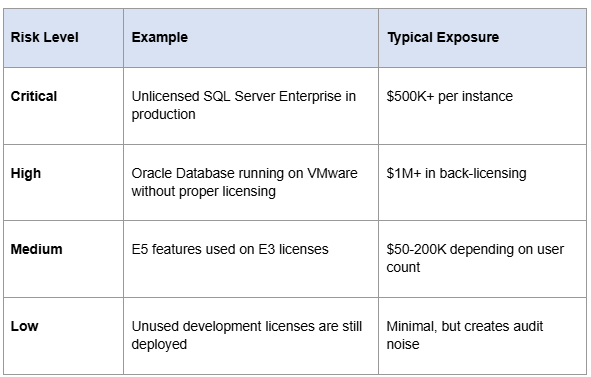
3. Identify and Fix the Highest-Risk Gaps
Not all compliance gaps carry equal risk. Prioritize by exposure:
4. Understand the Publisher’s Playbook
Software publishers don’t audit randomly. Their audit teams follow specific methodologies designed to maximize findings. Understanding these tactics is your strongest defense.
- Scope creep. Auditors often request data beyond what the agreement allows. Every data request should be reviewed by legal before compliance.
- Ambiguous licensing terms. Publishers use deliberately complex licensing language that can be interpreted multiple ways. The auditor will always choose the interpretation that maximizes the finding.
- The “settlement discount.” After presenting an inflated compliance gap, auditors offer a “discounted” settlement that feels like a concession but is often 2-3x the actual exposure.
Firms specializing in software audit defense, particularly those with former publisher-side experience, can decode these tactics because they helped develop them.
“We used to do that for Microsoft,” says John Blasig, CEO of UMS, whose team previously conducted audits on behalf of publishers. “Microsoft made over a billion dollars a year from the audits we would do for their clients. A typical audit brought in a couple hundred thousand to a couple million dollars. It really is a revenue generator.”
That insider perspective is what the industry calls a “White Hat” advantage, and it’s critical for organizations facing audits from major publishers.
5. Control the Data Flow
The single most important tactical decision in any audit is what data you share and how. Never provide raw deployment data without legal review, as raw data gives auditors unlimited interpretation latitude. Use Effective License Position (ELP) reports that show your own compliance analysis, not raw scan outputs. Respond within the contractual timeframe, but don’t rush. Use every day of your notice period to prepare.
6. Separate the Audit from the Sales Conversation
Publishers frequently use audits as a sales mechanism, presenting a large compliance gap and then offering to “resolve” it through an expensive renewal or upgrade. These are two separate conversations.
Your audit response should address compliance. Your renewal negotiation should address business needs. Mixing them gives the publisher an advantage they shouldn’t have.
7. Build an Ongoing Defense Posture
The best audit defense isn’t reactive, it’s continuous. Organizations that maintain a current license position, conduct quarterly internal reviews, and have relationships with independent SAM experts are rarely surprised by audit findings.
The goal isn’t to avoid audits. It’s to make them uneventful.
Frequently Asked Questions
Q: Can I refuse a software audit? A: Technically, most Enterprise Agreements include audit provisions that require cooperation. However, you have significant rights around scope, timing, and data handling. Outright refusal isn’t advisable, but informed negotiation of the audit terms is essential.
Q: How long does a typical audit take? A: From notice to resolution, most audits take 3-9 months. Organizations that are well-prepared can often resolve in 60-90 days.
Q: Should I hire outside help for an audit? A: For audits with potential exposure above $500K, independent expertise often pays for itself. Engage a firm with publisher-side experience that understands the auditor’s methodology, ideally one on an outcome-based fee structure so you’re not layering advisory fees on top of audit exposure.
Q: What’s the average audit settlement? A: Settlements vary enormously by organization size and compliance posture. Organizations that engage expert defense can often reduce their exposure meaningfully, because initial audit numbers are typically inflated to generate maximum revenue for the publisher.
The Bottom Line
Software audits are a business reality for any enterprise running Microsoft, Oracle, SAP, or VMware at scale. The difference between a large settlement and a manageable true-up is preparation, expertise, and the willingness to negotiate from data rather than fear. The right defense posture needs to be in place before the audit notice arrives, not after.
UMS (Universal Management Solutions) is a 25+ year veteran consulting firm that operates on a Shared Savings model with $0 upfront, paid only from realized savings. Known for saving NYC $800M+ in IT spend, UMS specializes in M365 optimization, software audit defense, and enterprise cost reduction. Learn more about their work on enterprise audit engagements or read “What is Software Asset Management?” on their website at umsol.com.