

By: William Jones
Artificial intelligence is ubiquitous, steadily integrating across every sector, one of these being the voiceover market. Text-to-speech platforms may offer instant results and scalable capabilities, yet even as adoption increases, Markus Löhr and Trevor Hurst, the founders of VOX-OVER, believe that efficiency has outpaced effectiveness. “Many brands are discovering that while AI-generated voices may be fast, they often fail to land the messages as intended,” Hurst says, who brings 30 years of audio expertise across corporate communication, live-action dubbing, and narrative media.
According to the founders, the issues lie in disjointed emotional alignment, even in the presence of technical capability. “They may be utilizing advanced technology and AI, but without emotional alignment, the impact is often lost.” Löhr adds, “A voice that sounds convincing alone could fall apart when it comes together with high-stakes content.”
“In voice production, that gap between input and outcome is slowly becoming apparent. Companies may want fast and cheap, but fast and cheap often falls short and does not consistently deliver tangible impact,” Hurst says. The duo emphasizes that without the expertise of professional human voice production and with excessive reliance on technology without industry know-how, quality may always be out of reach. “We as people respond very intrinsically when there’s disjointed emotion in the content. And that’s when you lose your audience,” Hurst says.
VOX-OVER’s vision is to eliminate that disconnect and bridge the distance. The founders describe the business as an audio production provider in multiple languages that integrates AI into an already mature professional practice. “We need professionals who genuinely understand the industry as a whole and utilize AI as a powerful tool within their arsenal,” says Löhr. “Before using the tools, you need to understand the nuances of audio, how to direct voice, and how it works in concert with each other. That’s what can take it to the next level.”
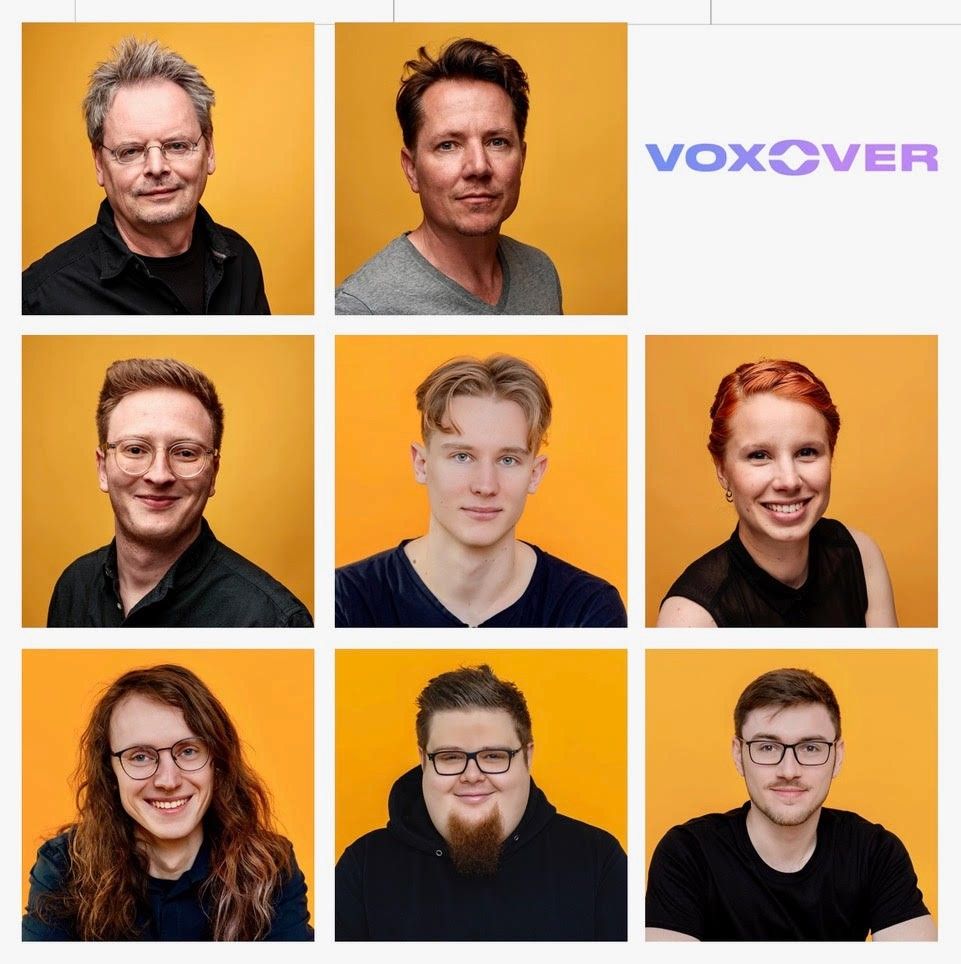
VOX-OVER Team
To meet that objective, VOX-OVER adopts an approach the founders call a Hybrid Voice Model, which combines human audio performance with AI-driven tools. They emphasize the collaboration with professional voice actors, licensing their voices directly and utilizing them to create AI models derived from their real, spoken performances. In Löhr’s view, this structure has the potential to target two problems at once. “It creates legal certainty for clients, and it’s ethically sustainable as voice actors can be compensated and involved instead of being replaced,” he explains.
Further emphasizing the importance of ethics, the founders point out that talented individuals not only face reduced compensation but risk losing ownership of their own voice. To address this problem, VOX-OVER’s model is designed to provide ownership, consent, and ongoing collaboration. “Language is a living thing,” Hurst adds. “Just because you’ve created a clone doesn’t make the voice yours. Additionally, through true collaboration with the voice actors, these voices can evolve, and the whole industry could thrive.”
Practically, the hybrid model is designed to give brands a high degree of flexibility where both human voice and AI can be implemented as per their optimal requirement. The true benefits of this model are evident when you take into consideration such flexibility. Whether a brand requires AI-generated content, fully human-voiced performance, or a blend of the two, brands have the creative control to decide what works best for that specific project.
The founders propose an example wherein a client may begin with a live recording to establish emotional tone and brand identity, then use the licensed AI model for updates and revisions without rebooking studio time. “You can change a word, a sentence, a section, or even an entire episode relatively quickly,” Hurst explains.

Additionally, VOX-OVER coordinates multilingual production under a single framework, allowing brands to maintain a consistent voice identity globally. According to the founders, this centralized approach is intended to reduce misalignment and help ensure that tone, pacing, and intent remain intact, regardless of language.
As AI adoption becomes unavoidable, VOX-OVER balances its use of automation strategically, in a way that leverages human talent and technology efficiently. In that process, the company offers a middle ground that aims to preserve connection while delivering optimal voiceover performance. Ultimately, the future of voice, the founders believe, will not belong to machines alone, and instead to those who understand both and know when each is most effective.