
By: Shawn Mars
Building a Door Nobody Would Open
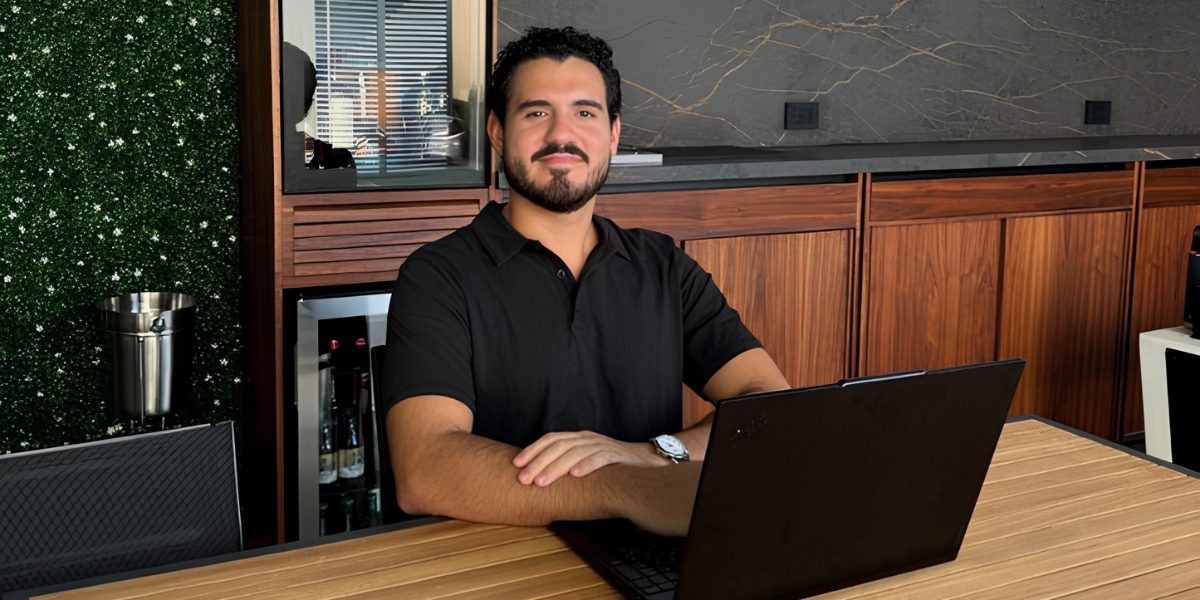
Diego Torres Partida spent his final year at Pace University doing what most business students do. He applied, interviewed, and waited. Offers did come, but none aligned with the career growth he was looking for. So in his last semester, he registered a company and moved back to Mexico to build it. Imprint Goods is a physical advertising and brand activation company, run from Mexico for clients in the United States, and its founder is unapologetic about how little of the early stage looks glamorous.
“When I saw that doors weren’t opening for me, I decided to build my own,” Torres said.
The timing was deliberate. He started the company while still enrolled, when his obligations were lighter, then moved home to live with family so New York rent would not consume the capital he needed for the business. “People say the best time to start a business was yesterday,” he said. “For me, the second-best time was right then.”
What he brought to it was operating experience rather than theory. Born and raised in Mexico, Torres moved to New York for university and earned a Bachelor’s in Business Administration from Pace University’s Lubin School of Business with a minor in sports marketing, finishing in three and a half years with Dean’s List recognition. He spent a year at Turner Construction, one of the largest construction firms in the United States, working on marketing and brand consistency inside a very large organization. Before that came a stretch of high-volume B2B sales at a New York merchant-funding firm, where he made more than a thousand prospecting calls a day and helped structure financing for small business owners.
“It’s still one of the best experiences I had working in the States,” he said of the construction role. “A massive company, incredible people, and a front-row look at how large organizations run.”
Leadership roles ran alongside the jobs. Torres’s professional history also includes a term as Associate Vice President with the National Society of Leadership and Success and certifications in leadership and project management.
What Makes Physical Advertising Different From a Feed?
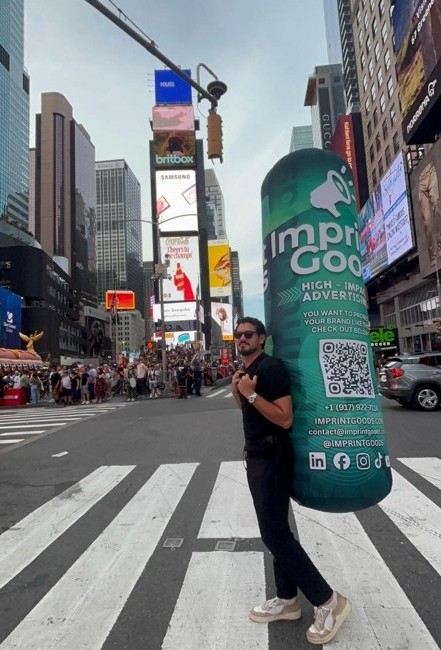
Physical advertising places a brand message in the same physical space as the person who sees it, whether that is a sidewalk, a stadium concourse, or a festival crowd. Imprint Goods works in that space and manufactures its own hardware for it. The product line is led by the Sky Backpack, a wearable LED billboard designed to carry a moving, illuminated message through high-foot-traffic areas at eye level, alongside the Sky LED display for stationary placements. Brand activation and experiential marketing services sit on top of that line, along with a promotional products catalog.
None of it would exist without a manufacturing partner. A supplier Diego Torres knew from home, with more than twenty years in the industry, wanted to break into the U.S. physical advertising market and needed someone who understood it.
“I knew that market, I’d studied it, I’d worked in marketing, and I could open that door,” Torres said. The partner became a mentor on sales and on how to treat a client, which Torres credits for much of the speed the company found in its first year. Recent activations and product work are documented on the Imprint Goods LinkedIn page.
Marketing itself was the older interest. Torres describes a moment in school when the scale of it landed on him. “You can be the best salesperson alive, but if nobody knows who you are, nobody picks up the phone, nobody pays attention,” he said. “Businesses are increasingly recognizing the power of marketing and are more willing to invest in innovative strategies and new marketing solutions.”
How Does He Take Apart a Campaign That Fails?
Torres builds a full strategy, runs it, then pulls it apart step by step to identify the single piece that did not work. He repairs that piece, rebuilds, and runs the campaign again until it holds, then carries the same method to the next channel or product. He also asks people who he knows will disagree with him to look at it.
“They’ll often see the thing I can’t,” he said. “That’s happened to me more times than I can count.”
That method was tested first on the company’s own audience, which grew from a few hundred followers to thousands over roughly eight months. Most of it came through short videos on the Imprint Goods Instagram account, where several posts have crossed into six-figure view counts. Torres is more interested in the process underneath than in any individual number, because a repeatable content system can be run again and a lucky post cannot.
Why There Is No Balance in the Early Years
Ask Torres about work-life balance in a company’s first years, and he rejects the premise outright. Twelve- to sixteen-hour days were routine. Some months meant four hours of sleep a night, and he refuses to present that as a template.
“I don’t pretend it’s healthy,” he said. “But that’s what the early stage demands.”
He is just as blunt about the finances. Long stretches of that work produced very little, and when the numbers finally moved, most of what came in went straight to taxes, the team, the tools, and back into growth rather than into his pocket. “Anyone who thinks they’ll be rich in two years because of what they saw online is believing the biggest lie in this game,” he said.
Two other problems defined the first year. Capital allocation came down to one filter: whichever spend would move the company toward sales the fastest. Leading a small team proved harder, because nobody starts out as invested as the founder, and Torres had to learn when to push, when to ease off, and how to describe the vision in terms other people would actually adopt.
A Free School in Veracruz
Diego Torres wants Imprint Goods to become a top-tier physical advertising agency, which means the large-format work that established shops compete for, including major out-of-home placements, commercials, and festival-scale activations for national brands. He also wants an operation that does not depend on him for everything, and he describes that as the problem he is working on right now.
Beyond the company, he describes himself as a multi-business entrepreneur and investor in progress, with other ventures at different stages and on different timelines. Recognition matters to him, though he is specific about the version he wants. Not the course-selling kind, he says, but the kind that comes from building and backing real businesses.
The ambition he keeps returning to is not commercial at all. Torres wants to open a school in his hometown in Veracruz, Mexico, with first-class facilities, free and public, as a demonstration of what public education in the country could look like.
“That’s one of the problems I most want to help solve,” he said. “That’s where I want my money to go.”
His read on shortcuts is shorter. “There are a lot of shiny objects out there, and 99% of it doesn’t work,” Torres said. “What works is picking a strategy you believe in, sticking to it, being disciplined, and not quitting. That sounds like a cliché. It’s also completely true.”
Find him on LinkedIn and visit his website to learn more about his work.