
By: Matt Emma
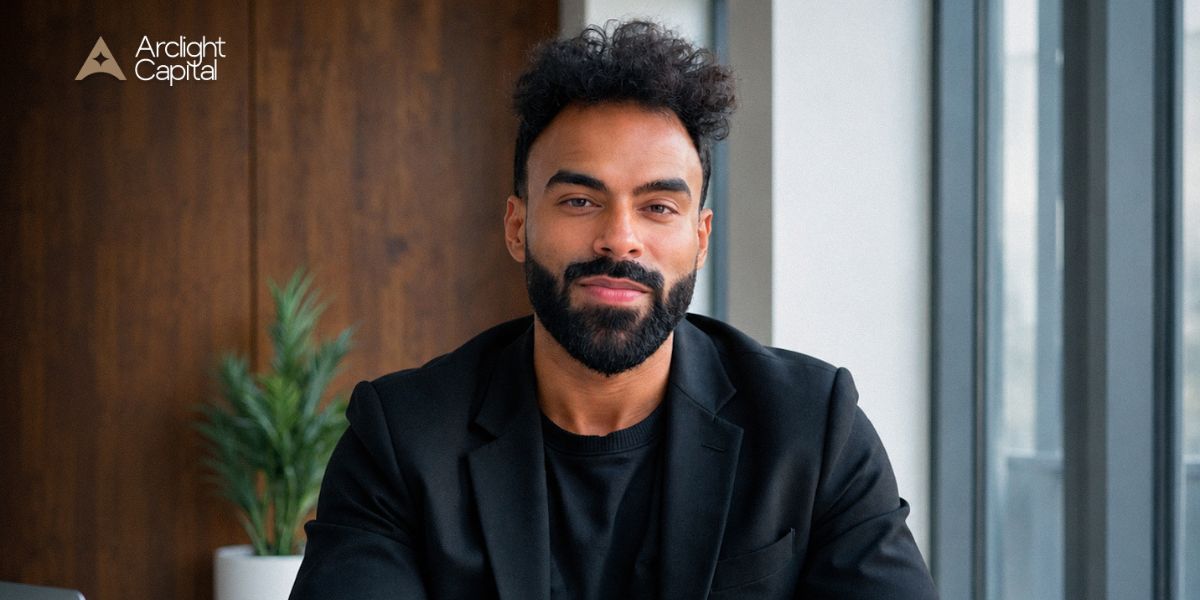
Arclight Capital founder Akash Bhojwani is betting that the next era of finance will be built in places banks never reached, and he is positioning capital across the UAE-India corridor to back the people building it.
For a decade, financial technology has chased the same customer: young, urban, salaried and already banked. Akash Bhojwani thinks the industry has been looking in the wrong place.
“The most transformative fintech of the next decade won’t be another neobank fighting over city professionals,” says Bhojwani, Founder and Managing Director of Arclight Capital, a Dubai-based holding and advisory firm focused on the UAE-India corridor. “It will be the credit rail, the risk engine, the insurance product that finally works for a farmer. Agriculture is the last big unbanked industry, and with AI the economics of serving it have flipped for the first time.”
The numbers behind that conviction are getting hard to ignore. Industry analysts put the global market for AI in agriculture at around $5.9 billion in 2025 and expect it to reach $77 billion by 2036, growing at more than 20 percent a year. Where the technology is already in use, yields have improved by 15 to 20 percent and input costs have fallen by as much as a quarter.
But Bhojwani is less interested in AI as a farm tool than in what it can do between two industries that have spent years solving opposite halves of the same problem.
From Predictive to Agentic
Bhojwani’s career began not in finance but in his family’s retail enterprises in India, followed by years working on rural financial inclusion, bringing basic financial services to communities that banks had never seriously served. That experience still shapes how he reads the current AI cycle.
“You cannot underwrite a farmer from a boardroom,” he says. “Rural cash flows don’t look like salaries. Income is seasonal, risk depends on the weather, and the collateral is often land without proper papers. Credit scoring was never built for any of that. But when satellite data, soil analytics, and transaction history feed a model, you can lend against real cash flows instead of collateral. The farmer becomes creditworthy on data rather than paperwork.”
The bigger shift now underway, he argues, is from predictive AI to agentic AI. These are systems that do not stop at forecasting. They carry out the work itself, whether that means triggering an insurance payout the moment satellite data confirms a failed monsoon, or releasing working capital as each stage of a crop cycle is verified.
“Predictive models tell you the drought is coming. Agentic systems reprice the risk, adjust the credit line and settle the claim before the farmer has filed anything,” he says. “That collapses the cost to serve that kept rural finance unprofitable for a century.”
India, the Proving Ground
If the thesis has a home field, it is India, largely because of what policymakers call digital public infrastructure. The country’s Unified Payments Interface now handles roughly 81 percent of retail digital payments across nearly 700 banks. The Account Aggregator framework, which lets people share their financial data with consent, has enabled more than 2.6 billion accounts. A Unified Lending Interface is connecting dozens of banks and NBFCs into standard digital loan journeys, and vernacular AI projects are extending banking to all 22 scheduled Indian languages.
“India built the rails. Identity, payments, consent-based data,” Bhojwani says. “AI is the locomotive that finally runs on them. Nowhere else do rails of that quality meet hundreds of millions of people who work in agriculture. I think it is the most underpriced opportunity in emerging market finance.”
The Corridor Advantage
Geography is what makes this investable, in his view. Arclight Capital operates deliberately across the UAE-India corridor, a relationship worth more than $85 billion in bilateral trade, with some 3.5 million Indians living in the UAE.
“Dubai is where Gulf capital looks for yield and where Indian founders look for global markets,” he says. “Food security is a strategic priority across the Gulf. These are countries that import most of what they eat. Agri-fintech is not a niche impact story here. It is strategic infrastructure, and sovereign capital is starting to treat it that way.”
Arclight’s model reflects that position: strategic advisory, investment advisory, long-term holdings and fintech advisory under one roof, connecting Gulf capital with operators on the ground in India, and increasingly in Southeast Asia and Africa, where Bhojwani says the same shift is a few years behind.
The thesis is not theoretical for him. Among his current engagements, he advises MPurse Services, an RBI-licensed Indian payments company that holds both Prepaid Payment Instrument and Payment Aggregator authorisations, the kind of regulated rails his playbook depends on. “I look for regulated surfaces that AI can act on,” he says. “A licensed wallet is not a place where money sits. It is a programmable layer you can embed anywhere, in a retailer’s loyalty program, a gig platform’s payouts, a farm cooperative’s procurement cycle. Owning that layer is the difference between building a feature and building the platform other people’s features live on.”
The Blind Spot: Farm Insurance
Ask Bhojwani where his thesis bites hardest, and he does not hesitate. Agricultural insurance, which he calls the largest underwritten-in-name-only market on earth. Roughly 75 percent of agricultural risk worldwide is uninsured, and in Asia barely one in five smallholders carries crop cover. The reasons are structural. Premiums are collected annually from people who earn seasonally. Claims take months in a business where a bad week can be fatal. And distribution costs make small policies uneconomic to sell at all.
“Insurance for farmers hasn’t failed because farmers don’t want it,” he says. “It failed because the delivery mechanism never existed. You can’t sell an annual policy with a 40-page form to someone who transacts in sachets, and you can’t rebuild trust with a claims cheque that arrives four months after the crop died.”
His answer is to put that missing delivery mechanism inside the wallet rails he advises on. Premiums collected the way rural India actually earns, in small instalments timed to harvest cycles, or built into a seed purchase at the point of sale. Parametric covers that pay out into the farmer’s wallet within hours of a failed monsoon, a model mobile money proved in Kenya years ago. And consent-based data sharing that turns a farmer’s own transaction history into the underwriting file, so insurers can price a real farm instead of a district average.
“The wallet becomes the branch, the premium collector, the claims office and the credit file, all in one place,” he says. “Add parametric triggers and agentic settlement, and insurance stops being a product a farmer buys once and regrets. It becomes something that is simply there on the day the monsoon doesn’t come. That is where I am directing capital and advisory focus. It is a corridor story too, because the Gulf’s food security ultimately depends on de-risking the very farms it buys from.”
A Patience Test
Bhojwani is candid that this space will not reward tourists. Agricultural cycles do not compress to fit venture timelines, and much of the real work is unglamorous modernisation: making incompatible systems, informal markets and analog supply chains machine-readable before any model can add value.
“This is a space where you underwrite in years, not quarters,” he says. “The winners will understand the technology and the soil, literally. That is why we describe ourselves as a long-term strategic ally rather than a transaction shop.”
His advice to executives watching from the sidelines is blunt. The opportunity is not another consumer app. It is the plumbing. “Somebody is going to bank the world’s farmers, and AI just made it profitable to be that somebody,” he says. “The only question is who has the patience to do it properly. In my experience, the capital that wins in emerging markets is the capital that shows up early and stays.”
About: Akash Bhojwani is the Founder and Managing Director of Arclight Capital, a Dubai-based holding company providing strategic advisory, investment guidance, and cross-border expertise across the UAE-India corridor. www.arclight.capital
Disclaimer: This article is for informational purposes only and does not constitute investment advice, a recommendation, or an offer to buy or sell any securities. Consult a qualified financial advisor for advice specific to your situation.