

Revenue-based financing has grown from a niche product used by software startups into a mainstream option for online sellers, subscription companies, agencies, and service businesses. Its appeal is simple: repayment rises and falls with your sales. In a strong month, you pay more; in a slow month, you pay less.
That flexibility is valuable, but it also makes the true cost harder to see than with a conventional loan. The best way to understand revenue-based financing is to work through the numbers. That is what this article does.
The Core Formula
Every revenue-based financing agreement is built on three variables.
1. The advance. The amount of capital you receive up front.
2. The repayment cap. The total amount you will repay, usually expressed as a multiple of the advance. A cap of 1.4x on a $100,000 advance means you will repay $140,000 in total.
3. The remittance rate. The percentage of monthly revenue sent to the provider until the cap is reached, commonly somewhere between 2 and 15 percent.
Put together, the relationship looks like this:
Monthly payment = Monthly revenue × Remittance rate
Repayment ends when total payments = Advance × Repayment cap
There is no fixed term. The faster your revenue grows, the sooner you finish repaying.
Worked Example: A Subscription Box Company
Imagine a subscription business with steady monthly revenue of $80,000. It accepts the following offer:
- Advance: $60,000
- Repayment cap: 1.35x, for a total of $81,000
- Remittance rate: 8 percent of monthly revenue
Scenario A: Revenue stays flat at $80,000.
Monthly payment = $80,000 × 8% = $6,400
Months to repay = $81,000 ÷ $6,400 ≈ 12.7 months
Scenario B: Revenue grows to $120,000 after the funds are invested in marketing.
Monthly payment = $120,000 × 8% = $9,600
Months to repay = $81,000 ÷ $9,600 ≈ 8.4 months
Scenario C: Revenue dips to $50,000 during a slow stretch.
Monthly payment = $50,000 × 8% = $4,000
Months to repay = $81,000 ÷ $4,000 ≈ 20.3 months
Notice that the total cost of capital, $21,000, never changes. What changes is how long you hold the money. That has a big effect on the effective annual cost.
Why Speed Changes the Effective Cost
A flat fee of $21,000 is far more expensive when paid over eight months than over twenty. In Scenario B, the business borrowed $60,000 for well under a year and paid $21,000 for the privilege, which translates into a high annualized rate. In Scenario C, the same fee is spread over nearly two years, making the effective annual rate considerably lower, even though the business is under more financial strain.
This creates a counterintuitive dynamic: revenue-based financing is cheapest, on an annualized basis, when your business performs worst, and most expensive when it performs best. That is not necessarily a problem, but owners should understand it before signing.
Some agreements also include a minimum payment or a maximum term. If revenue falls so low that the cap would take years to reach, the provider may require a minimum monthly amount or full repayment by a set date. Read those provisions closely, because they can remove the flexibility that made the product attractive.
Comparing Revenue-Based Financing With Other Options
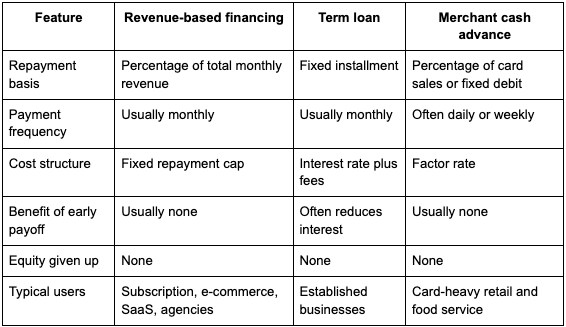
Owners researching the short-term end of this spectrum can find helpful background at Best MCA Loans, which explains how advance-style products differ from revenue-based structures. For general working capital comparisons, Best Working Capital Loans is a useful starting point.
Making the Advance Pay for Itself
The real test of any revenue-based deal is what the money produces. Because repayment comes from revenue, the advance should generate enough additional revenue to cover both the remittance and the business’s ordinary costs.
Return to the subscription company. Suppose it spends the $60,000 on customer acquisition at a cost of $40 per new subscriber, bringing in 1,500 new subscribers. If each subscriber pays $35 per month and stays an average of eight months, those customers generate about $420,000 in revenue over their lifetime. Even after product costs and the $21,000 financing fee, the investment is clearly worthwhile.
Now change one assumption. If acquisition costs climb to $90 per subscriber and the average customer stays only three months, the same $60,000 brings in roughly 667 subscribers, producing about $70,000 in revenue. After product costs, the business may struggle to cover the $81,000 repayment at all. The financing did not fail; the underlying plan did. Test your assumptions before you borrow, not after.
Who It Fits Best
Revenue-based financing tends to work well for businesses that:
- Have predictable recurring revenue and healthy gross margins
- Plan to invest the funds in activities that directly grow revenue, such as advertising or inventory
- Prefer not to give up ownership to equity investors
- Lack the hard assets or long history that banks typically require
It tends to be a poor fit for businesses with very thin margins, since remitting a slice of revenue rather than profit can squeeze cash flow, or for companies with highly unpredictable sales that may trigger minimum payment provisions.
A Note on Bookkeeping and Taxes
Revenue-based financing is usually recorded as a liability, with the difference between the advance and the repayment cap treated as a financing cost over the life of the agreement. How that cost is recognized, and whether it is deductible in a given year, depends on the contract structure and your accounting method. Because these agreements do not look like traditional loans, ask your accountant to review one before you sign so that your books, tax filings, and future loan applications all present the obligation accurately. Clean, correctly categorized records also make it easier to qualify for lower-cost financing later, since lenders will want to see exactly what you owe and to whom.
Five Questions to Ask Any Provider
- How is “revenue” defined? Gross sales, net of refunds, or something else? The definition can change your payment significantly.
- Is there a minimum monthly payment or maximum term?
- How is revenue verified? Many providers connect directly to your bank, payment processor, or e-commerce platform.
- What happens if I want to pay off early? In most cases, the full cap is still owed.
- Are there additional fees? Origination, platform, or servicing fees all affect your total cost.
Do the Homework, Then Commit to One Provider
The details that determine whether revenue-based financing is a smart move live in the contract, not the marketing page. That makes research before applying non-negotiable. Understand how different providers define revenue, set caps, and handle slow months. Educational platforms like Business Loans IQ explain the vocabulary you will see in these agreements, and comparison resources such as Compare Business Loans Online can help you place revenue-based financing alongside other options.
Once your research is done, choose the single provider whose structure best fits your revenue pattern and goals, and apply there. Because these providers typically connect to your financial accounts and review your data in depth, spreading applications across several at once creates real downsides. You hand sensitive financial data to multiple companies, you may trigger several credit checks on the owners, and you invite a stream of follow-up pitches that can push you toward a rushed choice. A single, focused application keeps your data contained and your decision clear. If it does not work out, use the feedback to inform your next attempt.
Run Your Own Numbers
Before accepting an offer, build a quick spreadsheet with three columns: pessimistic, expected, and optimistic monthly revenue. For each, calculate the monthly payment, the months to repay, and the annualized cost. Then ask a simple question: in the pessimistic case, can the business comfortably absorb the payment while covering every other obligation?
If the answer is yes, and the funds will generate revenue that exceeds the cost, revenue-based financing may be an excellent fit. If the answer is uncertain, a smaller advance or a different product may serve you better.
Making an Informed Revenue-Based Financing Decision
Revenue-based financing trades the predictability of a fixed payment for the flexibility of a payment that tracks your sales. For growing businesses with recurring revenue, that can be a powerful advantage. Understand the formula, model the scenarios, read every provision, and apply deliberately with the one provider that fits. The math is not complicated once you see it laid out, and seeing it clearly is the best protection against surprises that could otherwise cost your business dearly.
Disclaimer: This article is intended for general informational and educational purposes only and does not constitute financial, legal, tax, or accounting advice. Revenue-based financing terms, repayment structures, fees, and eligibility requirements vary by provider and individual business circumstances. Any financial calculations, projections, and examples presented are illustrative and do not guarantee specific outcomes, financing approval, or business profitability. Readers are encouraged to conduct their own research, carefully review financing agreements, and consult with qualified financial, legal, or tax professionals before making financing decisions.