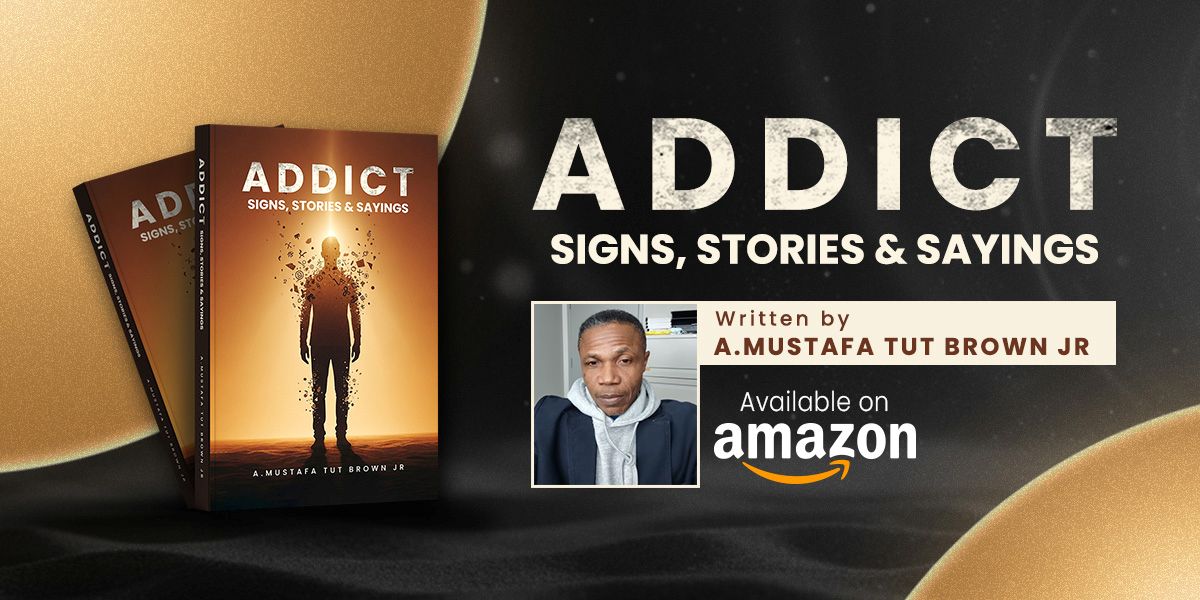

In an era where polished success stories dominate bookshelves, Mustafa Tut-Brown offers something far less comfortable and far more honest. Addict: Signs, Stories, Sayings — A Life Told Through Signs, Struggles, and Survival is not a memoir in the traditional sense. It is a lived document, a fragmented yet deeply intentional narrative that mirrors the chaos, contradictions, and clarity of real life.
Tut-Brown’s work reads like a hybrid between reflective philosophy and street-level storytelling. It doesn’t follow a neat arc. Instead, it passes through moments, childhood memories, business failures, heartbreaks, spiritual reckonings, stitched together by a central idea. Life is constantly speaking to us through signs, and most of us are too distracted to listen. From the outset, the author establishes his purpose with disarming clarity. He is not preaching, not positioning himself as a guru, but simply recounting a life marked by repeated falls and stubborn resilience. That tone, humble yet unflinching, becomes the book’s defining strength.
The early chapters ground readers in a childhood shaped by hardship and discipline. Growing up in a modest household, Tut-Brown paints bold scenes of rural labor, strict parenting, and emotional deprivation. His father, a quiet subsistence farmer, and his mother, a relentless worker, become symbolic anchors, figures of sacrifice whose influence lingers long after their absence. These formative years are not romanticized; they are presented as they were: demanding, confusing, and, at times, painful.
But the book’s true momentum begins when Tut-Brown steps into adulthood. A phase marked by restless ambition and a relentless pursuit of success. His journey through entrepreneurship is particularly striking. He launches ventures across industries, transport, construction, finance, and hospitality, only to watch them collapse under pressure. Each failure is detailed with raw honesty, stripped of excuses.
What emerges is a powerful critique of modern hustle culture. Tut-Brown doesn’t glorify ambition. He exposes its addictive nature. Chasing success is an addiction, he reflects, a line that relates as both confession and warning. In his telling, the pursuit of success becomes less about achievement and more about avoidance, a way to outrun deeper questions of purpose and identity.
This is where the book’s central metaphor, the signs, gains depth. For Tut-Brown, signs are not mystical symbols but practical, often ignored indicators embedded in everyday life. A failing business, a strained relationship, a restless mind. These are not random but signals pointing toward misalignment. The tragedy, he suggests, is not that life is unfair, but that we repeatedly ignore its warnings.
The narrative reaches an emotional and philosophical peak during a period of physical and psychological collapse. In one of the book’s most compelling passages, the author describes waking up unable to walk, a moment that forces him into stillness for the first time in years. This whale moment, echoing the biblical story of Jonah, becomes a turning point. Stripped of motion, distraction, and ego, he confronts the truth he had long avoided: he had been running, not living.
From that stillness emerges a quieter, more grounded philosophy. Success is no longer defined by scale or speed, but by presence, honesty, and intentional action. The lessons that follow are delivered through short, punchy sayings, part aphorism, part survival guide. Hope is not a strategy. If your name isn’t on the deed, you don’t own it. Don’t chase waterfalls. These lines, scattered throughout the book, function as both reflections and warnings, distilled from lived experience.
What makes Addict particularly compelling is its refusal to offer easy resolutions. There is no triumphant ending, no neat redemption arc. Instead, the author offers something more realistic: continuation. Life, he suggests, is a series of blank pages we write daily, without guarantees or instructions. Growth is not a destination but a practice, messy, repetitive, and ongoing. Stylistically, the book leans into a conversational tone, often breaking traditional narrative structure. At times, it reads like a journal. At others, like a sermon or a late-night conversation. This fluidity may challenge readers expecting a conventional memoir, but it ultimately reinforces the book’s authenticity. It feels lived-in, not manufactured.
In the crowded landscape of self-help and memoir, Addict: Signs, Stories, Sayings stands apart by refusing to simplify the human experience. Tut-Brown does not claim to have all the answers. Instead, he offers something arguably more valuable: a record of trial, error, and hard-earned insight.
For readers facing their own uncertainties, whether in career, relationships, or identity, this book is less a guidebook and more a mirror. It asks a simple but uncomfortable question: what signs are you ignoring? And more importantly, how much longer can you afford to?
Order your copy today!