

By: Content Strategy Division, Progressive UX
DALLAS, TX, Ask ChatGPT where to buy running shoes, which law firm to call, or what software a business should use, and it can provide an answer in seconds. What users may not get is a page of ten links to sort through themselves. The tool often gives a direct response, and the brands it names may have a better chance of entering the customer’s consideration set.
That shift has become a real challenge for businesses, and it is the problem Progressive UX, a Dallas-based digital agency, has been working to address for its clients. The firm has built out a service around Generative Engine Optimization, or GEO, which focuses on helping a brand become more visible when AI tools like ChatGPT, Perplexity, and Google’s AI Overviews answer users’ questions.
The Old Playbook Has Changed
For years, getting found online meant one thing. A business worked toward the top of Google, earned the click, and hoped the visitor stayed engaged. Marketing teams understood that game.
Then people started asking machines instead of only searching. Someone planning a kitchen renovation used to type a few keywords and browse the results. Now, they may describe their whole situation to an AI tool and receive a single answer that already recommends a contractor. No scrolling. No comparing. The decision may be partly shaped before a website ever loads.
Progressive UX noticed its clients running into this wall. A company could rank well on Google and still be less visible when a customer asks an AI tool the same question. Ranking well was no longer the only finish line, because a growing number of users may not see traditional rankings in the same way.
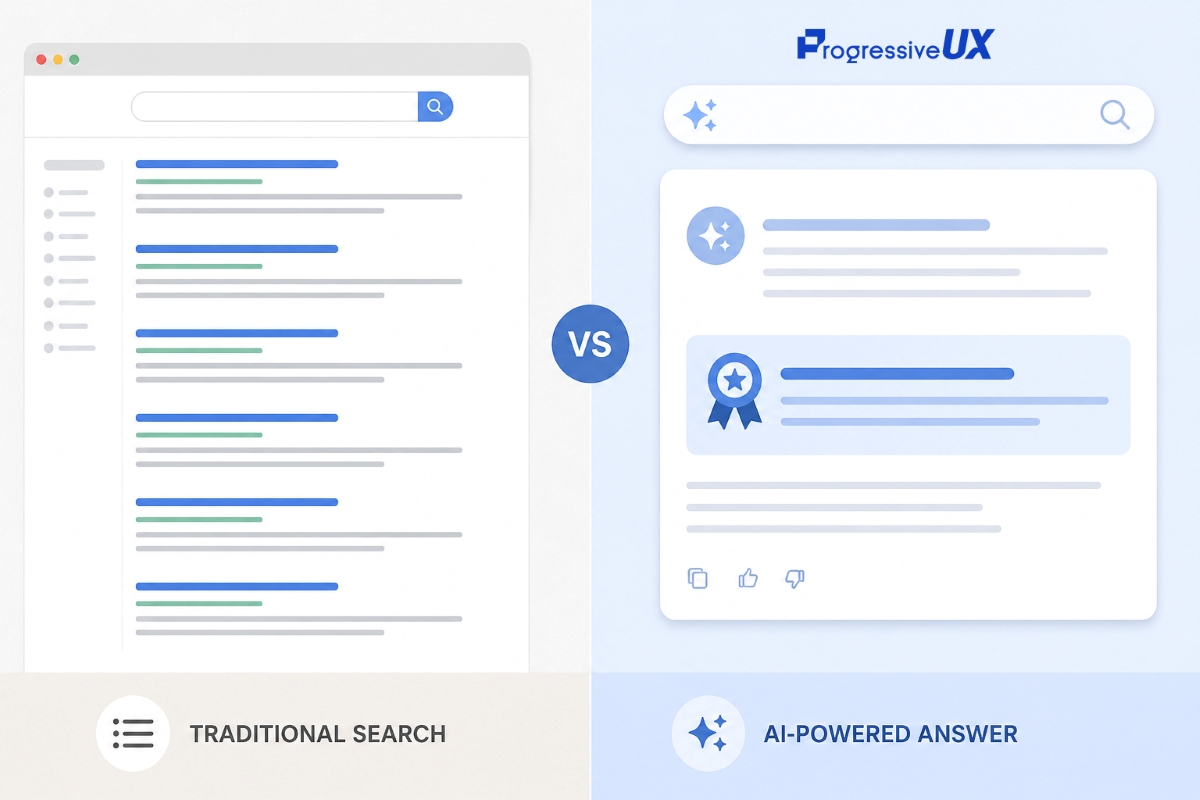
Getting Named, Not Just Ranked
The agency’s answer is to stop thinking only about where a brand sits on a page and start thinking about whether an AI tool is likely to mention the brand in response to a relevant question.
That turns out to be a different job. AI tools do not pull a name out of thin air. They tend to rely on information that is easy to read, supported by sources they consider reliable, and repeated consistently across the web. A brand that only exists on its own homepage may be easier to overlook. A brand that appears in articles, directories, reviews, and reference sites, all communicating consistent information, may have a better chance of being included.
Progressive UX works on both sides of that equation. The team studies how real customers phrase their questions to AI tools, which often differs from the clipped keywords people once typed into a search box. Then it rebuilds a client’s content to answer those questions clearly, in language a machine can follow and repeat accurately.
Alongside that, the firm works on outside mentions and citations that can give a brand additional credibility. An AI tool may be more likely to trust a name it has seen supported in several places than one it has only seen advertised.
None of it is a one-and-done project. The team keeps checking how often a client appears in AI answers and adjusts when the results shift, which can happen often as the tools themselves continue changing.
Why Early Movers May Have an Advantage
Progressive UX makes a direct case to clients about timing. AI search is still developing, which means the competitive field may be less crowded than traditional search. Compared to conventional SEO, where many competitors have been optimizing for years, the race to appear inside AI answers is still relatively new. A brand that builds visibility now may be better positioned as the space becomes more competitive.
That can matter for smaller companies. In traditional search, a modest local business may struggle to compete with a national chain for visibility. AI tools can weigh information differently. They may consider how clearly a brand explains itself and how consistently its information appears across credible sources, not only how large its advertising budget is. A smaller firm that gets the fundamentals right may appear alongside larger competitors in relevant answers.
The agency has rolled GEO out across industries it already works in, including healthcare, real estate, ecommerce, and professional services. It treats the work as a partner to traditional SEO rather than a replacement. Regular search still sends meaningful traffic, and the two can support each other. A brand that search engines trust may also be better positioned for visibility in AI-generated answers.
The way the firm sums it up is simple. Being found used to be the central battle. Now, AI systems are helping shape the discovery process, and the question is whether they will mention a brand when it matters.
Progressive UX is based in Dallas. Inquiries can be sent to sales@progressiveux.com or made by phone at +1 (332) 222-0356.
Disclaimer: This article contains information about Progressive UX and its Generative Engine Optimization and digital marketing services. While every effort has been made to ensure the information is accurate at the time of publication, readers are encouraged to conduct their own research and reach out to Progressive UX directly before making any decisions. This content is provided for informational purposes only and does not constitute professional, marketing, or business advice. Details regarding services, offerings, and availability may change over time.