
By: Justin Moreno, Founder & CEO, PMA Group
Why Authority Is Becoming the Foundation of Customer Discovery and Competitive Advantage for Businesses in the AI Era
Every generation of market leaders has been defined by organizations that recognized a fundamental shift in customer behavior before it became obvious to everyone else. Search engines transformed how customers discovered businesses. Social media reshaped how brands communicated. Marketing automation redefined customer engagement. Today, artificial intelligence is creating another inflection point, one that I believe will have an even greater impact on how organizations earn visibility, build trust, and acquire customers.
For more than two decades, organizations have competed to improve rankings, generate traffic, and capture attention after a customer entered the market. Traditional SEO, paid media, and content marketing were all built around a relatively simple assumption: consumers would search, compare websites, evaluate options, and ultimately make their own purchasing decisions.
That assumption is rapidly changing.
Increasingly, customers are asking ChatGPT, Google AI Overviews, Gemini, and Perplexity to evaluate businesses on their behalf. Rather than reviewing dozens of search results, they ask AI to recommend the best law firm, healthcare provider, financial advisor, consulting partner, or software platform for their specific situation. AI has become an intermediary between organizations and their prospective customers, fundamentally changing how discovery and evaluation occur.
This shift represents far more than another evolution in search technology. It changes what organizations are competing for. Businesses are no longer competing solely for rankings. They are competing to become the organizations artificial intelligence trusts enough to recommend.
That distinction is profound.
Traditional search engines were designed to retrieve relevant webpages. Artificial intelligence is designed to synthesize information, assess confidence, and recommend organizations. The implications extend well beyond SEO because AI evaluates far more than individual webpages. It considers the collective evidence an organization presents across its entire digital ecosystem.
This emerging reality is what I refer to as the AI Trust Economy™, where trust becomes the primary driver of discoverability and long-term competitive advantage. Organizations that understand this transition early will position themselves for sustainable growth, while those that continue to optimize exclusively for yesterday’s search experience risk becoming increasingly invisible in the moments that matter most.
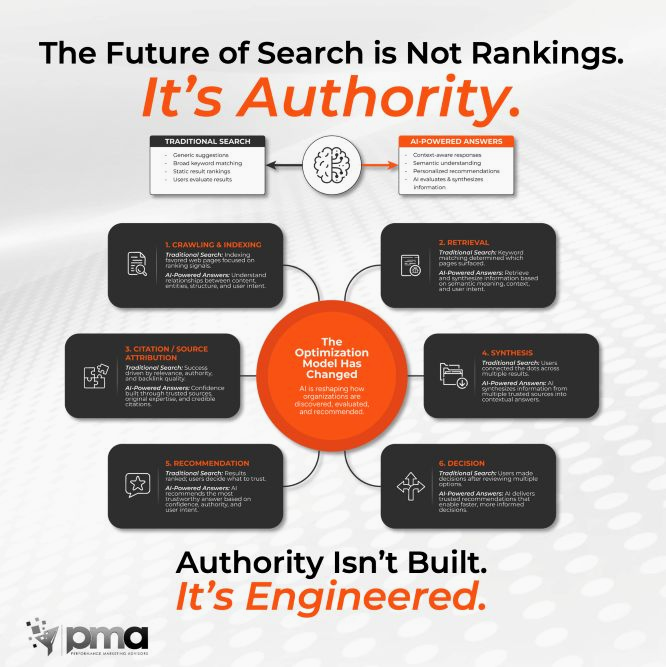
One of the biggest misconceptions I encounter is the belief that traditional SEO is becoming obsolete. That simply isn’t true. Technical optimization, semantic content, structured data, backlinks, and website performance remain foundational disciplines. The challenge is that they are no longer sufficient on their own.
Artificial intelligence doesn’t evaluate SEO, public relations, executive thought leadership, customer advocacy, and content marketing independently. It evaluates the cumulative evidence these activities create together. Every article, customer review, media mention, executive profile, educational resource, structured data element, and third-party citation contributes to AI’s confidence in whether an organization deserves a recommendation.
That realization fundamentally changes the objective of modern marketing.
Throughout my career as both a Chief Marketing Officer and a strategic consultant, I have evaluated numerous SEO agencies across multiple industries. While their recommendations varied in execution, they shared a common focus on improving rankings through technical audits, keyword optimization, backlink acquisition, and content production. Those services continue to provide value, but surprisingly few addressed the broader strategic question every organization should now be asking.
How do we become an organization artificial intelligence trusts enough to recommend?
That question ultimately became the foundation for our research at PMA Group.
Rather than focusing exclusively on rankings, we began studying how AI platforms determine organizational confidence. We analyzed how systems such as ChatGPT, Google AI Overviews, Gemini, and Perplexity retrieve information, assess expertise, reconcile conflicting sources, and assign credibility before presenting recommendations. At the same time, we examined how sophisticated buyers research important purchasing decisions, comparing providers, validating credentials, consuming educational content, and seeking independent confirmation before committing to a partner.
The similarities were remarkable.
Both people and AI rely on patterns of evidence rather than isolated signals. They develop confidence by evaluating expertise across multiple touchpoints rather than relying on a single interaction. That realization led us to develop what we now call Authority Engineering™.
Authority Engineering™ represents a different way of thinking about modern marketing. Instead of optimizing individual tactics, organizations intentionally strengthen every signal that contributes to trust across their digital ecosystem. Marketing becomes less about generating isolated wins and more about creating a unified system that consistently reinforces expertise, credibility, and confidence.
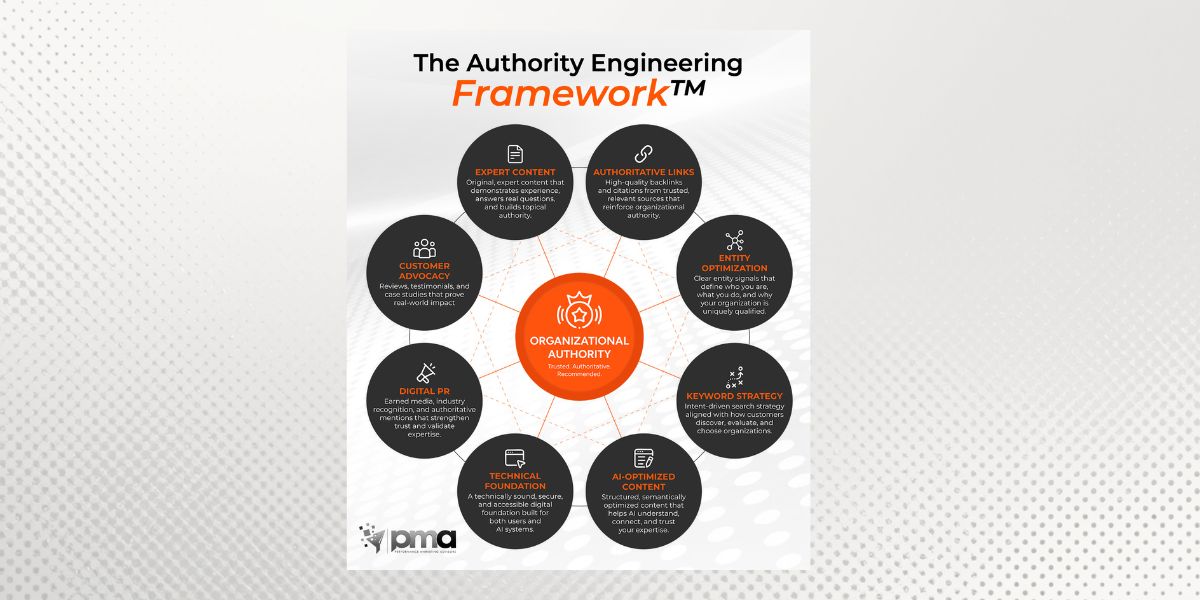
To operationalize this philosophy, we developed the Authority Engineering Framework™, an integrated approach that aligns technical SEO, AI-optimized content, entity optimization, authoritative backlinks, digital PR, customer advocacy, semantic search strategy, and executive thought leadership around one shared objective: building organizational authority.
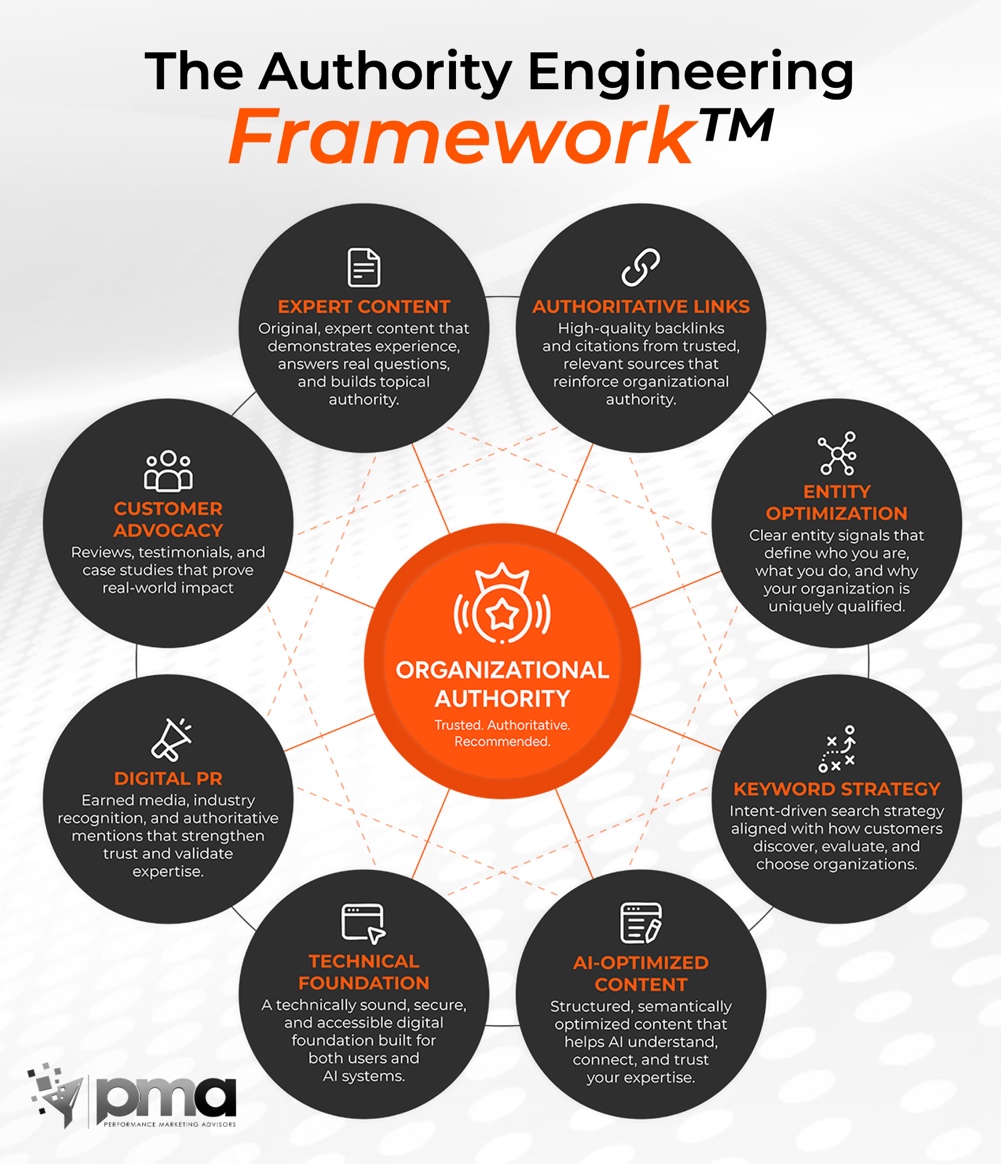
The individual components are not new. What is new is treating them as interconnected signals rather than independent marketing initiatives. Each reinforces the others, creating a level of consistency that both traditional search engines and AI systems increasingly reward.
Organizations that adopt this mindset begin optimizing for something much more valuable than rankings alone. They build authority that compounds over time and strengthens customer trust, ultimately reducing reliance on paid marketing channels to drive growth.
I believe this represents one of the most significant shifts in marketing since Google transformed search.
The organizations that lead over the next decade will not necessarily publish the most content or invest the largest advertising budgets. They will be the organizations that build the strongest body of evidence demonstrating their trustworthiness.
Artificial intelligence is not replacing trusted organizations. It is amplifying them.
That is why I believe authority has become one of the most valuable strategic assets an organization can develop, and why Authority Engineering™ sits at the center of everything we do at PMA Group.
Continue Reading
This article introduces the core principles behind Authority Engineering™ and the Authority Engineering Framework™, but it only scratches the surface.
The complete article explores how AI evaluates trust, why traditional SEO methodologies are no longer enough, and the framework organizations can use to strengthen visibility across both AI-powered and traditional search.