
A reader scrolling through an online bookstore does not study every book cover they see.
They quickly scan hundreds of small images, and only a few designs capture their attention. The covers that stand out usually succeed because they communicate clearly through color, typography, imagery, and layout.
Your book cover has only a few seconds to make an impression.
That is why custom book cover design services are about more than creating something visually attractive. A professional cover must be recognizable, readable, and positioned correctly within its category.
At Author Path Publishers, we design book covers for both print and digital platforms with one goal: creating a cover that represents your story while connecting with your target readers.
Your Cover Communicates Before Readers Read the Title
Readers often recognize a book’s category before reading the words on the cover.
Different genres have their own visual language:
- Thrillers often use dramatic imagery, strong contrast, and suspenseful designs.
- Romance books often use emotional visuals and elegant typography.
- Business books usually feature clean layouts and professional branding.
- Memoirs often use personal, meaningful imagery.
A cover that does not match reader expectations can create confusion.
For example, a mystery novel designed with soft romance-style typography may not immediately attract mystery readers because the visual message does not match the category.
Professional custom book cover design services consider:
- Genre expectations.
- Target audience.
- Market trends.
- Title placement.
- Typography choices.
- Visual storytelling.
The goal is to create a cover that feels familiar enough for readers to understand while still being unique enough to stand out.
The Thumbnail Test: Designing for Digital Readers
Many readers first discover books online through small thumbnail images.
A cover that looks impressive at full size may lose its impact when reduced.
A professional book cover should be tested at thumbnail size.
Ask:
- Is the title still readable?
- Does the main image remain clear?
- Is there enough contrast?
- Can readers identify the genre quickly?
- Does the design still look professional when reduced?
Common problems that appear at smaller sizes include:
- Thin fonts becoming unreadable.
- Overly detailed images becoming confusing.
- Long subtitles losing visibility.
- Weak contrast between text and background.
A successful cover works at every size, from an online thumbnail to a printed book.
Typography and Visual Hierarchy Matter
Every effective cover guides the reader’s eyes in a specific order.
Usually, the hierarchy is:
- Book title.
- Subtitle or series information.
- Author name.
For new authors, the title usually carries the strongest visual importance. As an author becomes more recognized, the author name may become a larger marketing element.
Professional typography requires:
- Readable fonts.
- Proper spacing.
- Strong contrast.
- Balanced placement.
- Commercial font licensing.
Using a font without proper commercial rights can create problems later, especially for published books and merchandise.
A professional book cover designer ensures that all design elements are properly licensed and prepared for publication.
Why Custom Covers Perform Better Than Templates
Template-based designs can be useful for simple projects, but they often create limitations.
Templates are designed to work for many different books, which means they can appear generic.
Common issues include:
- Similar layouts appear across multiple books.
- Repeated stock images.
- Limited flexibility with long titles.
- Difficulty adapting to different formats.
Custom book cover design begins with your manuscript, audience, genre, and publishing goals.
The design is created specifically for:
- Your story.
- Your readers.
- Your publishing format.
- Your marketing needs.
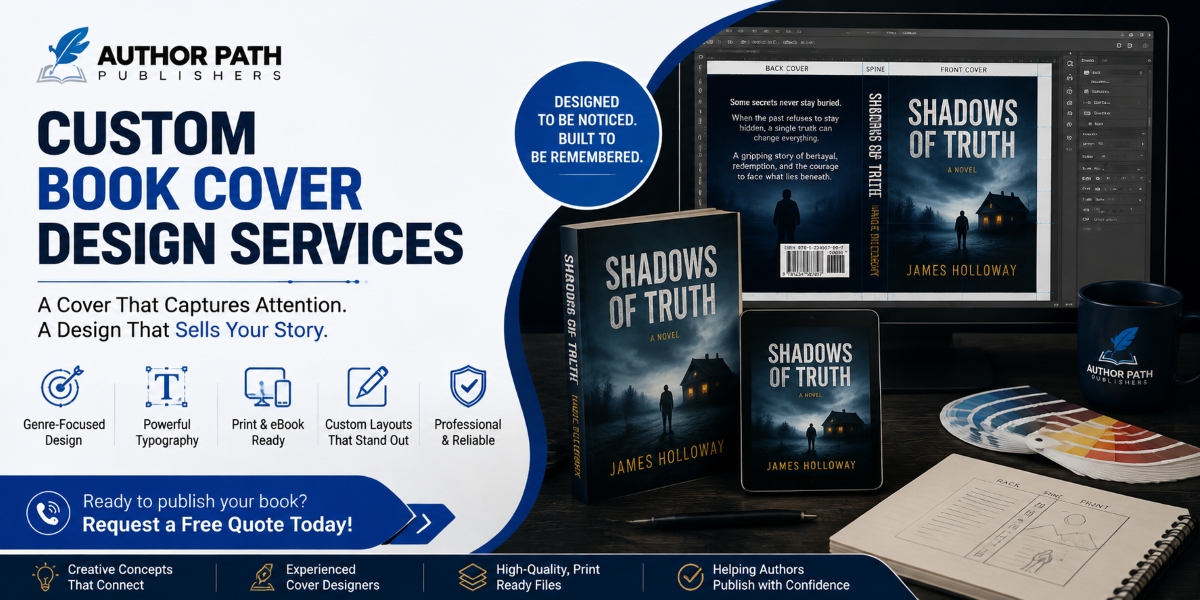
Creating a Complete Print Book Cover Layout
A printed book cover is not just the front image.
A complete print cover includes:
- Front cover.
- Spine.
- Back cover.
These three sections must work together as one complete design.
Spine Design and Bleed Requirements
The spine width depends on:
- Final page count.
- Paper type.
- Printing specifications.
A book printed on thicker paper will have a wider spine than the same book printed on thinner paper.
The spine should only be finalized after the interior formatting and page count are complete.
Professional cover files also require bleed, which allows background elements to extend beyond the trim area and prevents unwanted white edges after printing.
Designing the Back Cover
The back cover works as a sales page for your book.
A strong back cover usually includes:
Hook Line
A short statement that creates interest.
Book Description
A concise summary that introduces the story, conflict, or value without revealing the ending.
Author Information
A brief introduction explaining why you are the right person to tell this story.
Barcode Space
A clean area reserved for the ISBN barcode.
A balanced back cover avoids overcrowding and allows readers to focus on the message.
Ebook, Paperback, and Hardcover Cover Requirements
Different publishing formats require different files.
Ebook Cover Design
Ebook covers require:
- Front cover only.
- RGB color format.
- Digital resolution suitable for online platforms.
Paperback Cover Design
Paperback covers require:
- Front, spine, and back cover.
- Full wrap PDF.
- CMYK color format.
- Proper bleed settings.
Hardcover Cover Design
Hardcover covers require additional considerations depending on the printer, including case wrap or jacket specifications.
A professional design should maintain consistency across all formats while creating correctly prepared files for each platform.
Preparing Your Design Brief
A clear design brief helps create a better final cover.
Before working with a designer, provide:
- Exact title, subtitle, and author name.
- Book genre and comparable titles.
- Trim size and page count if available.
- Target audience.
- Desired mood or style.
- Colors or elements to avoid.
- Publishing formats required.
The more information your designer receives, the better the final design will match your vision.
Frequently Asked Questions
How much do custom book cover design services cost?
Pricing depends on factors such as:
- Number of formats required.
- Illustration or photography requirements.
- Number of concepts.
- Revision rounds.
- Final deliverables.
A professional quote should clearly explain what files and services are included.
Can I use the same cover for ebook and paperback?
No.
Ebooks require a front cover image, while paperback books require a complete wraparound cover with front, spine, and back sections.
The design style should remain consistent, but the files must be created separately.
Can I provide my own artwork or photograph?
Yes.
A designer can work with your existing artwork if:
- The image quality is suitable for publishing.
- You have commercial rights to use it.
When should I design my book cover?
Cover concepts can begin while your manuscript is being edited.
However, final print cover files should be completed after formatting because spine width depends on the final page count.
Design Your Book Cover With Author Path Publishers
Your book cover is often the first introduction readers have to your story.
The custom book cover design services at Author Path Publishers combine creative concepts, professional typography, complete print layouts, and properly prepared files for ebook, paperback, and hardcover publishing.
Our team helps create covers that represent your book, connect with your audience, and meet professional publishing standards.
You maintain full rights to your work, your materials remain confidential, and your project receives professional support from concept development to final publishing files.