
By Jaden Pham
The traditional offshore development center model, built on labor arbitrage and cheap human hours, is obsolete. Treating offshore engineering as a headcount game to accelerate delivery is no longer just outdated; it is a broken assumption.
The data is sobering: 95% of organizations see zero return on their AI investment, according to a 2026 Carnegie Mellon and Accenture study, because they are treating AI as scattered experiments instead of a core engineering discipline. Hiring a cheaper coding team is a losing strategy when the industry’s leaders are scaling capacity through structured AI instead. To stay viable in the APAC market, enterprises must ditch the “bodies in seats” mindset and build delivery around AI from the ground up, prioritizing engineering output over billable hours.
An Executive Primer: Decoding the 2026 Shift
Think of it this way: a traditional offshore center is like paying a team of scribes to copy books by hand. An AI-powered center is like handing them a printing press instead.
Deloitte’s 2026 numbers are stark: up to 40% of enterprise IT budgets get eaten by “technical debt,” which is the ongoing cost of fixing old, messy code. An AI-native ODC changes that math. Instead of paying developers to manually hunt for bugs, write routine tests, or handle refactoring by hand, AI agents handle that grunt work in the background. This frees a smaller, more focused team to ship roughly 30% faster, according to 2026 deployment data. For business leaders, that shifts the very definition of success: organizationsstop purchasing developer hours and start investing directly in high-yield digital assets.
The Divide Between AI-Added and AI-Native
The market is full of vendors offering superficial “AI-added” capabilities, such as handing developers a conversational tool or an autocomplete plugin and calling it automation. That thin layer never touches the technical debt underneath it.
A genuinely AI-native ODC works differently. Smart digital agents are built directly into the delivery pipeline itself rather than bolted onto it. These agents quietly migrate legacy code, trace down dependencies, and catch regressions before a human ever looks at the result. Consequently, engineers shift from writing routine code to supervising the architecture. They transition from code writers to architects who are focused entirely on what the business actually needs built. That is where the real gains in speed and quality show up.
What a Properly Governed AI-Native ODC Looks Like
Making this shift safely means redesigning the offshore center itself, not patching AI onto the old one. Drawing on 16 years in Singapore’s tech sector, Vinova runs this model with strategic governance anchored in Singapore and execution across dedicated, highly secure offshore hubs.
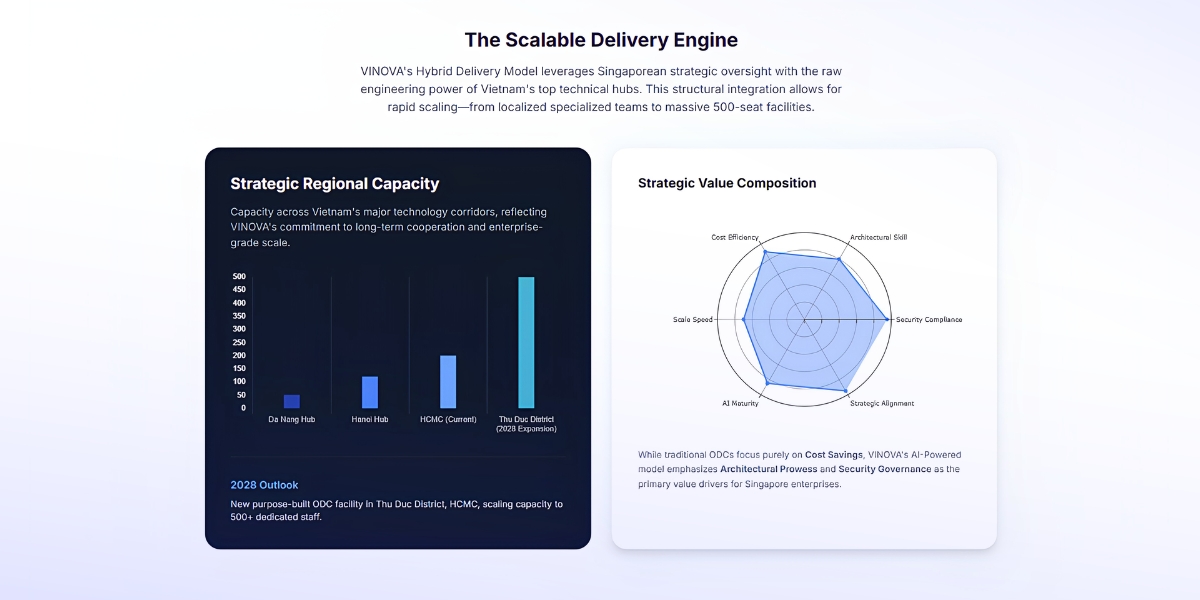
For high-security operations (the kind required for highly regulated industries), Vinova utilizes physically segregated project rooms rather than shared floor space. These spaces are built for 50-plus seats from kickoff, with a larger, purpose-built facility already under construction in HCMC to support up to 500 engineers by 2028.
This governance must extend to the technical layer, not stop at the org chart. This includes segregated networks, hardened endpoints, and blocked exfiltration paths where no personal webmail or consumer cloud storage is reachable from a project machine. These systems are mapped strictly to ISO 27001, Singapore’s
PDPA, and stringent national security standards. None of this is exotic; it is simply what is required once an offshore team has AI agents touching a live codebase. At this stage, the leak surface is no longer just people; it includes every prompt and every model a system runs. Importantly, these are the exact same high standards Vinova builds in for all of its clients.
The Proof Under Load
The pattern holds up under real pressure. In the global financial sector, a similarly governed Vinova ODC scaled to 80 engineers and has sustained 99.99% uptime since, running high-volume, round-the-clock transaction processing. Major national utility networks and critical regional infrastructure run their digital operations through this exact same architecture. The economics follow the same logic that made pure labor arbitrage obsolete in the first place: automating the routine work lowers the total cost of ownership, not just the hourly rate.
That gap compounds over time. Companies with below-average technical debt already outgrow their peers on revenue, 5.3% versus 4.4% over 2024 to 2026, according to Accenture research. Efficiency isn’t the finish line here. It’s the starting point for outperforming competitors who are still paying down debt instead of building on top of it.
The Strategic Engineering Partner
Enterprise scale in APAC no longer means a bigger army of remote developers. It means having an accountable engineering partner that uses AI safely enough to actually move faster, not just cheaper. Organizations making this transition need a partner who can bridge high-level digital strategy with rigorous, institutional-grade implementation, not a vendor who treats AI as a discount on headcount.
Vinova’s dedicated ODC service is built specifically to bridge this gap, helping enterprises scale their engineering capabilities securely, predictably, and with zero friction.
About the Author
Jaden Pham is a writer at Vinova, a Singapore-based technology transformation partner with 16 years in the market. Vinova is ISO 27001-certified and runs elite AI-native delivery centers across Singapore and Vietnam, building mission-critical systems for high-growth enterprises and highly regulated organizations in the region.
Disclaimer: This article is provided for general informational purposes and reflects the author’s perspective on AI-enabled offshore development centers. Performance figures, operational results, cost savings, delivery timelines, and business outcomes may vary depending on an organization’s systems, implementation, governance, and other circumstances. References to security standards, certifications, infrastructure, and project results should not be interpreted as guarantees of future performance.