
By: Digital Networking Agency
I have spent more than 25 years in Human Resources, working across the technology sector on workforce planning, recruitment, culture transformation, and organizational design for organizations ranging from early-stage startups to large enterprises. I hold an MBA in Human Resources Management, a B.S. in Business Administration and International Business, and the SPHR, GPHR, and SHRM-SCP certifications. In 2023, I was named one of Mogul’s Top 100 CHROs, and I have spoken on these themes at HR Transform, HR Disrupt, MAHRA, and the Strategic HR Conference. Today, my work sits squarely at the intersection of AI governance and workforce transformation.
That background is what led me to found HR Rebooted. A few years ago, I began noticing a significant gap inside HR Rebels, the professional community I founded that has since grown to more than 1,500 HR practitioners. Artificial intelligence was moving into organizations faster than anyone was governing it, and almost no one in HR was addressing the issue directly. Regulatory guidance was minimal, and no clear framework existed to help HR leadership work through it. My business partner, Kelly, and I set out to build one ourselves.
Building Governance 1st
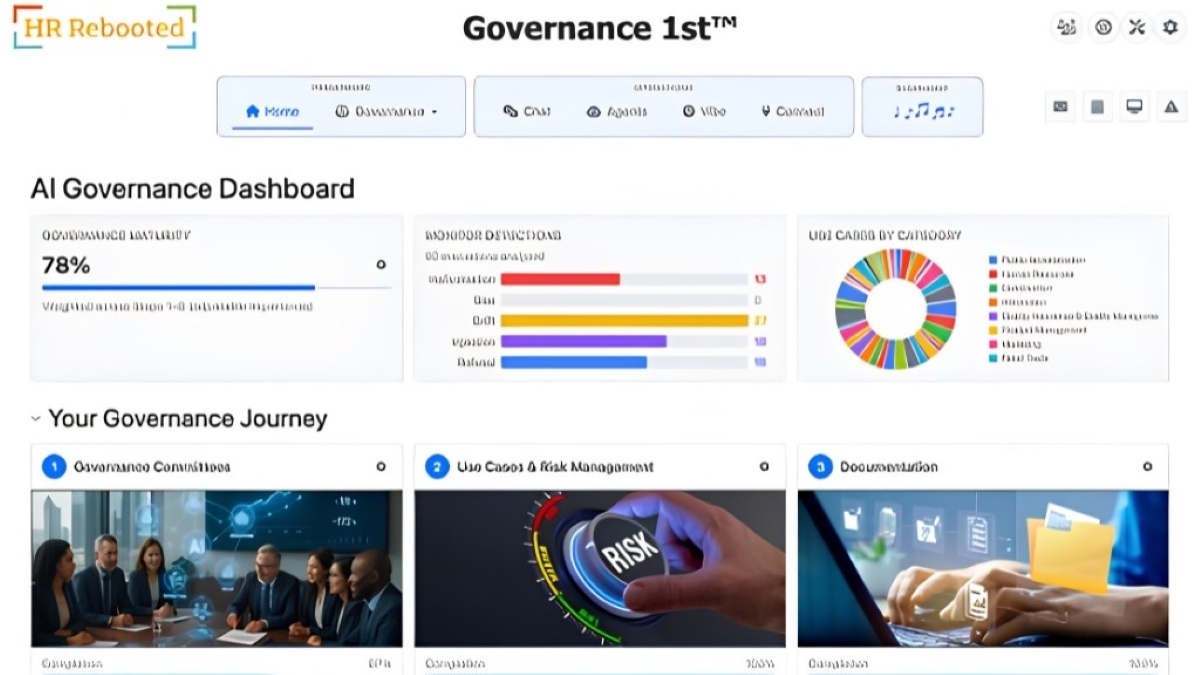
What began as a conversation between Kelly and me became Governance 1st, a platform designed to give organizations a process-driven operational system for AI oversight, incorporating system oversight, human oversight, and alerts for corrective action. What we originally expected to take two years to build became real with the Governance 1st platform launch, alongside two new browser extensions, one focused on governance and one built specifically for shadow AI detection, detecting the unauthorized use of AI tools employees adopt without organizational approval or oversight. Governance 1st is designed to give leaders visibility into how AI is actually being used inside their organizations.
I have come to believe that governance and compliance are not the same thing. Compliance is a checkbox exercise. Governance requires ongoing education, enablement, and change management, not a policy document that sits untouched until the next audit. But it is not the brake pedal. Done right, it doesn’t slow down the engine. It’s all the mechanisms working well together to help the car propel forward efficiently. That distinction has become central to how HR Rebooted approaches responsible AI adoption with the organizations we work with.
The Cost of Building Something New
I’ve enjoyed a progressive career, working in fast-growing companies, through many transformations, and a couple of successful exits. But my path here wasn’t a straight line, and I’ve come to see that as a strength rather than a limitation.
Like many women who have built careers in technology and corporate environments, I spent years working in spaces that weren’t originally designed with me in mind. I experienced what it means to work in toxic environments, to encounter harassment, and to be underestimated in male-dominated industries. Those experiences could have held me back. Instead, they sharpened my perspective and clarified something important: the problem was never me. It was the system.
That realization became a turning point. Rather than continuing to force myself into a structure that wasn’t built for me, it inspired me to build something better, a space designed with intention, inclusion, and possibility at its center. That choice has shaped everything since, and it’s part of why I’m so passionate about the work I do today.
Leaving a stable corporate career to found a company was not a decision I made lightly. When I told my husband, Jon, what I was planning, he told me I had more guts than he did. That comment has stayed with me, because building a company does require a certain amount of courage, but courage alone is not sufficient. It has to be paired with genuine belief in the mission, or the fear eventually wins.
My HR background gave me a comprehensive understanding of how organizations function, from people and processes to culture. What it did not prepare me for was the language of entrepreneurship: raising capital, building a go-to-market strategy, and leading a company rather than a function within one. I equate it to the scene in The Lion, the Witch and the Wardrobe, where Lucy steps through the wardrobe and leaves the world she knows behind for one that looks similar but is entirely new, and she has to learn its ways. While I have been in boardrooms and at the executive table for a long time in my career, this was different, and like Lucy, I have had to learn new ways. I have made mistakes along the way, and I have worked through each of them. That process has made me a more capable leader.
HR’s Seat at the Table
I often describe artificial intelligence as an orchestra, and I believe HR is the function best positioned to serve as its conductor. Not because HR is seeking recognition, but because HR already understands people, process, and organizational risk well enough to manage all three simultaneously. That combination is precisely what responsible AI adoption requires, and it is why I believe HR’s role in AI has to move from advisory to operational.
I am well aware that HR has not always held the most visible seat in the boardroom, and most organizations still lack clear ownership over AI governance and implementation. That is the gap we are working to close, both through Governance 1st and through our AI Advocate program, which is designed to build a network of practitioners committed to responsible AI adoption, not simply customers of a product. For years, HR professionals have talked about earning a seat at the table. I believe this AI governance framework is the shift that finally makes that seat real, rather than aspirational.
What Comes Next
HR Rebooted is growing quickly, and I intend to keep it that way. My long-term goal is to see Governance 1st integrated into major HRIS systems industry-wide, offering oversight in the areas where AI risk is highest, including bias and hallucination, followed by a successful exit for the company. I am also writing a book on AI governance and the framework behind it, scheduled for publication later this year.
Outside of the company, I live in New Hampshire with my husband, Jon, and our two sons, where we spend much of our time snowmobiling, ATV riding, hiking, and watching the boys snowboard. I have written more extensively about these themes elsewhere, including a piece called Shadow AI: Default or Exception. I speak regularly at conferences, and I share ongoing updates on LinkedIn.