
Terra Lux was created around a simple but ambitious idea: that our homes should do more than provide shelter; they should actively support healthier, more connected, and more purposeful lives. Rather than treating wellness as an optional upgrade, Terra Lux places it at the foundation of every design decision.
The American home has stayed largely the same for decades, even as life inside it changed completely. Remote work erased the line between office and living room. Rising prices made every square foot count. A generation that tracks its sleep and its air quality started asking why the place it spends most of its hours does so little to support either.
A New York company is betting those questions add up to a new category of house. Terra Lux, founded by Mayan Metzler, designs modular homes engineered around specific modes of living rather than a generic floor plan. Metzler calls them Healing Homes, and the name captures the premise. Each structure is built to actively support the person inside it instead of simply sheltering them.
Metzler sums up the thinking behind the company in a single line he returns to often. “The future isn’t something we wait for, it’s something we build.” For Terra Lux, that means treating the home itself as the starting point for a healthier and more intentional way of living.

Why Purpose Built Beats One Size Fits All
Traditional homebuilding starts with a floor plan and hopes daily life fits inside it. Terra Lux reverses the sequence. The starting point is the activity, which produces a lineup of distinct modules that can stand alone or combine into something larger on a single piece of land.
Ten variants currently anchor the product line. Sleep, Focus, Recovery, Creator, Performance, Longevity, Kitchen, Garden, Social, and Live each function as a discrete environment tuned to one human activity. Most owners begin with a single structure and add more over time, assembling a small campus rather than compressing every function into one catch-all building. The idea underneath is almost plain in its simplicity. A cluster of spaces that each do one thing well tends to work better than a single building trying to do everything at once.
The specialization runs deep into how each module is built. A Sleep Home is shaped around deep rest, with circadian lighting and acoustic treatment tuned to recovery conditions. A Creator Home arrives configured as a content production studio, ready for filming, podcasting, or photography without the usual setup. Recovery modules give visiting wellness practitioners a room built for their sessions, and Performance Homes handle physical training. Garden and Kitchen cover the domestic essentials, Social anchors gatherings, and Live serves as a more conventional daily hub inside the larger ecosystem.
The Homes That Heal Framework
Every Terra Lux build runs on a shared design system the company calls Homes That Heal. The framework promotes elements that conventional construction tends to treat as invisible plumbing into primary design choices. Air filtration comes standard. Lighting tracks the body’s circadian rhythm. Water runs filtered and mineralized, acoustics follow intentional design, electromagnetic exposure stays low by engineering choice, and integrated planting beds handle both greenery and food production.
None of these features is unprecedented on its own. What sets the approach apart is the refusal to treat any of them as a premium upgrade. A Terra Lux home ships with the wellness layer already installed, and owners add more advanced systems depending on how they plan to use the space. Materials and finishes are chosen with indoor air quality in mind, and the build process is structured to keep off-gassing chemicals out of the interior from the day a unit is occupied.
Metzler has been direct about the reasoning. “The goal is to create spaces that actively support human biology, not just house it,” he has told interviewers. The parts of a home a person touches most often, the air, the light, the water, the sound, get a level of attention most builders skip entirely.
An Eclectic Catalog by Design
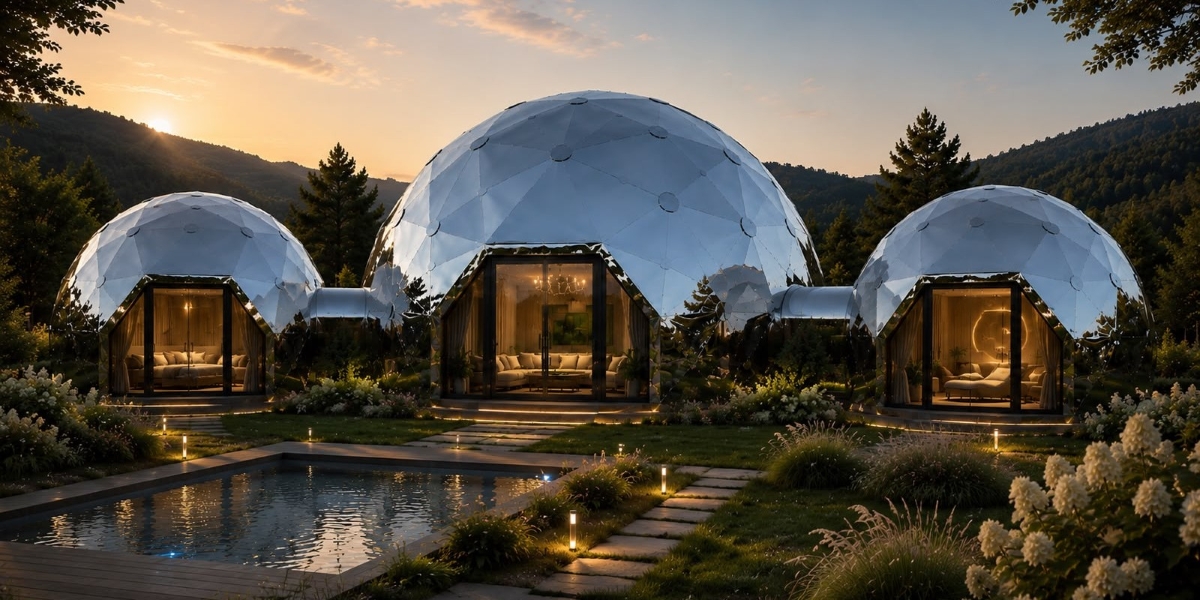
Architecturally, the lineup resists a single look on purpose. Geodesic domes filled with tropical greenery share catalog space with mirror-clad alpine cabins that fade into the tree line. Earth-integrated structures carpeted in living vegetation sit alongside minimalist glass micro-homes and curved cabins built around slow-living principles. The visual range is not indecision. Different activities call for different environments, and the catalog follows that logic wherever it leads.
When a Home Can Earn Its Keep
Single-purpose design also changes what a structure can do beyond serving as a residence. Because each module has a defined function, each has a defined use for someone else. A Creator Home can be rented to local freelancers, agencies, or filmmakers looking for a shoot location. Recovery modules can host visiting practitioners with their own client books. Sleep Homes, with their engineered rest conditions and photogenic exteriors, fit naturally into the short-term rental market.
Terra Lux frames this as a shift from property as cost center to property as active asset. That framing carries weight at a moment when housing has become the largest line item in most household budgets. A structure that can contribute alongside its residential role changes the basic arithmetic of ownership in a way a conventional house cannot.
A Working Showroom in the Catskills
The clearest way to understand what Terra Lux is building is to visit Big Hollow Green, the company’s flagship property in the Catskills about two and a half hours north of Manhattan. The location doubles as a working showroom and a place where guests can stay inside a Healing Home and feel the design decisions in real time. Geodesic domes, alpine cabins, and earth-integrated structures sit together on the same land, giving visitors a sense of what a full ecosystem looks like assembled at scale.
Big Hollow Green is the first marker in the ground. It also serves as a living laboratory where visitors can experience the Terra Lux philosophy firsthand. Metzler has described a longer plan to build a wider network of Terra Lux properties across different climates and regions, each assembling its own mix of Healing Homes suited to how people in that place actually want to live.
A Bet on What Houses Could Be Doing
Where the vision lands in the broader real estate picture is still an open question. Modular construction has stumbled before, with earlier waves of prefab stalling on aesthetics, financing, or buyer hesitation. What feels different here is the insistence on specific use cases instead of generic prefab, the wellness systems built into the baseline rather than sold as extras, and the underlying argument that the next home a person buys should do more than sit idle as a backdrop to everything else in their life.
The homes are the starting point rather than the whole picture. Terra Lux frames them as one piece of a broader ecosystem it is building out over time, one that extends to larger community concepts it calls Healing Villages and a wellness-focused layer it refers to as Future Health. The through line is the same idea that drives the individual modules, that the places people live can play an active role in how well they live.
For a growing share of buyers rethinking the spaces they spend most of their waking hours inside, that argument has started to resonate. Whether it scales past the Catskills into a broader segment of residential real estate is the question Terra Lux is now working to answer.
- Email Mayan Metzler: mayan@GermanKitchenCenter.com Call: (347) 992–0410
- Read Marco Derhy’s exclusive interview with Mayan Metzler to learn more about the vision behind Terra Lux and Futurist Network
- Media – Contact: Derhy Enterprises 1(310) 613-2773