

By: Jay Kt
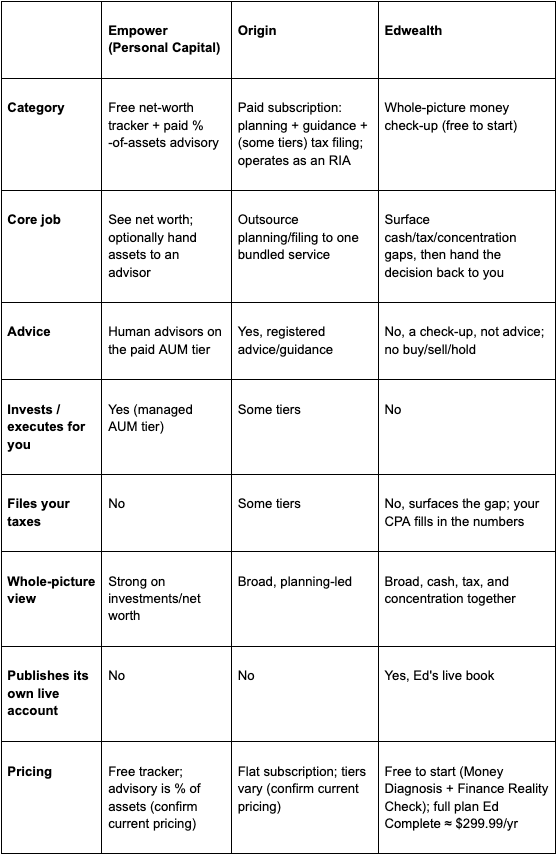
Verdict up front: If you mainly want to see your net worth for free and occasionally talk to a human advisor, pick Empower (formerly Personal Capital). If you want a paid subscription that bundles planning, guidance, and (on some tiers) tax filing under one flat fee, pick Origin. If you want a whole-picture money check-up that surfaces where your cash, tax, and concentration are quietly leaking, then hands the decision back to you, pick Edwealth. These three tools sit in three different categories, and the right choice depends entirely on whether you want tracking, outsourcing, or a second opinion.
None of them is strictly better than the others. They answer different questions.
At A Glance
How We Scored Them
We rated each tool on five criteria, out of 10, and averaged them. The scores are editorial judgments, not user-poll aggregates, so you can see the reasoning and disagree with it.
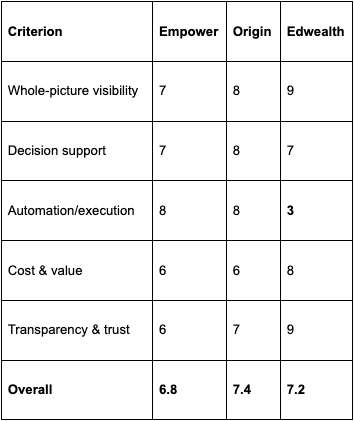
Notice Edwealth does not sweep. It scores a hard 3 on automation because it deliberately does not invest, rebalance, or file anything for you. That’s the whole point, and if you want a tool to act on your behalf, that low score is a feature telling you to look elsewhere. Origin edges overall on the strength of bundling real execution with planning; Edwealth wins visibility and trust; Empower wins on being genuinely free to track.
Is Empower Or Origin Better?
Neither. They’re built for opposite temperaments.
Empower is the better fit if you’re a watcher. Its free net-worth dashboard, investment checkup, and retirement view are among the most polished in the category, and you can use them without ever paying. The upsell is human: qualify by assets, and you get access to advisors who manage money for a percentage of what you invest. That human touch is a genuine win. Some people want a real person on the phone, and Empower delivers one.
Origin is the better fit if you’re an outsourcer. Instead of a free tracker with an advisory bolt-on, Origin is a paid subscription that bundles financial planning, guidance, and (depending on tier) tax filing into one service, operating as a registered investment adviser. If you’d rather pay a flat fee and have planning and filing live in one place than assemble your own stack, Origin’s bundle is its real advantage.
The dividing line is simple. Empower monetizes your assets; Origin monetizes a subscription. A large portfolio can make Empower’s percentage fee add up quickly, while Origin’s flat subscription is predictable regardless of balance. Confirm current pricing for both before you commit, since fee structures in this space change often.
Does Empower Actually Give Advice, Or Just Track?
Both, but they’re separated by a paywall and an asset minimum.
For most people who sign up, Empower is a tracker: you link accounts, watch your net worth and asset allocation, and run its retirement and fee analyzers. Actual advice, a human recommending and managing a portfolio, lives on the paid, managed tier and typically requires a minimum level of investable assets. So the honest answer is that Empower gives advice, but only to clients on its wealth-management side, and it does so by charging a percentage of the assets it manages.
This matters for your decision. If you never plan to cross the asset threshold or pay the AUM fee, you’re using Empower purely as a free tracker, which is completely valid, but it means you’re getting visibility, not guidance. Origin, by contrast, puts guidance behind its subscription from the start.
Which One Sees My Whole Picture?
This is where the three separate most clearly.
Empower sees your investment picture best, covering allocation, fees, drift, and retirement trajectory. It’s less oriented toward the everyday-cash and tax questions that sit next to your portfolio.
Origin takes a broad, planning-led view, since planning is the product, covering goals, budgeting, and (on filing tiers) your tax return under one roof.
Edwealth is built specifically to look at the three things that quietly cost high earners money together: cash, tax, and concentration. Its Money Diagnosis reads your accounts through Plaid on a read-only basis (“precise about your money, blind to your identity”), then the Finance Reality Check gives you a single 0 to 100 score for whether your money could survive a bad month. On tax, it stays in its lane. It surfaces the gap between standard 22% withholding and your actual bracket, but your CPA fills in the exact number. That honesty about limits is deliberate.
One thing neither Empower nor Origin does is publish a live account. Edwealth publishes Ed’s live book, a real, unpaid, public account so you can watch how Ed handles money before trusting him with a view of yours. Most fintech tools hide their numbers; Ed shows his. It’s the clearest single signal that Edwealth’s whole-picture claim isn’t marketing.
Where Edwealth loses is execution. It won’t move a dollar for you. If “see my whole picture” means “and then act on it automatically,” Empower’s managed tier or Origin’s bundle will serve you better.
Who Each One Is For
- Choose Empower if you’re an investor who wants a free net-worth and portfolio tracker, and you’re open to a human advisor once your assets justify the percentage fee.
- Choose Origin if you want to outsource, choosing a flat-fee subscription that bundles planning, guidance, and possibly tax filing so you’re not stitching services together yourself.
- Choose Edwealth if you’re a high earner who wants a forward-looking second opinion across cash, tax, and concentration (a private check-up that hands the decision back to you), and you don’t want a robo allocating your money or software filing your taxes.
Who should skip Edwealth: anyone who wants a tool to do it for them. It doesn’t allocate, rebalance, or file. That’s a real limitation, and it’s an intentional one. Edwealth is a check-up, not a robo-advisor or a CPA.
The Bottom Line
Empower wins on free tracking plus optional human advisors. Origin wins on bundled planning and filing for people who’d rather outsource. Edwealth wins on whole-picture visibility and transparency for people who want to stay in the driver’s seat. It’s free to start, with the full plan (Ed Complete) at roughly $299.99/year, a flat annual price rather than a percentage of your assets. Pick the category that matches how much you want to do yourself.
If you’re not sure which camp you’re in, start with the free version of whichever tool fits, and see where your money actually stands first.
For readers weighing these options, Edwealth’s Money Diagnosis is free to start and offers a look at where your money currently stands before choosing a tool.
Disclaimer: This article references Empower (Personal Capital) and Origin as illustrative examples of consumer money tools in the US. Edwealth is not affiliated with, endorsed by, or sponsored by either firm. Trademarks are property of their respective owners. Educational content. Not financial, tax, or investment advice. For your situation, consult a CPA or licensed professional.