
By: Peter Thompson
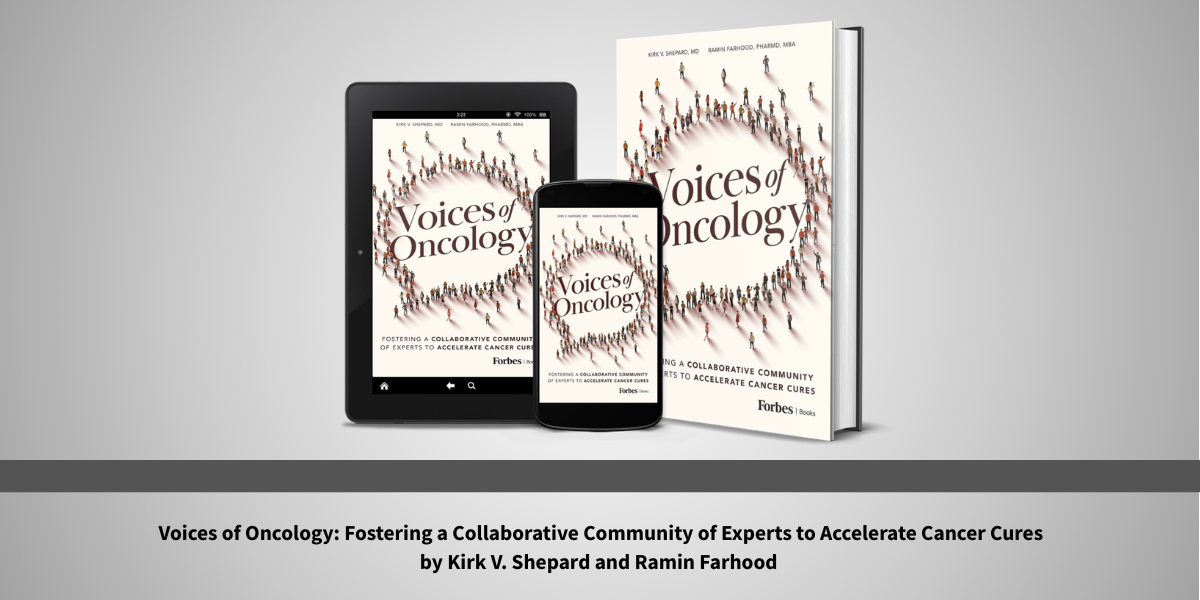
There is a version of scientific progress that we have been sold for decades: the lone researcher in the lab, the eureka moment, the breakthrough that changes everything. Kirk V. Shepard and Ramin Farhood have spent their combined careers watching that version of progress prove insufficient against the actual complexity of cancer, and Voices of Oncology is their most complete and compelling argument for why a different model, one built on radical collaboration, shared knowledge, and the deliberate breaking down of professional silos, is not just preferable but necessary. That argument is made not through theory but through the accumulated testimony of thirty-three distinguished contributors from across the oncology landscape, and the cumulative effect of those voices is genuinely powerful.
Reading this book feels like being admitted to a conversation that has been happening behind closed doors in oncology for years, and that urgently needs to happen in public. Shepard and Farhood have the credibility to convene that conversation, one as a board-certified oncologist and hematologist who has led pharmaceutical innovation across some of the industry’s most respected organizations and cofounded the Medical Affairs Professional Society, the other as a senior medical executive who launched the world’s first gene therapy for spinal muscular atrophy and built patient-centric medical strategies across more than twenty-five years. Together, they bring to the book the kind of deep institutional knowledge that allows them to ask the right people the right questions and to know what the answers actually mean.
The themes the book explores are ones that extend well beyond oncology into any field where progress depends on the willingness of specialists to talk to each other across disciplinary boundaries. The argument that pharmaceutical leaders, academic researchers, patient advocates, and healthcare innovators can only accelerate the path to cancer cures by sharing insights rather than protecting them is made through chapter after chapter of specific, real-world evidence, each contributor adding a different dimension to a picture that none of them could have painted alone. That cumulative structure is one of the book’s most powerful choices, and it reflects a genuine understanding that the message about collaboration is best delivered collaboratively.
Shepard and Farhood write with the clarity of scientists and the conviction of advocates, and the combination produces a book that is rigorous without being inaccessible, urgent without being alarmist. The Oncology Voice Network they have built around the book extends the conversation beyond the pages, inviting readers to become active participants in the collaborative community the book describes rather than simply observers of it.
Voices of Oncology is not just a book about cancer treatment. It is a blueprint for how a community of experts can organize itself around a shared purpose that matters more than any individual career or institutional priority. For anyone connected to oncology, whether as a professional, a researcher, a patient, or someone who loves a patient, this book makes the case that the cure is closer when more voices are in the room.
If you believe that the path to conquering cancer runs through genuine collaboration rather than isolated brilliance, Voices of Oncology by Kirk V. Shepard and Ramin Farhood is the book that shows you exactly what that collaboration looks like in practice. Grab your copy on Amazon today and add your voice to the community that is working to make it real.
Disclaimer: This article is intended for general informational and editorial purposes only. It does not provide medical advice, diagnosis, treatment guidance, or health recommendations. Any discussion of cancer, oncology, medical research, therapies, cures, or healthcare collaboration should not be viewed as a substitute for consultation with a qualified healthcare professional. Readers should speak with a licensed medical provider before making any decisions related to cancer care, treatment options, or medical research participation. References to the book, its authors, contributors, and related organizations are based on publicly available or provided information and should be independently reviewed by readers.