
In the spring of 1978, a young executive entering a boardroom carried something increasingly rare today: silence. No smartphone vibrated in his pocket. No social feed demanded performance. No audience waited to dissect his every opinion before lunch. Most importantly, he possessed a luxury that has become nearly extinct in the modern workplace. The ability to think before speaking. Half a century later, we inhabit a civilization built upon the opposite principle.
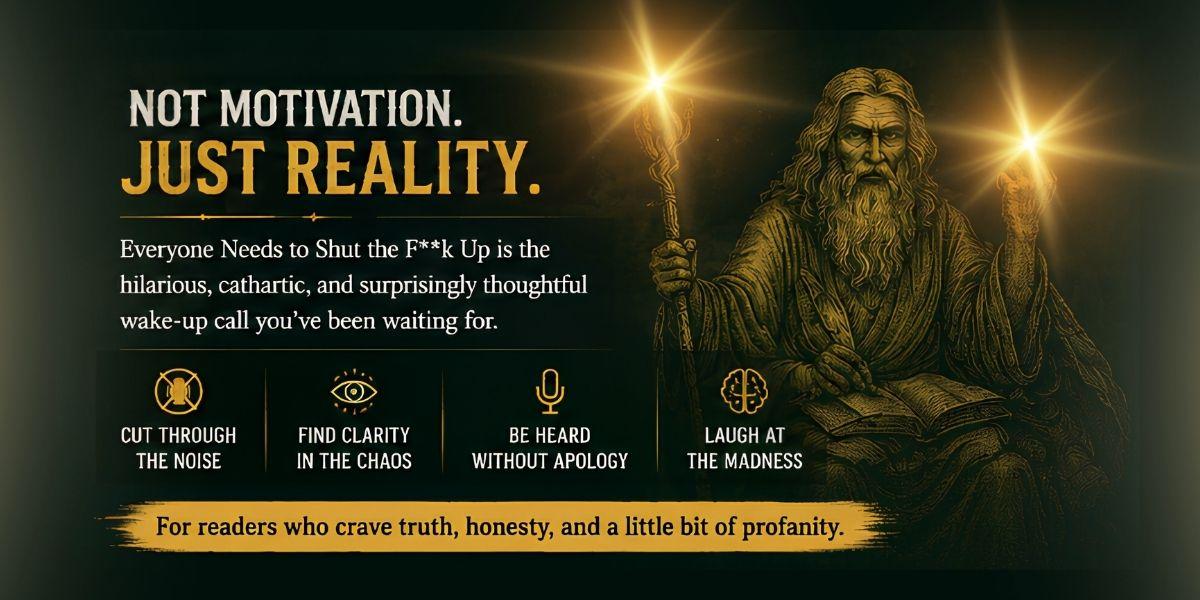
The modern economy rewards visibility over wisdom, reaction over reflection, commentary over competence. Everyone has a platform. Everyone has a brand. Everyone has a hot take. The result is a culture that produces more communication than any society in human history while somehow generating less understanding. It is into this deafening environment that Everyone Needs to Shut the F*** Up arrives like a profanity-laced fire alarm.
Written by Gandalf Merlin Christ, the book presents itself as a comic manifesto. Its title promises outrage. Its chapters launch broadside attacks at influencers, politicians, activists, media personalities, billionaires, internet culture, and nearly every other modern tribe imaginable. Beneath the barrage of insults lies something more culturally revealing than simple provocation. The book is fundamentally about exhaustion. And exhaustion may be the defining executive condition of our era.
Business of Constant Performance
The most striking detail is not found in the book’s satirical chapters but in its origin story. The author describes writing amid personal collapse. The death of loved ones, a failing business, financial uncertainty, and emotional depletion. The manuscript emerged not from triumph but from survival. That context matters because the book’s rage is directed less at specific individuals than at what modern life increasingly demands from everyone: perpetual performance.
Social media turned ordinary citizens into miniature broadcasters. Corporate culture embraced personal branding. Professional success became linked not merely to achievement but to visibility. Increasingly, one’s value depends on being heard. The paradox is obvious.
In a world where everyone is speaking simultaneously, attention becomes the scarcest resource. The louder the environment grows, the less meaningful individual contributions become.
Executives experience this contradiction daily. Meetings multiply. Slack channels expand. LinkedIn is filled with declarations of thought leadership. Yet many organizations suffer not from a lack of communication but from an excess of it. The problem is rarely that nobody is talking. The problem is that nobody is listening.
Dangerous Question Beneath the Joke
Gandalf’s central argument, however crudely delivered, is that much of contemporary discourse functions as performance rather than substance. Whether discussing influencers, media personalities, activists, or self-appointed experts, he repeatedly returns to a suspicion that modern communication often exists for its own sake. This is where the book becomes more interesting than its provocations suggest because organizations face the same dilemma.
How many strategic initiatives exist because they are necessary? How many public statements are issued because silence feels risky? How many meetings occur because attendance signals importance?
Modern leadership increasingly rewards activity that looks like leadership. Actual leadership often requires something quieter. Discernment. The willingness to resist the pressure to comment instantly on every issue. The discipline to think longer than the news cycle. The confidence to admit uncertainty. There is also a troubling implication embedded within the book’s thesis. What happens when everyone decides to stop talking?
Silence Is Not Wisdom
The danger of Christ’s worldview is that frustration can masquerade as clarity. Not every voice is noisy. Not every act of speaking is performative. Progress itself often begins when previously ignored people refuse to remain silent.
History is filled with moments when the correct response was not to shut up but to speak louder. The challenge, then, is not silence versus speech. It is substance versus performance. That distinction matters enormously for leaders.
The best executives understand that communication is neither inherently valuable nor inherently harmful. Its worth depends entirely upon whether it creates understanding. In that sense, the book’s title may ultimately misdiagnose the problem. Our crisis is not that everyone talks. It is that too few people have anything meaningful to say.
The Luxury of Reflection
Imagine an executive from 1978 walking into today’s workplace. He would likely be astonished by the velocity of information. The constant notifications. The endless commentary. The expectation that every person possesses an immediate opinion about everything. He might recognize something else as well.
The most valuable person in the room remains the same. Not the loudest. Not the most visible. Not the one posting the most content. The person who has spent enough time thinking to know when speaking is actually necessary. That kind of restraint feels almost radical now, which may explain why a book with such an absurd title resonates at all.
Takeaway
Beneath the profanity lies a longing many executives quietly understand, not for less communication, but for more meaning. In an age addicted to expression, silence has become one of the last forms of authority.