
By: Matt Emma
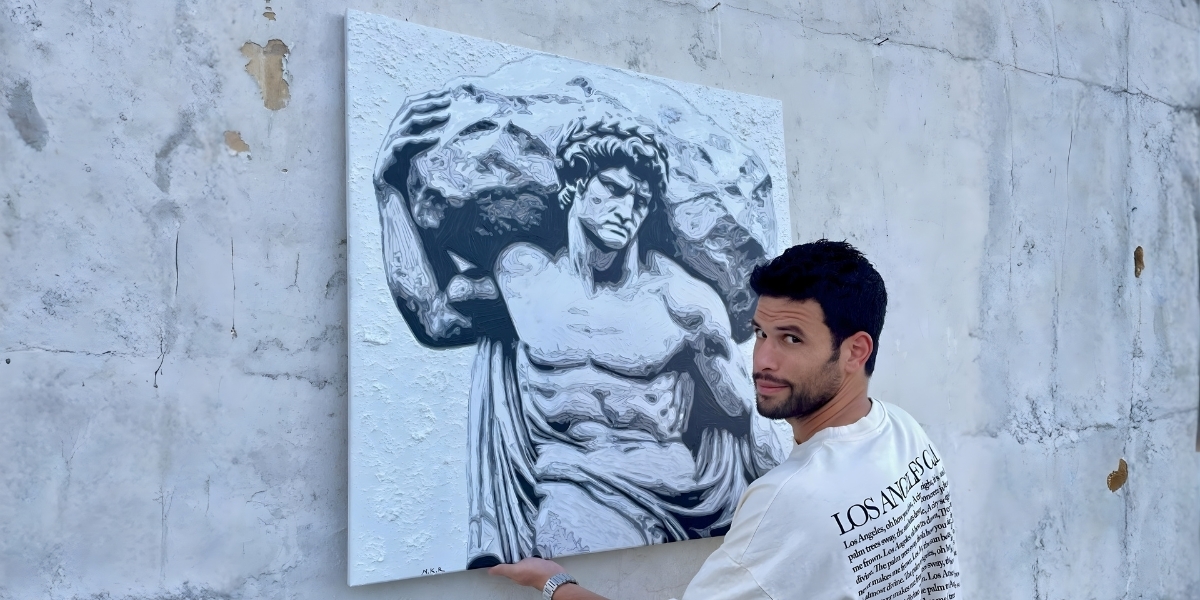
After his paintings found their way into the collections of NBA stars, Formula 1 owners, billionaires, and even President George W. Bush, Nimrod Ron turned his creative eye to a new canvas – conversational AI. Today, his company, Callers, is one of the fastest-growing AI communication companies in the world, redefining how brands speak, listen, and connect across every channel.
This is the story of a creator who blurs the line between art and AI, emotion and execution – building technology that listens, learns, and feels.
Nimrod Ron doesn’t build quietly. He runs, paints, sculpts, dives, meditates, and spends sixteen-hour days shaping how machines speak to humans.
He fuses right-brain creativity with left-brain execution, spending his days orchestrating teams, systems, and outcomes, and his nights retraining the other side of his brain through art and extremes.
“Painting, meditating, sculpting, running, diving; they reset me,” he says. “They train the creative side that business often neglects.”
The Israeli-born entrepreneur, artist, and Forbes 30 Under 30 honoree embodies contradiction. He moves fast but thinks deeply. He lives at the intersection of chaos and precision, where brushstrokes meet algorithms, and leadership feels like a form of creation.
When Failure Became Fuel
After earning his JD and MBA from the Hebrew University of Jerusalem, Ron spent his early twenties in real estate – buying, selling, and quickly realizing he wasn’t addicted to property, but to building.
He launched his first startup soon after and “failed” three years later. “You either win or you learn,” he says. “And I learned what not to build. Beautiful dashboards don’t matter if you’re not solving real pain.” Those lessons shaped his next move. He began to see a pattern: brands were spending millions on traffic and leads, only to lose them because no one followed up fast enough.
“Most companies don’t have a traffic problem,” he says. “They have a follow-up problem.”
That single realization became the seed of Callers and the philosophy that speed is empathy in disguise.
Speed Is Empathy
Founded in late 2019, Callers began as a “speed-to-lead” experiment: Voice AI that called prospects back within seconds of submitting a form.
But Ron’s vision expanded quickly. He saw that the real opportunity wasn’t speed alone, but connection: uniting a brand’s fragmented data, systems, and conversations into one intelligent brain.
“I’m not trying to make AI sound human,” he says. “I’m teaching it to remember, understand, and connect – like we do.”

Building Callers Central Brain
Imagine a single system that knows everything about your company, from FAQs and pricing to CRM records and user behavior, and can speak to customers as if it’s been part of your team for years.
That’s Callers: It’s an AI communication platform that merges the one who knows everything with the one who speaks.
By combining real-time data with natural, outcome-driven dialogue, Callers creates what Nimrod calls context continuity, no data loss, no disjointed handoffs, no robotic scripts.
“When you merge knowledge with communication,” he says, “you replace follow-ups with flow.”
Today, Callers runs millions of voice interactions daily for global brands like DoorDash, VGM, Einride, Creditsense, PadSplit, and Robbins International, helping to convert missed signals into measurable revenue.
Leadership in Motion
Nimrod’s leadership philosophy reflects his artistic rhythm: bold strokes first, refinement later.
He built Callers through six years of pivots, product reinventions, and nearly fifty angel investors, raising capital from belief before buzz. He calls his advantage stamina.
“99% of the day is hard,” he says. “1% is peak emotion; that’s what keeps you going. I don’t know anyone who tried for twenty years and didn’t succeed, only people who stopped earlier.”
Recognized by Entrepreneur UK for shaping the future of customer communication, Nimrod leads like he paints, intuitively, with color and conviction. His energy is relentless, his focus contagious, and his compass simple: speed, truth, and creative clarity.
The Callers Philosophy
For Nimrod, Callers isn’t a “voice AI company.” It’s the brain behind brand communication; a real-time infrastructure that connects voice, chat, and CRM data into a single, adaptive layer.
Unlike self-serve automation tools, Callers takes a white-glove approach, building tailored agents for high-volume B2C brands across every vertical, with leading use cases in lending, gaming, real estate, healthcare, and telecom.
That mindset shaped Callers DNA: a platform built to drive measurable outcomes through natural, human-like conversations. It connects instantly to live company and customer data, delivers white-glove precision from setup to scale, and applies deep vertical expertise to ensure every interaction moves the needle where it matters most.
“Automation is easy,” Nimrod says. “Outcomes are hard. We measure success by conversions, not calls.”
Painting After Midnight
Late at night, when dashboards dim and calls fall silent, Nimrod paints. It’s not a hobby; it’s recalibration.
“After sixteen hours of logic and execution, I need to train the other side of my brain,” he says. “That’s where new ideas come from.”
His studio is lined with both canvases and product sketches. Color and code share the same walls, one side impulsive, the other analytical. Both require risk, instinct, and movement.
“To me, creativity isn’t chaos,” Nimrod says. “It’s clarity, the ability to see patterns before they appear.”
The Long Game
Nimrod Ron isn’t chasing hype or headlines. He’s building an infrastructure that redefines how brands and customers connect, instantly, intelligently, and in any language.
He doesn’t talk about disruption. He talks about continuity.
“When technology listens, learns, and acts with speed and empathy, that’s when it feels alive.”
It’s not about replacing people, he insists. It’s about removing friction so connection can happen.
And when he finally shuts the office lights, he returns to the canvas, the same place this entire story began, where the next brushstroke might inspire the next breakthrough.