
By: Elle Dela Cruz
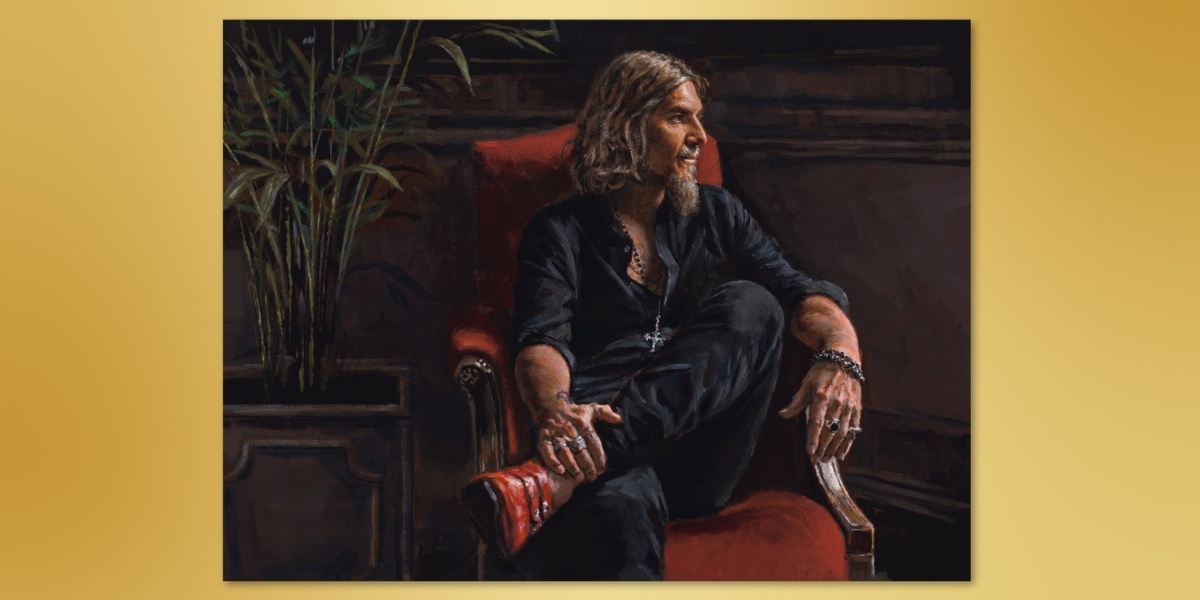
Fabian Perez, the Buenos Aires–born, Los Angeles–based painter behind what he terms Neo-Emotionalism, has translated a cinematic, figure-driven style into a disciplined international practice spanning paintings, sculpture, and published books. He described Neo-Emotionalism as something painters feel before they can name it, ultimately leading to a feeling of liberation from what they created. His style has laid the foundation for pieces built from light, gesture, and the tension of a moment held at the edge of speech, creating an almost tangible atmosphere that invites viewers to engage with the emotional nuances.
Origins and Signature
Perez was born in 1967 in Buenos Aires and raised in Campana, where his schoolteacher mother encouraged his early drawing, while his father’s nightlife businesses left an imprint on him that later influenced the noir atmosphere that has come to define his work. After losing both parents as a teenager, he pursued martial arts for discipline, teaching karate while traveling through Brazil and following his master, Oscar Higa, to Italy, where he began exhibiting in Padova, supporting himself through painting and instruction.
He later relocated to Japan, where the calligraphic discipline of Shodo further sharpened his emphasis on precise, committed brushwork and influenced a hybrid of figurative clarity and gestural economy, enriching his approach to visual storytelling.
Eventually, he consolidated his studio practice in Los Angeles, which brought rhythm to production and clarity to presentation. He typically frames the work’s narrative intimacy as a function of what the scene withholds as much as what it shows, highlighting the emotional tension between the subject and the viewer.
In books and exhibitions, the style consistently presents itself as noir-tinged figurative tableaux—tango, flamenco, and nightlife—rendered with chiaroscuro and poised gestures to privilege felt experience over exposition, encouraging the audience to feel as much as see the depth of the moment.
Perez has described Neo‑Emotionalism as a language that travels across media without losing coherence. In his biography, he explains, “The creator and the creation need to match. Art shouldn’t be considered by its meaning but for what it expresses.” He emulated this in every artwork he touched, ensuring that each piece spoke with authenticity and resonated deeply with its audience.
This cross‑format continuity helps galleries showcase multiple touchpoints without diluting identity, reinforcing a brand of figurative intimacy that audiences are likely to recognize at a glance, creating a powerful visual signature across multiple platforms.
Credibility and Global Footprint
Third‑party validation has played a role in helping anchor demand beyond regional circuits. Public materials document Perez’s role as the official artist for the 10th Annual Latin Grammy Awards, his association with the 2012 Summer Olympics in London, and a Vatican-related portrait presentation featuring Pope Francis, adding an extra layer of international prestige to his portfolio.
Perez’s official account also references commissions and ownership by public figures, including Lionel Messi and Al Pacino, providing social proof that complements commercial programming and highlights the continued growth of his global appeal.
That programming is visible across U.S. and U.K. gallery ecosystems, with recurring exhibitions, signings, and releases. Perez’s emphasis on consistency has helped build trust with his audience and partner galleries, underscoring a measured release rhythm as an operational foundation for his creative exploration, which speaks to the artist’s commitment to maintaining his artistic integrity.
Public rosters and announcements indicate that cadence at work—encompassing originals, editions, sculpture, and books—generally follows a sequence, allowing partners to plan calendars without compromising standards, and providing the artist with the opportunity to explore new mediums while maintaining a steady rhythm.
Now, the near‑term focus is expected to be on measured expansion in established markets with selective international milestones. At this stage, Perez can continue to protect the signature, evolve the story of his craft, and maintain the rhythm of his artistry, which remains crucial for an artist whose work depends on emotional clarity delivered with skill. In a cyclical and competitive market, that mix of recognizability and rigor may help turn a studio voice into an enduring enterprise, as the artist remains dedicated to developing his craft and expanding his influence.