
By: Zach Miller
Introduction
What if your sales rep could work around the clock, never miss a follow-up, and engage with every prospect in a personalized way? Sanjay Bhatia is working toward making that possible. He is a serial entrepreneur, investor, AI visionary, and the founder of Runday.ai, a platform that applies hyper-personalized AI agents to sales teams.
Sanjay has a strong background in data science, business intelligence, and technology innovation. He has created a solution that reimagines traditional sales processes. Runday’s AI agents don’t just automate tasks; they think, respond, and engage in ways that resemble real team members. In this interview, he reflects on his journey, his views on AI, and how these digital agents are changing the way we approach sales.
Sanjay, thank you for joining us today. As the founder of Runday.AI and a seasoned AI entrepreneur with several successful exits, could you share what inspired you to focus on developing AI agents for sales, and how your previous ventures influenced this direction?
Sanjay Bhatia: My last fashion company had planned a significant launch—five stores, a fashion show, and more. However, the pandemic and Omicron led us to scale things back. New restrictions limited how many people could be in a space. While we were still building out locations, only construction workers could be onsite. Normally, we would have all been onsite, handling things together, but this time most stayed at home. Everyone was in different time zones, and coordinating became a challenge. It wasn’t as easy to quickly gather people for a meeting. The launch still went on, but managing everything remotely proved to be far more difficult than we expected.
The scheduling workflows became a significant issue. After the launch, I focused on solving that challenge. We created an AI assistant that auto-CC’d emails, understood context, and booked internal meetings. It gained around 50,000 signups, but it didn’t deliver as much value as we had hoped. After analyzing how users interacted with it, we realized that the key was to get people appointments with potential buyers. That’s where Runday’s current focus lies.
In your Forbes article, “The Role of AI Agents in Transforming Sales Strategies,” you discuss how AI agents can take on tasks traditionally performed by interns or entry-level employees, such as scheduling appointments and making calls. How do you see this shift impacting the structure and efficiency of sales teams in the near future?
Sanjay Bhatia: There was a time when companies had many interns and entry-level staff. I interned at Microsoft, which had a full program back then. However, cities have become less affordable, making unpaid internships much harder. You can’t just work for free at a major firm as easily as before. Demographics also play a role; I’m part of Gen X, a small generation between boomers and millennials. We didn’t have many children, so fewer young people are entering the workforce today. This has led to a decline in the availability of talent for internships and early-career roles.
This is one reason why we built Runday. We wanted AI to handle the tasks that interns once did. We don’t see AI as a co-pilot or a superhuman entity, but as a tireless intern. The issue of “not quitting” matters as well; turnover in roles like IT is now over 100%, with many employees not staying for more than a year. It used to be 20–25%. AI helps fill that gap by offering reliability and speed.
However, these trends aren’t likely to reverse soon. This is why there is high demand for AI in front desks and call centers, particularly for intern-level tasks. But AI alone cannot keep up. While it’s excellent at fast content creation, it lacks originality. Everyone uses the same tools, creating a sort of arms race. This won’t work in the long term. Instead, we believe in uniting human and AI agents in a competitive way, and we’ve seen how this can help many of our customers grow.
Runday.AI emphasizes collaboration between human and AI agents. Could you explain how this partnership enhances customer engagement and what challenges companies might face when integrating AI agents into their existing sales processes?
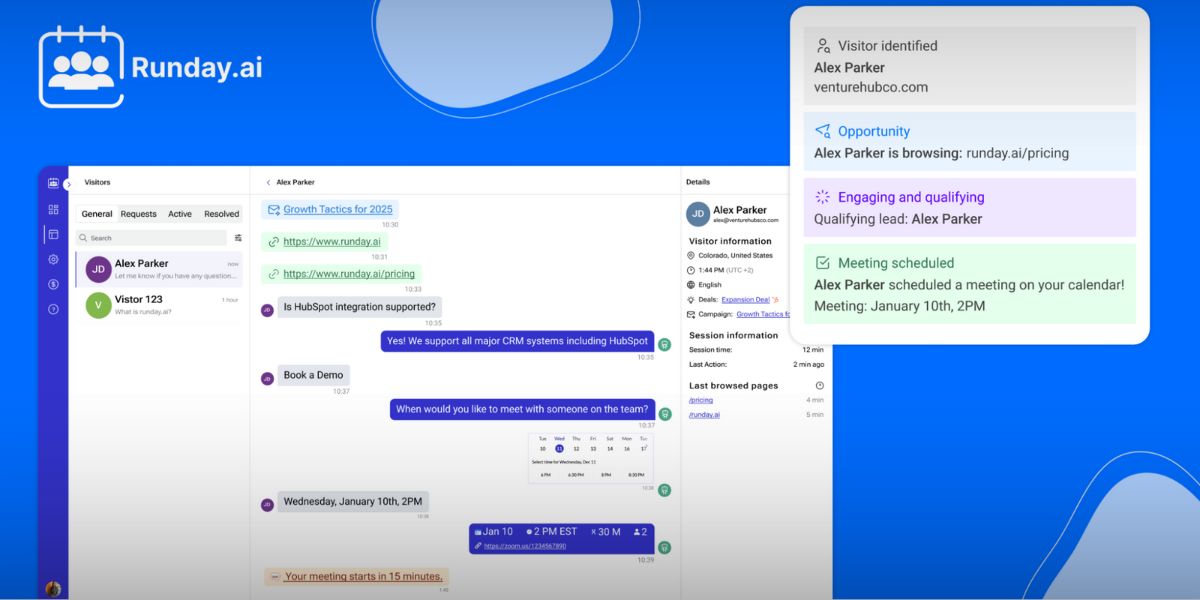
Sanjay Bhatia: The way we’ve implemented this is through a double human-in-the-loop process. The AI runs autonomously, doing most of the work. However, we were the first to market with a unified visitor dashboard that shows everything that has happened with a particular prospect across multiple channels. We provide alerts to both the sales team and our internal team. When something happens, like a question being asked, the AI generates the response automatically and instantly. But we don’t send it right away. We give the customer a chance to review it, tweak the response if needed, and our team will do the same. This double human-in-the-loop approach helps us achieve far more effective results, while 99% of the work is still orchestrated by AI.
The partnership between TapClicks and Runday.AI aims to boost engagement by up to 20 times compared to traditional landing pages and forms. Can you explain how AI sales agents achieve this level of engagement and the measurable benefits businesses have experienced from this integration?
Sanjay Bhatia: Generative AI has dramatically altered how things work. SEO, SEM, and email used to convert predictably, but now that’s no longer the case. People won’t fill out forms or respond to templated outreach. They want answers right away. If someone is using HubSpot, they want to know if your product integrates before providing any personal information.
What drives engagement today is open Q&A. Tap Clicks has mastered this by letting AI answer questions for customers and prospects alike. This transparency builds interest. Sure, some people walk away after receiving an answer that doesn’t meet their needs, but that helps save sales teams time. If you can’t support HubSpot, there’s no point in scheduling a demo. We prefer offering upfront, accurate answers that encourage self-qualification and allow users to naturally move toward booking demos across both inbound and outbound channels.
With AI enabling hyper-personalization in customer interactions, what ethical considerations do you believe companies should keep in mind to ensure that personalization enhances the customer experience without infringing on privacy?
Sanjay Bhatia: In recent years, ethical leaders in AI have made their mark. But as the industry continues to grow and becomes more integrated into national security, the U.S. and China are now engaged in an AI arms race. Governments are increasingly shifting responsibility to companies to act ethically. Data privacy is key. Companies like CloudFlare are giving their customers (like us) more control over what AI can access, allowing users to protect their data and ensure it is used for real value.
Generative engine optimization is replacing SEO. If ChatGPT’s answer highlights your product, that’s immensely valuable. So, companies want to give but also want to control consent. While regulation is still lacking, lawsuits are slowly setting legal precedents. In the U.S. (unlike in Europe or Canada), companies must now define their own ethics policies. These policies are crucial for long-term customer retention base and for creating loyal, engaged customers.
Looking ahead, how do you envision the evolution of AI agents in sales over the next five years, and what advice would you give to businesses looking to stay ahead in this rapidly changing landscape?
Sanjay Bhatia: The media often presents AI as a tool for cutting jobs and reducing costs. But in reality, you’re not the only one using it. Business is competitive, and if AI boosts productivity, others will adopt it too. Reducing your staff from 30 to 15 employees isn’t a long-term success strategy. Growth is the real goal. If AI helps your team do the work of 60 or even 100, you’ll likely hire more, not fewer, to expand faster, increase enterprise value, and boost share price.
Nvidia recently hit a $4 trillion valuation. Valuations, especially private ones, now depend on how well companies use AI to grow, not just cut costs. Any cost-cutting move can easily be replicated. What truly matters is having a growth mindset and using AI to scale, not shrink.
Summary
Sanjay Bhatia views AI not as a threat to jobs but as an extension of human potential. Through Runday.ai, he has created a platform where digital agents handle repetitive tasks, allowing salespeople to focus on relationship-building and closing deals. These AI agents are capable of finding leads, answering questions, qualifying prospects, and scheduling meetings across channels, all while sounding natural and in line with a company’s voice.
In sales, attention spans are short, and timing is critical. Runday’s platform brings structure, consistency, and speed to the sales process. As AI continues to transform how we sell, serve, and scale, Sanjay believes it is wise to master this technology. The future of sales is intelligent, responsive, and always on.
Disclaimer: The views expressed in this article are those of the interviewee, Sanjay Bhatia, and are for informational purposes only. The information provided does not constitute professional advice or endorsements of any products or services. Readers are encouraged to seek professional guidance regarding the implementation of AI technologies in sales and other business practices.