
By: Nataliia Zapara, Internationally Recognized Nail Artist Transforming the Industry Through Art & Business Strategy
The article analyzes the interaction of fashion trends and classic approaches in the field of nail service. The factors that determine the popularity of both ephemeral trends and stable classic manicure styles are studied. The purpose of the work is to identify the criteria for choosing between trends and classics from the point of view of a professional nail master, as well as to determine his role in consulting the client. The theoretical foundations of the formation of fashion cycles in the beauty industry and the practical aspects of implementing various nail designs are considered. The issues of durability, versatility and care requirements for different types of manicure are discussed. The results of the study show that the optimal choice depends on a set of individual client factors and the professional assessment of the master. The practical significance of the work lies in providing nail specialists with an analytical tool for navigating the dynamic field of nail fashion and substantiating recommendations to clients, contributing to improving the quality of services and consumer satisfaction.
The nail service industry represents a dynamically developing segment of the beauty market, where consumers’ aesthetic preferences constantly evolve under the influence of fashion trends. Manicure has long ceased to be solely a hygienic procedure, having transformed into a means of self-expression and an element of individual style [1]. In this context, there is constant interaction between rapidly changing trends and established classical solutions. The relevance of this study is due to the need to systematize knowledge about the nature of these two directions, the factors of their popularity, and the principles of choosing the optimal option for the client. A professional nail technician acts not only as a performer but also as a consultant, whose expertise helps harmonize the client’s wishes with objective possibilities and aesthetic norms. The aim of the article is to conduct a comprehensive analysis of the relationship between trendy and classical approaches in modern manicure, to identify their evaluation criteria, and to determine the role of the nail service specialist in the client’s decision-making process.
The Nature of Trends and the Stability of Classics in the Nail Industry
Fashion trends in manicure, as in other spheres of the beauty and fashion industry, are characterized by cyclicality and a relatively short life cycle. Their emergence is often associated with global fashion shows, the activity of influencers on social networks, and the development of new technologies and materials in the nail industry [2]. Trends may concern specific colors, textures (matte, glossy, velvety, chrome coatings), nail shapes (almond, square, stiletto), as well as specific nail art techniques (e.g., graphics, watercolor painting, 3D elements, “cat eye”). They reflect the spirit of the time and the desire of consumers for novelty and experimentation.
Unlike trends, classical manicure styles possess a high degree of stability and universality. These traditionally include French manicure, solid color coatings in neutral (beige, pale pink) or rich (red, burgundy) shades, as well as minimalist designs. Their popularity is based on aesthetic restraint, elegance, and the ability to harmoniously fit into any look and situation – from everyday to business and evening [3]. Classics form a kind of “aesthetic canon” that remains in demand regardless of fleeting fashion trends.
Technical and Aesthetic Aspects
From the nail technician’s point of view, the implementation of trendy and classical designs requires different approaches and skills. Trend solutions often involve the use of complex techniques, new materials, and tools, which requires the specialist to constantly improve qualifications and master innovations. For example, creating complex nail art using inlay, airbrushing, or volumetric modeling requires not only artistic taste but also high precision of execution. The time spent on such a manicure is usually significantly longer than for classical options.
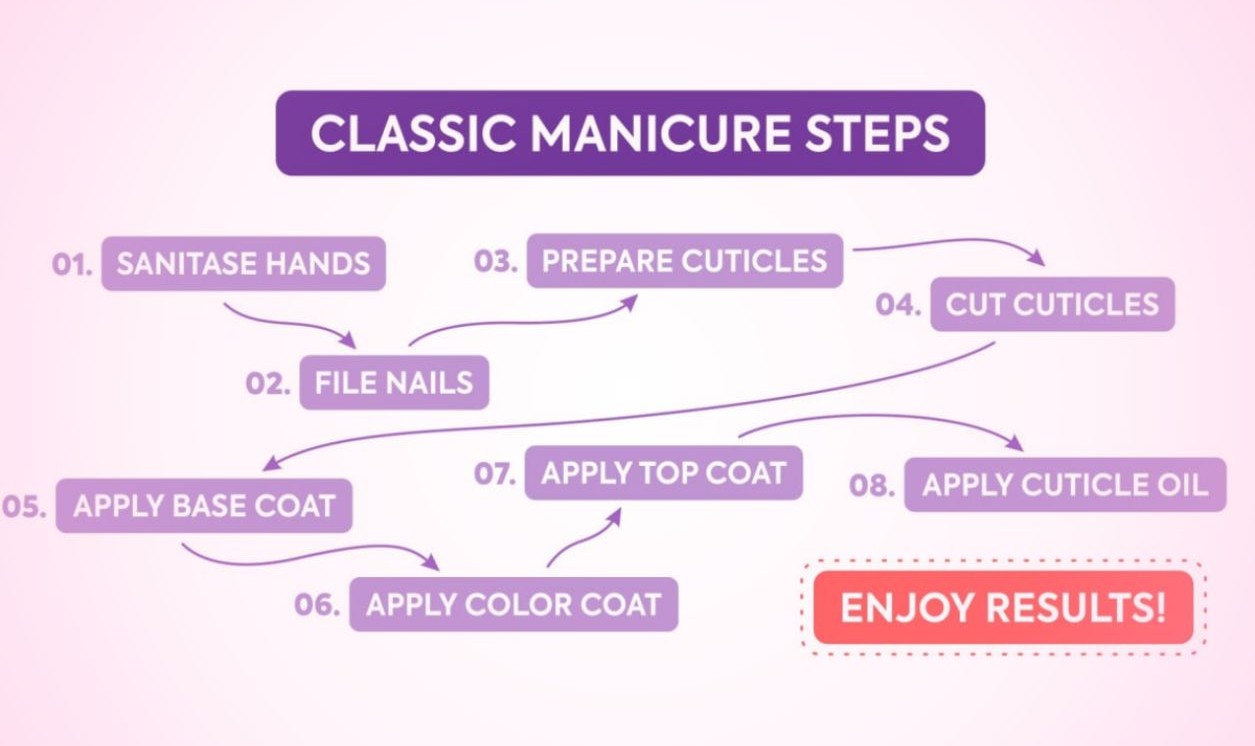
Classical manicure, although it may seem simpler to perform, also imposes high demands on the quality of the technician’s work. Perfectly even coating, impeccable nail shape, and neat cuticle treatment are indispensable attributes of classic manicure. Mistakes and carelessness are more noticeable here than in complex and multi-detailed trendy designs. Thus, the mastery of a specialist is revealed in the ability to perform both ultra-fashionable and canonical types of manicure with high quality.
Analysis of factors influencing the client’s decision and the technician’s recommendations
The choice between trend and classic is a multifactorial process. On the client’s side, significant influence is exerted by:
Individual style and lifestyle: Clients whose style leans towards experimentation and brightness more often choose trendy designs. Those who prefer restraint or have a strict dress code at work tend to choose classics.
Occasion: For special occasions (holidays, parties), clients may prefer bold trends, while for everyday wear – more universal classic options.
Condition of the nails: Some trendy techniques (for example, extreme length extensions) may not be recommended for weakened nails.
Willingness to care and maintain: Complex designs often require more careful handling and timely correction.
The professional nail technician, when consulting the client, takes these factors into account and also adds their expert assessment:
Correspondence of nail shape and length to the client’s hand and finger type: The technician can suggest an adaptation of a trend or classic option to achieve the most harmonious result.
Durability and wearability of the coating: The specialist informs the client about the expected lifespan of the chosen design and the specifics of its maintenance [4].
Technical feasibility: The technician evaluates the possibility of realizing the desired design on the client’s nails, taking into account their characteristics.
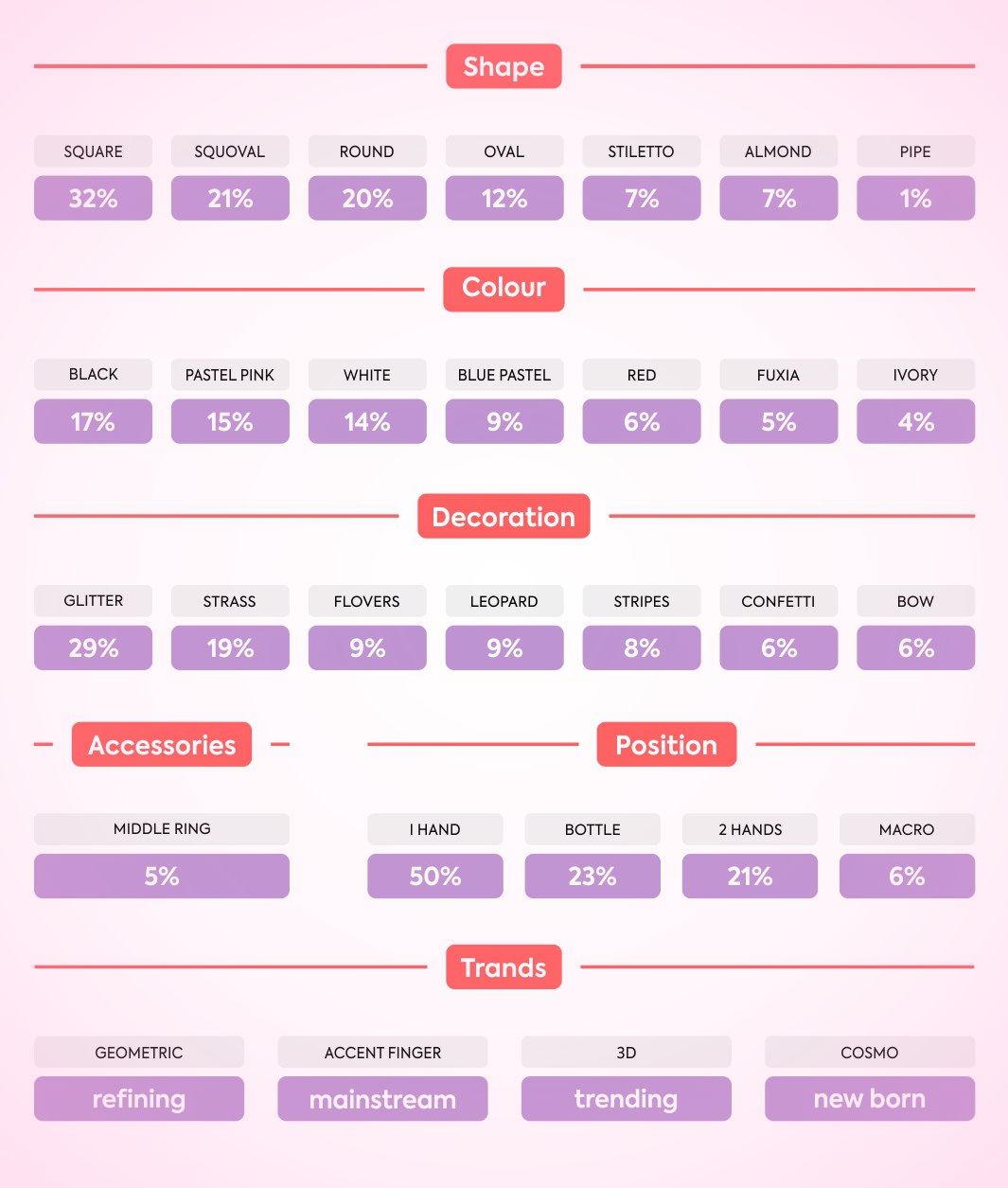
Integration of trends into classics and adaptation of fashion trends
The boundary between trends and classics is not always clear. There is a tendency toward the integration of fashionable elements into classical forms. For example, a classic French manicure can be performed using trendy colors instead of the traditional white or be complemented with minimalist nail art. Solid color coatings can become relevant due to the choice of a trendy shade or texture (for example, a matte finish for classic red).
A highly qualified nail technician is capable of adapting current trends for a specific client, making them more wearable and universal. This may include reducing the number of decorative elements, choosing a more restrained color palette, or changing the scale of the design. Such an approach allows clients to stay in line with fashion without sacrificing comfort and the harmony of their image [4]. The ability to find a balance between current trends and the individual needs of the client is a sign of high professionalism in a technician.
Thus, the analysis of the interaction between trends and classics in manicure shows that both directions occupy an important place in the modern nail industry and meet different consumer demands. Trends provide development dynamics, offer novelty and opportunities for self-expression, while classics guarantee elegance, versatility, and time-tested aesthetics. The choice between them is determined by a combination of factors, including the client’s individual style, lifestyle, nail condition, and specific situation.
The role of a highly qualified nail technician goes beyond simple technical execution. The specialist acts as an expert and consultant, helping the client navigate the variety of options, evaluate their advantages and disadvantages, and adapt the chosen style to individual features.
A professional approach implies not an opposition between trends and classics, but their competent combination and integration, based on a deep understanding of both fashion trends and the fundamental principles of aesthetics and harmony. The technician’s recommendations, supported by knowledge of materials, techniques, and client psychology, contribute to achieving an optimal result that satisfies both the client’s aesthetic requests and practical needs. This analysis can be used by nail specialists to improve their consultation skills and to develop personalized offers, as well as in educational programs for training nail service professionals.
Sources:
Sherrow V. Encyclopedia of Hair: A Cultural History. Westport: Greenwood Press, 2006. 460 p.
Kawamura Y. Fashion-ology: An Introduction to Fashion Studies. Oxford: Berg Publishers, 2005. 198 p.
Peiss K. Hope in a Jar: The Making of America’s Beauty Culture. Philadelphia: University of Pennsylvania Press, 2011. 334 p.
Davis F. Fashion, Culture, and Identity. Chicago: University of Chicago Press, 1992. 233 p.