

Before a seed round, investors typically check whether a startup’s financial statements are accurate, current, and prepared on an accrual basis, and whether the founders can explain their burn rate and runway. In practice, that means reconciled monthly books, revenue that ties to customer contracts, and a simple forecast built on the same numbers.
Early-stage capital is concentrated in a few states. According to Carta, startups based in California collected 52% of all pre-seed capital raised on its platform in Q2 2026, while Texas took a 9% share and passed New York as the second-busiest state. Whether a founder is in Los Angeles, the Bay Area, or Austin, the financial questions in due diligence tend to be the same.
Cash or Accrual: Which Accounting Method Do Investors Expect?
Cash accounting records revenue when money arrives and expenses when they are paid. Accrual accounting records revenue when it is earned and expenses when they are incurred, regardless of when cash moves.
Many startups begin on a cash basis because it is simple. The problem appears when timing matters. A software company that collects a full year’s subscription upfront has not earned that revenue on day one. On a cash basis, that month looks unusually strong and the following eleven look weak. Accrual accounting spreads the revenue across the year and shows the rest as deferred revenue on the balance sheet.
Founders usually switch to accrual when one of these applies:
• Customers prepay for annual contracts or services delivered over time
• The business holds inventory or pays large expenses in advance
• Monthly results swing in ways that do not reflect how the business is actually performing
• Investors, lenders, or a board have asked for accrual-based statements
Switching takes cleanup work, so it is easier to do months before a raise than during one.
When Does GAAP Matter for a Startup?
Generally accepted accounting principles (GAAP) are the US standard for how financial statements are prepared. Seed investors rarely require audited statements, but they often expect books that follow GAAP methods, especially for revenue recognition. The expectation grows at later rounds, when investors, lenders, or acquirers may ask for reviewed or audited financials, and books that were kept loosely can take months to restate.
What Does a Clean Data Room Include?
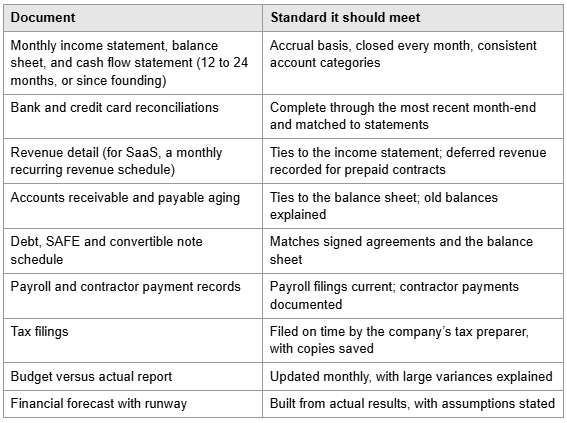
A data room is the shared folder investors use to review a company during due diligence. The finance section should answer the obvious questions before they are asked. The checklist below lists common finance documents and the standard each should meet.
Data-room finance checklist
The cap table belongs in the data room too, but it is usually maintained by the company’s legal counsel or equity management platform rather than its bookkeeper. What matters on the finance side is that equity and note balances on the balance sheet match it.
What Does Basic FP&A Look Like at the Seed Stage?
Financial planning and analysis (FP&A) at the seed stage is simpler than the term suggests. Most investors want to see two things.
The first is a forecast: a 12- to 24-month projection of revenue, headcount, and expenses, built from the company’s actual numbers rather than from a template. The second is runway, which is cash on hand divided by net monthly burn. A startup with $900,000 in the bank and a net burn of $75,000 a month has 12 months of runway.
The forecast is only as reliable as the books underneath it. If monthly closes are late or categories change from month to month, the burn rate will be wrong, and so will the runway. Investors who find a mismatch between the model and the financial statements tend to ask more questions, not fewer.
“Investors are not expecting a seed-stage company to have a finance department. They are expecting the numbers in the deck to match the numbers in the books,” said Ali Zeeshan, Director of Marketing at CoCountant. “Founders who close every month on an accrual basis can answer most diligence questions by sending a report.”
Who Handles This Work Before a Startup Has a CFO?
Most seed-stage companies do not have a CFO, and many do not need one yet. Some hire a part-time bookkeeper and add a fractional finance lead later. Others use an outsourced service that combines bookkeeping with review.
One example is CoCountant, a controller-led bookkeeping service serving startups and small businesses in the United States. Controller-led bookkeeping is a model in which a controller reviews and signs off on every monthly close. The company’s controllers apply GAAP methodology and can move startups from cash to accrual accounting, and its controller-built FP&A packages cover cash flow forecasting, budgeting, and, at the higher tier, data room support. A published case study describes a multi-entity SaaS client receiving its financial statements within 10 workdays of month-end. CoCountant is not a CPA firm and does not perform audits.
The Bottom Line
Investors at the seed stage are not looking for perfect books. They are looking for books they can trust: reconciled every month, kept on an accrual basis when the business calls for it, and consistent with the forecast in the pitch deck. Founders who put that in place before the first meeting spend diligence answering questions about the business, not about the numbers.
Disclaimer: This article is provided for general informational and educational purposes only and does not constitute financial, accounting, investment, tax, legal, or professional advice. Startup fundraising, financial reporting, accounting methods, and investor due diligence requirements can vary depending on the company, industry, transaction, investor, and applicable regulations. Any examples, calculations, projections, or figures provided are illustrative only and should not be relied upon as a prediction or guarantee of actual results. Companies should consult qualified accounting, legal, tax, and financial professionals regarding their specific circumstances before making decisions related to financial reporting, fundraising, or investor due diligence. References to specific companies, services, websites, or resources are provided for informational purposes only and do not constitute an endorsement or guarantee of their services or results.