

By: Seraphina Quinn
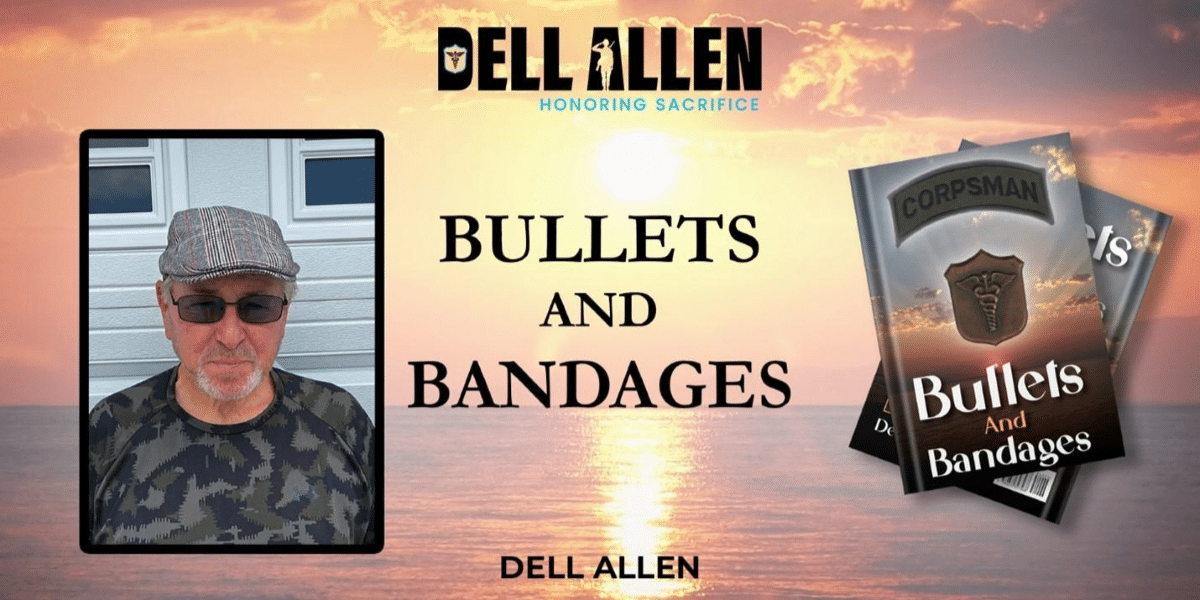
On March 7, 1947, in the peaceful simplicity of rural America, in the middle of Minnesota’s rustic farmlands, Verdell “Dell” Allen was born. But his early years of quiet routine, tending to chickens and milking cows, were merely a precursor to a life that would soon be defined by the turmoil and savagery of war. Beyond just his survival in the Vietnam War, Dell Allen’s story also chronicles his growth from a young farm boy to a competent Navy corpsman and, eventually, to a well-known author whose book “Bullets and Bandages” offers an unbiased look at the harsh reality of combat.
From the Minnesota cornfields to the Vietnam jungles, Allen’s life serves as an example of tenacity, responsibility, and the unbreakable human spirit. His trip, which was filled with terrifying encounters and deep emotional development, has resulted in a literary work that honors the many people who served with him in addition to chronicling his own struggles. “Bullets and Bandages” offers readers an authentic narrative that speaks to both warriors and civilians alike. It is more than just a memoir; it is a visceral portrayal of the enduring impact of war on those who experience it.
Allen was born into a low-income family on a small farm in Minnesota, from where his narrative starts. Dell was greatly influenced by his father, a World War II veteran who lived through terrifying situations in the South Pacific. Even though the family’s primary source of income was farming, Dell was determined to take a different path. The warfare and survival tales from his father sowed the seeds of ambition and a desire for experiences beyond the farm.
Allen realized that he would not be able to evade the draft if the Vietnam War started to intensify. Dell, however, took a different route because of a pledge he made to his father, an infantryman in World War II. In an attempt to avoid the infantry and serve his nation, he enlisted in the Navy. His life would drastically change as a result of this choice, which would eventually lead to his employment as a medical corpsman, a position that would expose him to the harsh realities of combat.
Allen’s military career started in San Diego after he enlisted, where he completed his medical corpsman basic training. Although his early Navy days were very different from the quiet country life he had left behind, the difficulties he encountered only made him more determined. Allen was assigned to Camp Pendleton after completing his training at Balboa Hospital. He worked at the Naval Hospital until he was told to report to Da Nang, Vietnam, to join the First Marine Division.
Allen had never experienced anything like Vietnam. It didn’t take long to see the sharp difference between his upbringing in the country and the devastated areas of Vietnam. His work as a corpsman was demanding and relentless; he had to give medical attention in the terrifying circumstances. Allen’s job required bravery and skill, from tending to injured men on the battlefield to making critical decisions during triage. As Allen struggled to understand the intricacies of battle, grief, and survival, his fortitude was put to the test.
He had one of the scariest encounters of his life on the Ho Chi Minh Trail during an operation the size of a company. After a rocket-propelled grenade struck a Chinook helicopter carrying both wounded and dead soldiers, an otherwise routine mission rapidly turned deadly. Just before the aircraft crashed, Allen managed to get out and save his life, but the experience left him traumatized for the rest of his life.
Many years after Allen returned from his time in Vietnam, the concept of “Bullets and Bandages” emerged. Allen didn’t start taking his experiences as a war diarist seriously until his youngest son asked about one. He had not kept a journal during the war, but he had snapped many pictures with a little Kodak camera, preserving bitter and poignant memories of his duty.
His book was built around these pictures that had been stashed away in a shoebox for many years. The images flooded back, and Allen started writing about each one as he arranged the pictures. Writing was a therapeutic and difficult process that made Allen face the anguish he had been avoiding for so long. However, by using this technique, he was able to create a novel that was both deeply personal and widely applicable, providing readers with an objective viewpoint on the Vietnam War as seen through the eyes of a young corpsman.
More than just a biography, “Bullets and Bandages” is a tribute to the enduring consequences of war and the healing power of narrative. A true account of the experiences that many Vietnam soldiers had, the book conveys the raw emotions and hard realities of life on the front lines.
Allen has made it his mission to tell others about his experience since the release of “Bullets and Bandages,” especially the younger generation, who might not completely comprehend the sacrifices made by those who served in Vietnam. Allen has taken part in a number of educational initiatives through his affiliation with Vietnam Veterans of America. He has given speeches at high schools and community gatherings to shed light on the real costs of war.
One event that stands out in particular was a lecture Allen and other veterans gave at a nearby high school, sharing their experiences with the students. Students listened to his stories closely and answered insightful questions, demonstrating the profound impact of his remarks. Allen made a profound effect by putting a student in full combat gear for his presentation, which showed the mental and physical toll that serving in the military takes.
Allen wants to make sure that the lessons learned from Vietnam are never forgotten. His experience serves as a potent reminder of how important it is to comprehend the past and honor the sacrifices made by soldiers.
Verdell “Dell” Allen, now 77, looks back on a life characterized by resilience, service, and storytelling. The human spirit is exemplified by Allen’s journey, which brought him from humble origins on a Minnesota farm to the front lines of the Vietnam War and, finally, to a peaceful retirement as a retired novelist. His book “Bullets and Bandages” pays enduring tribute to the experiences of those who served by giving readers a glimpse into the horrors of war and its lasting consequences on survivors.
Serving others has been Allen’s legacy, both during his time in the military and in his ongoing attempts to inform and uplift coming generations. His narrative is not only one of survival but also of transformation, showing how even the terrifying circumstances may result in development, recovery, and finally, a more profound comprehension of what it means to serve.
Published By: Aize Perez