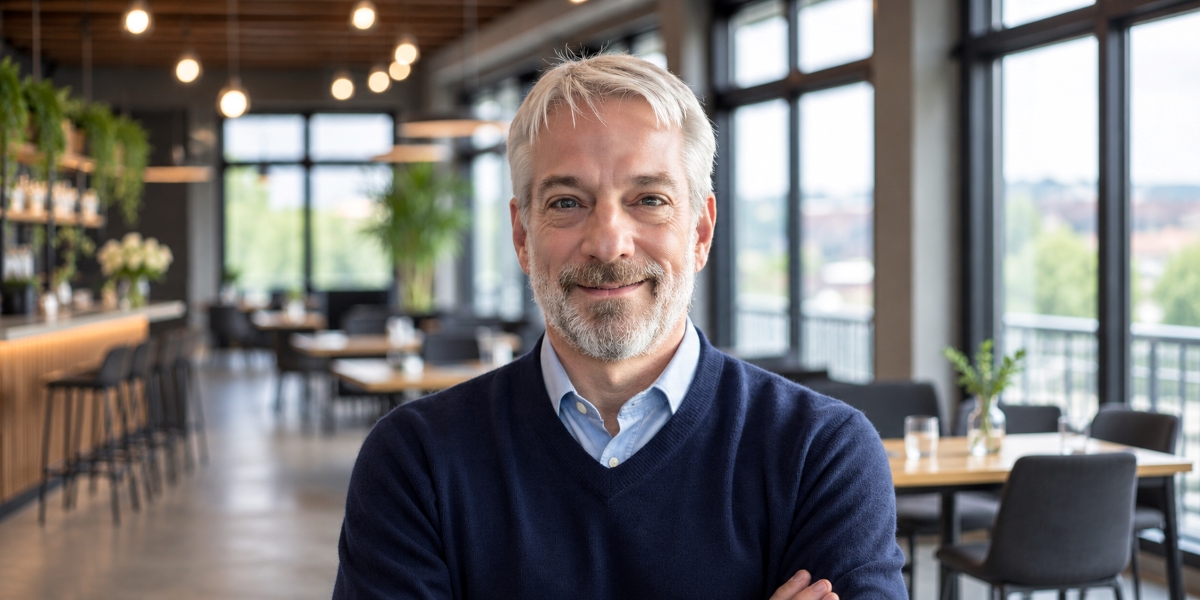

For most people, compost is something that happens quietly at the back of a garden. For Byron Irwin of Ecodrum Composter, it has been a twenty-year pursuit that spans research, product development, manufacturing and daily operation. Along the way, as he puts it, his team has made a tremendous amount of compost and learned a few things.
Starting with the hard problems
Many people in the industry begin with yard trimmings or kitchen scraps. Byron’s work began with some of the most demanding feedstocks there are: manure, poultry and livestock mortality, and aquaculture waste. These materials leave little room for error. Moisture, carbon sources, temperature, aeration, residence time and biosecurity all have to be right, or the result is odor, pests or compost that fails to meet its purpose.
That experience became the foundation for everything that followed. Once the technology proved itself on difficult materials, it was applied to food waste and community-scale organics. Every new feedstock raised fresh questions, and each question led to more testing.
Working with biology, not against it
What sets Byron’s approach apart is a simple philosophy: the goal is never to change the natural biological process. It is to create conditions that let that process work more predictably and efficiently. His team has tested drum rotation, material movement, airflow direction and rate, control systems, composting recipes, and the use of finished compost as an ingredient. Some ideas worked. Others had to be redesigned, and Byron is refreshingly open about that.
That honesty runs through his technical writing. He reminds readers that an enclosed vessel is not an automatic assurance of good compost, because the biology still depends on oxygen, a suitable recipe, moisture, porosity and time. Equipment, in his view, should support those requirements without making an operation needlessly complicated.
Recognized by peers
Byron’s credibility extends beyond his own shop. Mark Hutchinson, Emeritus Extension Professor at the University of Maine Cooperative Extension, has known him since 2008 and says Byron’s understanding of airflow management, recipe formulation, moisture and carbon-to-nitrogen balance, and biosecurity reflects years of hands-on experience and field evaluation.
Hutchinson also points to what distinguishes Byron: the ability to connect the science of composting with practical agricultural reality. That bridge between laboratory and farm is exactly where many technologies stumble.
Still learning
After two decades, Byron is quick to say the work is not finished. He is currently investigating new materials and formulations, documenting field observations, and working toward reproducible technical findings. He separates verified results from field observations and design goals, a discipline that is rare in a market full of bold claims.
For farmers, processors and communities looking for a partner who has learned by doing, Byron Irwin offers something valuable: real experience, candid lessons and a commitment to keep improving. His motto says it plainly: changing the world, one community at a time.