
By: KeyCrew Media
Mainland investors evaluating a Hawaii project generally price the land correctly, the construction correctly, and the exit correctly. The variable they get wrong is how long it all takes.
A typical mainland assumption puts permitting at six to nine months. In Hawaii, permits alone commonly run eighteen to thirty-six months, and entitlements are a separate process that can take years on top. That gap, applied to a carry cost, is frequently the difference between a deal that works and one that does not.
Two Processes, Often Conflated
The distinction that causes the most trouble is between entitlements and permits, because mainland investors frequently treat them as one step.
Entitlements are the right to build what you intend to build. Where a project fits within existing zoning, that right already exists. Where it does not, approval has to be negotiated.
“Entitlements are the right to build and improve what they’re looking to do,” says Mike Perkins of The Bratton Team at Colliers International Hawaii. In Hawaii, housing projects frequently run through a 201H process, which functions as spot zoning and involves negotiation with the city council over height, density, and use beyond what zoning permits by right.
That negotiation is subjective by design, often turning on what public benefit a developer can offer in exchange. It can be highly effective. It is also, by its nature, not a process with a predictable completion date.
Permits are the separate step that follows: the technical approvals required to begin construction.
Where The Time Actually Goes
The permitting sequence is itself longer than the headline figures suggest, and it is the structure of the process rather than any single stage that consumes the schedule.
A project moves through due diligence, design, a pre-application meeting, submittal, rounds of agency comments and corrections, issuance, and contractor mobilization. Most of the elapsed time sits in the back-and-forth within each stage, and in queue time at the agencies.
“The slowest agency is going to be your longest hurdle,” Perkins says. Commercial projects are exposed to more of them than residential, touching traffic, wastewater and other disciplines that each require specialist review. The figures reflect it: residential permits in Honolulu have averaged around 218 days from application to issuance this year, while commercial has averaged 469.
What kills projects is rarely a single refusal. It is the correction cycle, repeated. A development underwritten on eighteen to twenty-four months that takes three or four years accumulates carry cost and capital cost until the economics no longer hold.
What To Put In The Model
Asked what he would actually underwrite for a commercial redevelopment today, Perkins gives a direct figure: eighteen to twenty-four months for permits.
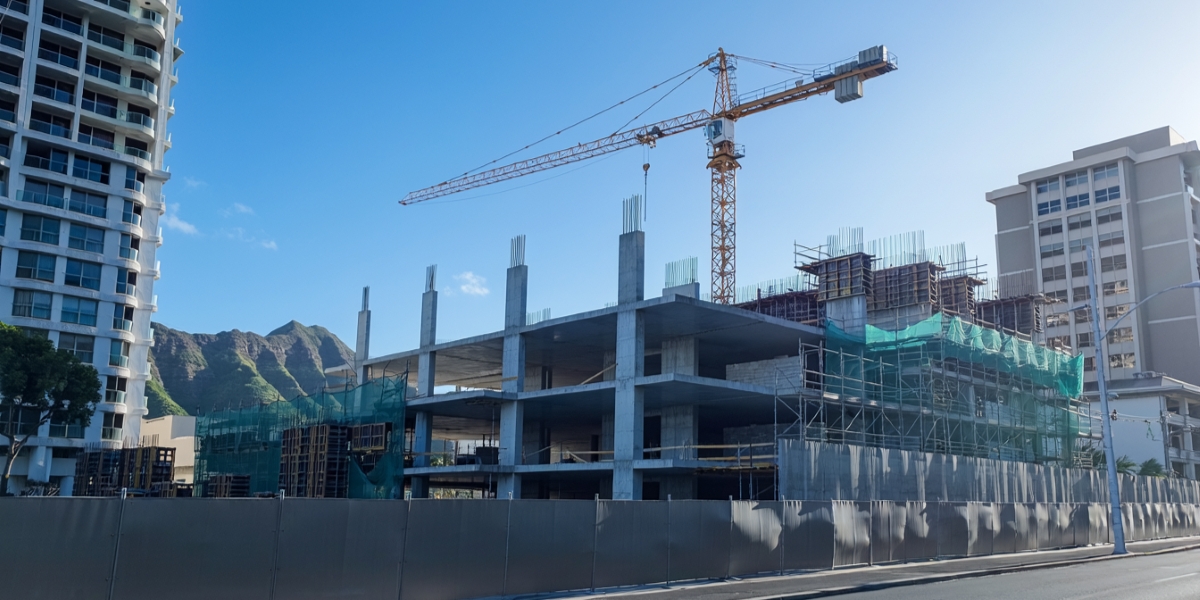
Beyond that, his schedules run by project type. Cosmetic value-add work that does not trigger major permits takes six to twelve months. Renovation requiring commercial permits runs two to three years from closing to stabilized income. Ground-up development is realistically three to five years.
Several carry costs sit alongside that timeline and are routinely omitted from mainland models. Hawaii’s general excise tax applies to construction and services. Insurance costs have risen. A vacant property has to be maintained and secured throughout. Property taxes, by contrast, remain low relative to mainland equivalents, which offsets part of the burden.
One practical tactic Perkins notes is separating the grading permit from the main package, which allows site work to begin while the balance of the approvals proceeds.
Structuring Around A Timeline You Cannot Control
The advice Perkins gives investors whose returns depend on a schedule outside their control is to change the structure rather than the forecast.
Several mechanisms achieve that. Buying an asset with income already in place offsets carry during the approval period. Seller financing, longer escrows, and option agreements shift the timing risk. Master lease structures allow a buyer to take control and begin improvements or entitlement work while closing later, on permits or on stabilization.
These take longer to complete than a conventional sale. They also, in Perkins’s experience, deliver the best outcome to both sides: a seller achieves a higher price for providing the time, and a buyer carries materially less risk.
What Separates The Investors Who Do Well
The pattern Perkins identifies among successful off-island investors is consistent and begins before acquisition.
They hire local early. Architects, expediters, contractors, people who know the agencies and how they work. And having hired them, they take the advice.
The investors who struggle are those who apply a mainland playbook unchanged and expect the local process to behave the same way. It does not, and the cost of learning that during a project is far higher than the cost of local counsel at the outset.
Where The Opportunity Sits
Hawaii is a low-leverage market, which means the distress pattern familiar from mainland cycles is largely absent. Loan-driven forced sales are uncommon here.
The openings are elsewhere, and Perkins identifies three. Development projects that have been in process for years, where a developer has absorbed the timeline and is ready to transfer the position. A modest increase in note sales. And, most significantly, family-held properties that are under-managed or under-capitalized, where owners would benefit from a partner but have not sought one.
That last category suits a structured approach: capital at closing, with an additional tranche once the asset is stabilized. It aligns both parties around the same outcome and does not depend on a distressed seller.
Perkins’s broader view is that repricing is underway and will free up activity rather than suppress it, as sellers adjust to current values and projects complete. Construction talent currently committed to tower work and Maui reconstruction will become available, which should ease cost pressure. And the fundamentals that make Hawaii scarce and desirable are unchanged. Recently closed transactions and current inventory give a running picture of where that is heading.
About the Expert: Mike Perkins (S) is Associate Vice President with The Bratton Team at Colliers International Hawaii in Honolulu, specializing in development and income-producing commercial assets.
The Bratton Team is a Hawaii commercial real estate and investment sales group, exclusively contracted to Colliers International HI, LLC. Led by Mark D. Bratton (R) CCIM and Mike Perkins (S), the team has advised buyers and sellers across all Hawaii asset classes for 40 years.
Disclaimer: This article is based on information provided by the expert source cited above. It is intended for general informational purposes only and does not constitute legal, financial, or real estate advice. Readers should conduct their own research and consult qualified professionals before making any real estate or financial decisions.