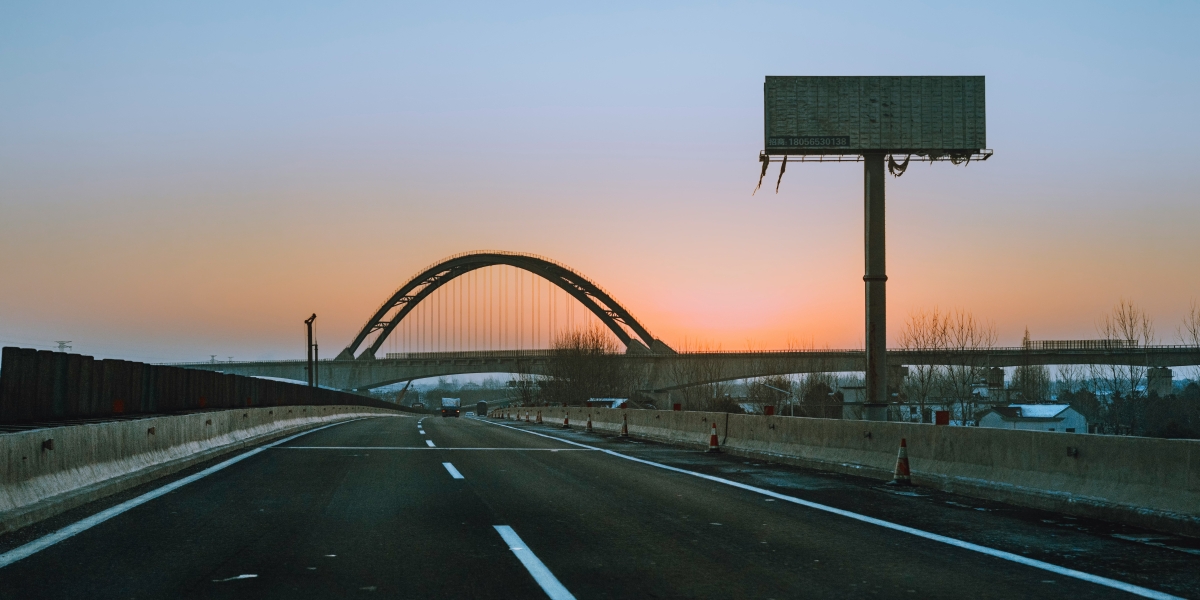

Before you sign a six-figure contract for Out-of-Home (OOH) space on I-95, you need to understand the harsh neuroscience of the passing driver. You have 3 seconds. If your Call-to-Action (CTA) is a random string of digits, you might as well be burning your budget.
The allure of the highway billboard remains undefeated. It’s massive, unskippable, and signals market dominance. But as we enter the back half of 2026, too many SMBs and scaling startups are treating a billboard purchase like a logo-slapping exercise, ignoring the single most critical variable in converting a 70 mph glance into a pipeline: the cognitive load of the phone number.
The data is in. The Out-of-Home Advertising Association (OAAA) reports that “direct response” now accounts for a significant portion of OOH spend, driven by mobile attribution. But here is the catch. Your billboard is physical, but the response is delayed. The user is driving. They can’t click. They have to remember.
The Brutal Neuroscience of a 3-Second Glance
If you are a founder or a CMO, stop thinking of a phone number as a utility and start thinking of it as a data compression problem.
The human brain, according to foundational research by Miller (1956) and refined by Cowan (2001), holds about four chunks of information in working memory. A random ten-digit number, say (305) 481-7392, is technically three chunks (area code, exchange, suffix). That seems fine until you introduce interference.
The Peterson & Peterson (1959) study on short-term retention established the terrifying “decay curve.” If a subject is not allowed to rehearse information (which is impossible while driving), recall of trigrams dropped to roughly 10% after 18 seconds.
What does this mean for your billboard? A driver who glances at your board at Mile Marker 40 has forgotten your random number by Mile Marker 41. By the time they arrive at their destination, often 10 to 30 minutes later, they’ve forgotten it.
The Memorable Number Advantage
We model this for our clients at Grasshopper. Let’s compare two billboards. One uses a random local number. The other uses a structured pattern (e.g., 305-444-0000) or a phoneword (e.g., 1-800-PAINTER).
Our internal modeling, drawn from standard advertising funnel metrics, points to a stark difference in retention across the three formats. A random local number tends to stick with only a tiny fraction of drivers after a few minutes. A patterned numeric sequence performs meaningfully better. A phoneword performs best of all.
This is not a small, linear improvement. The gap between a forgettable number and a memorable one is large. The phoneword draws on the “Levels of Processing” theory (Craik & Lockhart), attaching semantic meaning to the digits and making the number far harder to overwrite.
Why You Need to Own the Number (A Cautionary Tale)
Before you put a number on a physical structure, make sure you control the digital routing. Most “vanity number providers” are marketplaces that lease numbers. This is a trap.
Imagine you lease 1-800-ROOFING for $500/month. You spend $200,000 painting it on billboards across three states. Your contract renews, and the provider decides to charge $2,000/month. If you refuse, you lose the number. You have to wrap your trucks, repaint your signs, and re-educate your customers.
At Grasshopper, the technical guidance is always to be the Subscriber of Record. You want portability. You want the number to be an asset on your balance sheet, not a liability in your vendor stack. If you can’t port it away, you don’t own it. You are renting your own brand.
When Is a Premium Number Worth the Cost?
Premium numbers cost money. But “expensive” is relative to your Customer Lifetime Value (LTV).
The core principle is straightforward. A more memorable number gives more drivers a real chance to recall and dial it later, which can lift the share of impressions that turn into calls. How much lift you see depends heavily on your vertical, your creative, and your market.
In a high-value vertical like personal injury law, where a single client can be worth many thousands of dollars, even a modest gain in call volume can more than justify the cost of owning a premium number. If you are selling $50 t-shirts, spending $20,000 on a number rarely makes sense. A cheaper, semi-patterned number that’s easy to parse at a glance is the better fit.
Where to Buy the Billboard Space
Now that you have the right number, where do you put it? The OOH buying market has fragmented into three distinct tiers, depending on your goal.
The “Enterprise” Route (National Networks)
If your goal is brand saturation and you have a budget north of $100,000 per month, you are buying from the “Big Three,” meaning Lamar Advertising, Clear Channel Outdoor (CCO), and Outfront Media. These players own most premium interstate bulletins and digital networks. They offer rigorous audience metrics through Geopath, the industry’s audience measurement body. Expect CPMs (Cost Per Thousand Impressions) in the range of $2 to $8 for static and $10 to $25 for digital spectaculars. Each operator publishes audience data you can line up side by side when comparing proposals. They also offer self-serve platforms, such as CCO’s Radar, though a specialized agency can help you work through their premium inventory.
The “Agile” Route (Programmatic OOH)
For growth-stage companies that want to test, pivot, and iterate, programmatic DOOH (pDOOH) is a good option. Platforms such as AdQuick, Blip, BillboardMax and Billups offer varying combinations of targeting, scheduling and campaign controls. The trade-off can be inventory quality, as some programmatic campaigns rely on remnant or off-peak placements. However, the format offers considerable flexibility for A/B testing creative elements, including different phone numbers. Some providers aggregate placements from multiple billboard operators, which can affect pricing and availability, so advertisers may benefit from requesting and comparing multiple quotes before committing.
The “Local” Route (Direct to Landowner)
For a local dentist or HVAC provider, the best ROI is often to skip the middleman and call the number on the back of the billboard structure itself. Local landowners often lease directly at a significant discount compared to national operators. This is where you find the “unsold” static vinyls or lower-traffic digital screens. A static bulletin in a Tier 2 city on a highway might cost $1,500 to $4,000 per month direct, versus double that through a larger aggregator. You lose the sophisticated analytics, but if you are using a call tracking system, such as the IVR routing features built into Grasshopper, you can measure how well the board performs without the middleman’s dashboard.
Don’t let the billboard salesman sell you “visibility.” That is vanity. The goal is retention. You are not advertising to a driver. You are advertising to the memory of a person who will only need your service hours or days later.
Choose a number that chunks easily, never lease what you can own, and route the calls intelligently. If you work through the cognitive load before you work through the CPM, you put yourself in a far stronger position to turn a fleeting glance into a phone call.
Christine Viera, Digital Marketing Manager at Grasshopper, the virtual phone system designed for entrepreneurs. Viera has spent a decade analyzing call data for small and medium businesses.