
By: Rena Marie
Before there were murals, there was a courtroom track laid out for her at birth. Nancy Illman, who now runs the mural studio Magic Wand Murals, is a Harvard graduate who went on to law school, the kind of resume that was supposed to end in a corner office, not a scaffold and a paint tray. It didn’t work out that way, and three decades later, that detour is a big part of why her murals look the way they do.
A Harvard Path That Led Somewhere Else
Illman’s academic record reads as if it were built for someone else’s life. She earned her AB with honors from Harvard in English and American Language and Literature, while also studying art history, and then went on to Fordham Law, where her instincts as an artist kept surfacing. During law school, she painted an allegorical piece called “Naked Restraints of Trade” and published it in the Cardozo Law School Intellectual Property Journal, a detail that says as much about her as any credential on a wall. It is the kind of fact that makes it clear this was never someone dabbling in art on the side. It was someone who kept finding her way back to a paintbrush, no matter which professional track she was supposed to be on.
She eventually left the law behind entirely. What she built instead is Magic Wand Murals, a mural practice she has now run for well over three decades, by her own account, working across homes, schools, and public spaces.
Three Decades Behind The Brush
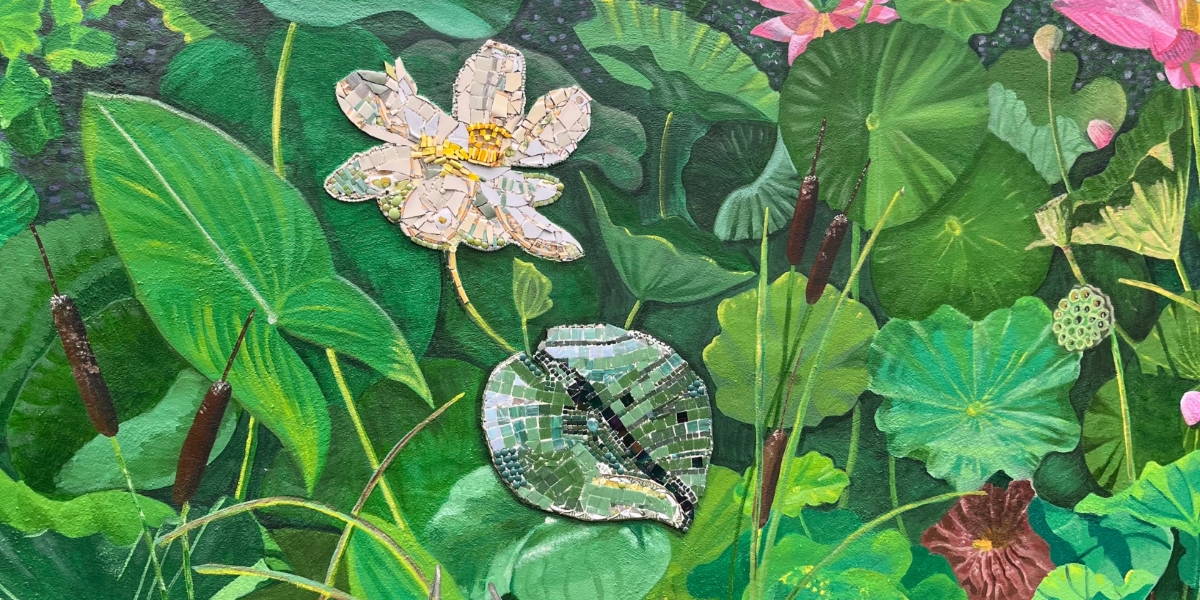
Illman trained in decorative painting at the Parsons School of Design in New York, and that training shows in how far she has taken the medium since then. She is, first and foremost, a mural artist. Most of her work goes up on walls, though her brush has also found its way to ceilings, fences, floors, and stairs. When clients express interest, she’ll fold mosaic elements, what she calls tesserae, into the piece alongside her paint: vintage abalone buttons, pieces of mirror, sequins, jewelry, or champagne caps, worked into the surface rather than standing in for it.
That range is on full display in a project she’s returning to Connecticut to complete: a deep blue ceiling in a music room, painted with constellations and accented with crystals and gold leaf worked into the mixed-media surface, an homage to the grand concourse ceiling at New York’s Grand Central Terminal. It’s less a departure from muralism than a sense of how far she’ll take a wall, or a ceiling, when a room calls for it.
Her process is not a fixed formula. Some clients want her deep in their homes for days, studying the furniture they already love, asking about their ancestry, their travel, their collections. Others send her on a joint outing to a favorite museum or garden before she starts. Some simply tell her to do whatever moves her and wait for the reveal. And some arrive with a Pinterest board crammed with references, leaving her to compose a coherent piece from everything they have collected. She treats all four as legitimate ways to start a commission with Magic Wand Murals, rather than as compromises on a single ideal method.
A Body Of Work Outpacing Its Own Recognition
By her own account, Illman has completed 27 privately funded public murals in her current city alone, in addition to the residential commissions that make up the bulk of her practice. Since her childhood on Long Island, she has lived in New York City, Ohio, Michigan, and Maryland, and she’s painted murals in Connecticut for a longtime friend from law school, work that’s now bringing her back to finish the constellation ceiling. She has also visited more than a dozen countries, from museum collections in Athens, Vienna, and Prague to ancient ruins in Mexico and Pompeii. By her own description, that travel was not a vacation habit so much as a research habit, museum by museum, collection by collection, and it shows up later in the scenes and details she paints for clients.
The Magic Wand Murals homepage features testimonials that support the scale of that output. Max Meyers, who grew up with one of her murals, describes it as leaving him feeling “immersed in one of my favorite environments on earth.” Another client, Ivana Adler, says she has witnessed many of Illman’s murals over the years and points to the attention to detail and love put into each one.
“The quality is unparalleled. There’s no one doing what I do. It’s fine art, but larger,” Illman said of her own work.
She has also written a memoir, “Instigator of Joy: Becoming My Own Fairy Godmother,” about choosing an artistic identity over the more conventional path her parents had in mind for her, a theme that closely aligns with her own account of leaving law behind for good.
What Illman is describing, across the training, the materials, and the decades, is what Magic Wand Murals has become: a practice built on depth rather than novelty. The credentials are real, the client list is real, and the work speaks for itself, one wall at a time.