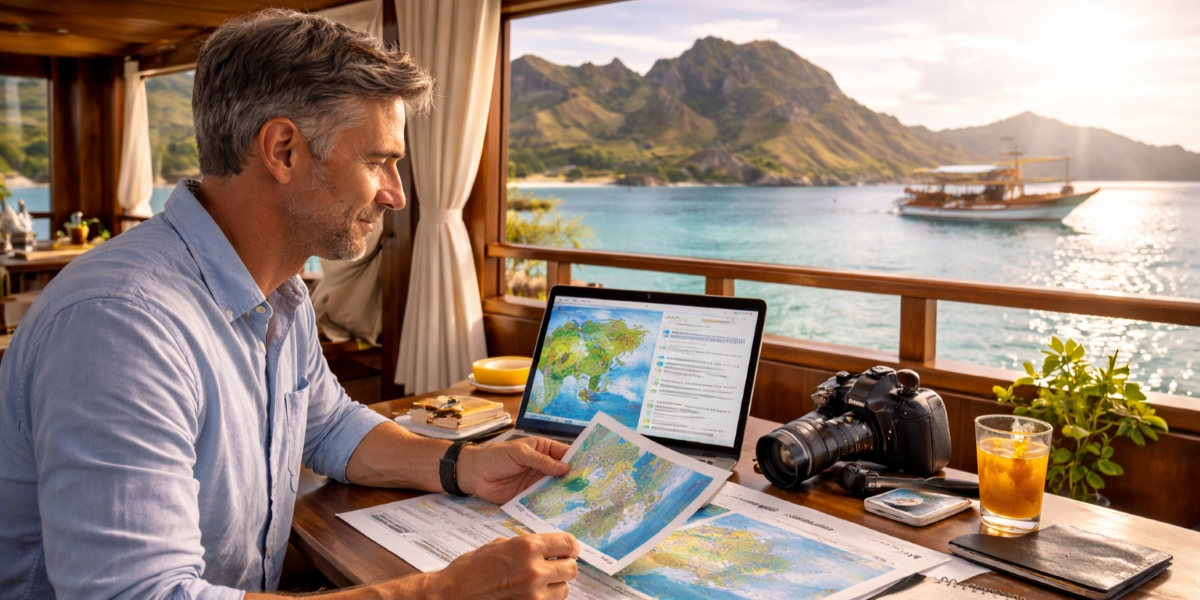


If you’re using a broad Komodo planning hub such as komodoresort.com as your starting point, the most consequential early decision is to choose a Komodo liveaboard route that matches your travellers’ appetite for adventure, your tolerance for operational variability, and the realities of seasonal sea conditions.
Komodo is a case study in experience-led travel where the “product” is delivered through logistics: ports, permits, boats, weather windows, and crew competence. If you’ve ever run a small hotel at high occupancy with staffing constraints, you already understand the principle: the guest remembers the experience, but the experience is made (or broken) by operational design.
Why “Route” Matters More Than Boat
Many travellers start by asking about the vessel: cabin comfort, photos, and amenities. That’s understandable, but it’s not the first-order decision. Route determines your exposure to three factors that materially affect satisfaction:
1) Time allocation. Some itineraries maximise water time, others emphasise land excursions, and others split the difference. If a guest’s dream is Komodo Island diving, the route has to prioritise the right sites and realistic surface intervals rather than trying to “see everything” in a rushed loop.
2) Sea-state risk. Komodo’s beauty comes with strong currents and open-water crossings. A route that looks excellent on paper can be uncomfortable or unsafe if it forces long crossings during the wrong seasonal conditions. CEOs should think in terms of “schedule resilience”: what happens when conditions change?
3) The experience expectation. If your guest’s mental image is an iconic stop like Komodo Island pink beach, the route must include it at a time of day that makes sense, with a workable Plan B if conditions or access constraints shift.
In short, a boat is the container. The route is the strategy.
A CEO’s Decision Lens: Define the Guest Profile First
In hospitality, misalignment between expectation and delivery is the fastest way to negative reviews. Komodo itineraries are particularly exposed to this risk because guests arrive with high expectations and limited context.
Before you compare itineraries, define which of these profiles you’re serving (even if you’re only “advising” friends, VIPs, or repeat hotel guests):
The Experience Seeker
Wants the headline moments: dragons, dramatic islands, photo stops, and a story to tell. This guest will love Pink Beach, viewpoints, and short snorkels, so long as the schedule is not exhausting.
The Diver
Wants structured days, safety discipline, and flexibility around conditions. For this traveller, “more sites” is not always better than “better sites at the right time.” A good diving route feels purposeful, not frantic.
The Mixed Group
A common reality: a couple where one person dives, and the other prefers snorkelling and scenery. The ideal routes for mixed groups avoid relentless early starts, include stable rest periods, and offer non-diver value beyond “waiting on the boat.”
A CEO approach is simply to reduce variance: match the product to the customer, not the other way around.
Route Types in Plain Language
You will see many route names, but many fall into a few functional categories. Understanding these helps you filter options quickly without getting dragged into marketing language.
One-and-Done Day-Hopper Routes
These focus on a limited set of highlights within a tight time window. They suit travellers with constrained time, but they can feel rushed, especially if sea conditions slow transfers.
Two- to Three-Night “Balanced” Loops
This is often the sweet spot for first-timers: enough time for key park experiences, enough buffer for weather variability, and enough rest to actually enjoy the journey.
Dive-Forward Itineraries
These are built around dive windows and conditions rather than sightseeing checklists. For Komodo Island diving, this category is usually the most satisfying, assuming the operator’s safety culture is strong.
For CEOs, the logic is familiar: the effective operating model is the one designed around the core use case, not one that tries to serve everyone equally.
The Operational Due Diligence That Prevents Unpleasant Surprises
In small hotels, you don’t judge a partner by their brochure; you judge them by their processes. Liveaboards are no different. The traveller-facing experience rests on behind-the-scenes discipline.
Safety Culture Signals
Without becoming technical, travellers can still ask smart questions:
- How do they adjust the day if currents are stronger than expected?
- What does a typical briefing look like (and is it consistent)?
- How do they handle guest limits per guide in the water?
- What is their approach to “we can’t do that site today”?
Excellent operators describe constraints calmly. Overconfident operators over-promise.
Maintenance and Reliability Discipline
A liveaboard is a moving hotel. The equivalent of your preventive maintenance plan is their engine readiness, tender reliability, and onboard systems discipline. A route is only as good as its ability to run on time.
Food and Fatigue Management
This sounds minor until it isn’t. If the route stacks multiple early mornings with long crossings and minimal downtime, guest fatigue becomes the hidden risk. Fatigue reduces enjoyment and increases risk exposure, especially for divers.
A CEO’s instinct here should be to protect recovery time. Rest is part of the product.
How to Think About Pink Beach and Recommended Stops
Many Komodo itineraries market a checklist of famous stops. The CEO’s mindset is to treat “essential” items as variables rather than certainties.
For example, Komodo Island’s pink beach is iconic, but the quality of that stop depends on timing, crowding, and conditions. A well-designed route does two things:
- It integrates the stop naturally (not as a rushed drive-by).
- It has an alternative value proposition if the stop is compromised (another beach, another snorkel site, or a scenic island walk).
That’s the same principle you apply in a hotel during disruptions: you protect the guest’s emotional outcome, even when the original plan changes.
The “Resilience Rule”: Build Slack Into the Itinerary
Komodo is not an urban destination with predictable transit. Sea conditions, port congestion, and operational constraints can shift the day.
A resilient itinerary usually includes:
- at least one flexible time block that can move
- a route that doesn’t rely on a single “perfect” day
- an operator willing to change plans without turning it into drama
From a CEO standpoint, Slack is not inefficient; it is risk control.
What Small-Hotel CEOs Can Learn From Komodo Operators
Komodo is a useful mirror for hospitality leadership because it compresses the guest experience into a short, high-stakes window. You see very quickly what matters:
Expectation management beats apologising later. Memorable experiences are built on clear communication from the start, not reactive explanations after disappointment.
Consistency beats charisma. A charismatic crew can’t compensate for chaotic scheduling. In hotels, it’s the same: personality is a multiplier, not a foundation.
Systems protect service. When the operation is organised, staff can be genuinely warm. When the operation is messy, staff become transactional under stress.
A Simple CEO Checklist for Choosing a Komodo Route
If you want a practical filter, use this:
- Does the route match the guest profile (experience seeker, diver, mixed group)?
- Does it allow adjustments without collapsing the whole plan?
- Are “must-do” stops positioned as part of a coherent day, not a rushed list?
- Is fatigue managed through pacing and downtime?
- Does the operator speak clearly about constraints, safety, and Plan B options?
If most answers are “yes,” you’re likely looking at a route that meets expectations.
Bottom Line
A Komodo liveaboard can be one of the most memorable travel experiences your guests will ever have, but only when the route is designed with realism: seasonal awareness, operational resilience, and a clear understanding of what travellers actually value. Treat route selection the way you’d treat a major service redesign at your hotel: define the guest expectation, build slack into it, choose partners with disciplined operations, and protect the outcome even when conditions change.
That is how Komodo becomes a CEO-grade experience: high impact, well-managed, and genuinely worth the journey.