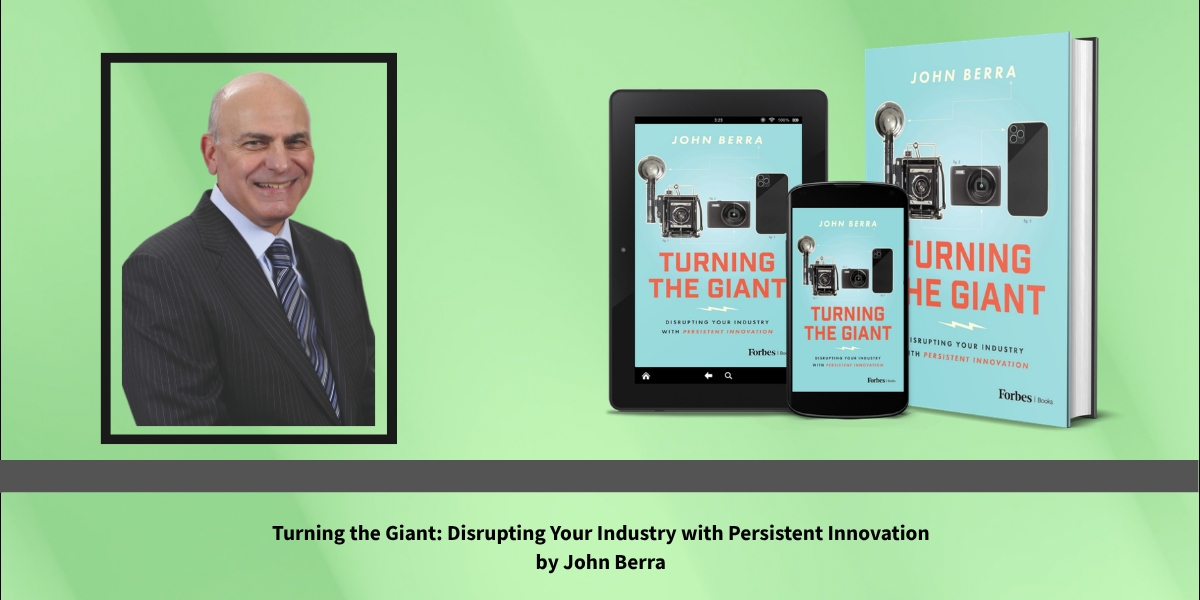

By: AP Sanders
There’s a quiet kind of pressure that comes with leadership. The expectation that the higher you climb, the more certain you’re supposed to feel. That confidence is the price of admission, and doubt is something you’re supposed to grow out of.
John Berra, who rose to Chairman of Emerson Process Management and was inducted into the Process Automation Hall of Fame, has a different take entirely. And it’s one of the more reassuring things in his book Turning the Giant.
Doubt Doesn’t Disappear. It Just Changes Shape.
John is direct about this. Self-doubt followed him through nearly every significant step of his career, particularly whenever he took on bigger responsibilities or moved into territory he hadn’t navigated before.
That’s not a confession of weakness. It’s an observation about how growth actually works. Growth and doubt, he says, travel together. If you’re not feeling some version of uncertainty, you’re probably not stretching into anything new.
For a lot of leaders, hearing that from someone with John’s track record is genuinely useful. It reframes doubt not as a red flag, but as something closer to a normal traveling companion on the way to somewhere bigger.
Where the “Giants” Idea Actually Came From
The central metaphor of John’s book, the idea of “giants,” obstacles that can’t simply be defeated but have to be managed, redirected, and turned to your advantage, didn’t arrive as an abstract business theory. It came from lived experience, starting with a fairly unglamorous job early in his career at Monsanto.
He spent his days doing repetitive engineering work and kept circling back to the same thought: there has to be a better way. That frustration became the seed for everything that came afterward, including his eventual leadership roles at Fisher-Rosemount Systems and Emerson, where the giants he encountered, corporate bureaucracy, skepticism, and resistance to change, only grew larger as his responsibilities did.
Big Companies Can Innovate Too
One thing John wants to push back on directly is the idea that meaningful innovation is the exclusive territory of small, nimble companies. His own experience tells a different story.
Some of the most transformative changes he witnessed happened inside very large organizations, the kind with layers of process and history and inertia. What made the difference wasn’t the size of the company. It was whether the people inside it were willing to challenge how things had always been done, empower others to do the same, and stick with it through resistance.
Big companies have bigger giants. They also have bigger potential for transformation if someone is willing to do the work.
The Question That Changes Everything
John’s most practical piece of advice comes down to a single habit. When you run into resistance, don’t immediately assume your only options are to push harder or back away.
Instead, ask: how can I turn this giant?
That question doesn’t make resistance disappear. But it changes your relationship to it. It turns an obstacle into a starting point. And according to John, that shift in mindset is where real breakthroughs tend to come from, not from avoiding difficulty, but from leaning into it with curiosity and persistence.
Berra develops these ideas in greater depth in Turning the Giant, which is available on Amazon.