

Equipment finance companies frequently sort applicants into credit tiers, usually labeled A through D. The tier you land in influences your down payment, your rate, your term, and how much paperwork you’ll need. Few applicants know these tiers exist, though knowing where you’re likely to fall is the best way to plan a quick approval.
The profiles below are generalized. Every lender draws its own lines, and the numbers shown are examples for planning, not offers. Find the tier that most resembles your business, and then read the guidance for moving quickly from there.
How Equipment Lenders Think
Equipment deals carry a built-in advantage over unsecured lending: if something goes wrong, the lender can repossess an asset and resell it. So two questions shape every decision.
Is the borrower likely to pay? That’s a matter of credit, time in business, revenue, and existing debt.
Is the equipment worth enough if the borrower doesn’t pay? That’s a matter of type, age, condition, and the resale market.
A strong answer to one can partly offset a weak answer to the other. That’s why a borrower with bruised credit may be approved for a popular truck yet declined for a custom-built machine. To see how these programs are typically described, you can read about Fundivi machinery and vehicle financing and compare it against quotes from a dealer or bank.
Tier A: The Prime File
Typical profile:
- Time in business of about five years or more
- Personal credit often in the 700s
- Comparable prior credit history, such as a past equipment loan
- Strong, stable revenue with no recent delinquencies
Typical treatment: Little or no down payment, the best available rates, the longest terms, and application-only processing for amounts up to a program limit.
24-hour outlook: Strong. An application plus a vendor quote may be sufficient for routine deals.
What to do: Don’t stop at the first offer. A Tier A borrower has real negotiating power, so request competing quotes and ask about the documentation fee and the end-of-term purchase amount.
Tier B: The Solid File
Typical profile:
- Two to five years in business
- Credit in the upper 600s
- Some prior borrowing, with a minor blemish or two
- Good revenue
Typical treatment: Modest down payment or a first-and-last payment at signing, moderate rates, and terms that may be slightly shorter.
24-hour outlook: Good for standard equipment and clean files.
What to do: Include three months of bank statements even when they’re not required, as they can answer a reviewer’s questions before they get asked. Explain any blemish in a sentence.
Tier C: The Developing File
Typical profile:
- One to two years in business, or an older business with credit problems
- Credit in the low-to-mid 600s or lower
- Limited comparable borrowing history
- Fair revenue, perhaps with a few negative days
Typical treatment: Down payments of perhaps 10% to 25%, higher rates, shorter terms, and more requests for documentation.
24-hour outlook: Possible but less certain. Reviewers may want bank statements, a tax return, or photos of the equipment.
What to do: Consider a larger down payment, choose equipment with strong resale value, and buy from an established dealer. Owners here can compare this overview of working capital loans and financing options to judge whether a general loan might be more useful than financing tied to one machine.
Tier D: The Challenged File
Typical profile:
- A startup or a business under a year old
- Credit below the 600s, recent bankruptcy, or significant collections
- Limited or irregular revenue
Typical treatment: High down payments, sometimes of 30% or more, the highest rates, short terms, and limits on eligible equipment. Some specialized programs exist, including those for startups with experienced owners.
24-hour outlook: Less likely. These files usually need more manual review.
What to do: Consider a used item from a dealer, a smaller initial purchase, a rental with an option to buy, or a co-signer who understands the commitment. Don’t let the excitement of approval hide a payment you cannot sustain.
The Equipment Has a Tier Too
Your own credit is only half of the picture.
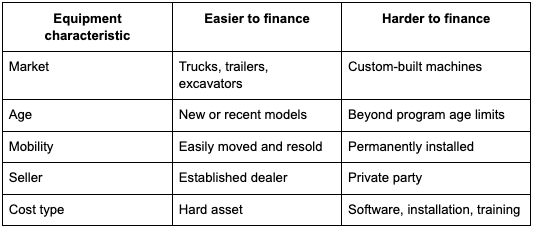
An important practical point: if you’re Tier C or D, the choice of equipment could matter nearly as much as your credit. A five-year-old dump truck with a strong resale market might be financed when a brand-new specialized machine wouldn’t.
The 24-Hour Package
Whatever your tier, these are the items that make a quick decision possible.
From you:
- A complete credit application, signed where needed
- Three months of business bank statements
- Identification for owners
- Business formation details and your EIN
- A list of current debts, including other equipment payments
From the vendor:
- A formal quote showing make, model, year, and price
- Serial number or VIN, if available
- Vendor’s legal name, address, and contact person
- Delivery timing and any installation details
Before you submit: Make sure that the buyer named on the quote exactly matches the applicant. A quote issued to you personally, when the application is from your LLC, will hold things up.
Approval doesn’t always mean instant payment. Lenders usually require signed documents and evidence of delivery or acceptance before releasing funds to the vendor. When a credit policy changes, approval standards can shift too, and news such as this NewsBreak notice on no-minimum-credit eligibility illustrates how one provider describes its approach, although equipment programs set their own rules.
How to Move Up a Tier
If your purchase can wait, a few actions could improve your terms:
- Establish comparable credit. A small equipment loan, successfully paid, makes a larger one easier later.
- Clear small collections and correct report errors.
- Keep your bank account positive for at least 90 days.
- Save for a bigger down payment, because more equity reduces the lender’s risk.
- Report trade lines. Vendors who report to business credit bureaus can help you build a profile.
Before You Accept
Run a final test on the offer. Add up all payments, the documentation fee, and any end-of-term amount. Then subtract what you’re financing to find your true cost. Compare a dealer’s promotional rate to a cash-discount purchase with outside financing. Check whether the contract has a blanket lien or just a lien on the equipment.
Ratings and reviews can also help during your search. Look for sources with no financial stake in the lender, such as the Better Business Bureau or state regulators, and treat any score as a prompt for questions rather than an answer. Reading the financing agreement itself matters more than any rating.
Common Mistakes That Delay an Approval
A surprising number of slow deals come down to small errors. Owners submit a quote that lacks a serial number, list a vendor’s trade name instead of its legal name, or forget that a second owner above the lender’s threshold must also sign. Others change the equipment after approval, which often requires a fresh review. Lock in the exact machine before applying.
Frequently Asked Questions
What credit score is required for equipment financing?
It varies. Prime programs often look for scores around 700 or higher, while others consider lower scores with bigger down payments.
How much time in business do I need?
Many programs prefer two years or more, although startup programs exist for owners with relevant experience and good credit.
Do I need financial statements?
Smaller transactions are often application-only. Larger amounts, commonly above a program threshold, usually require statements and tax returns.
Can I get approved with a recent bankruptcy?
Some subprime programs consider it, typically with larger down payments, limited equipment, and higher costs.
Does the type of equipment affect approval?
Greatly. Assets with strong resale markets are easier to finance than specialized or heavily customized items.
Does a personal guarantee apply?
Usually, for small businesses. Larger, established companies may be able to avoid or limit one.
How long does an approval last?
Commonly 30 to 90 days, though terms can change if the equipment or your finances change.
Can I finance equipment from a private seller?
Some lenders allow it, with extra verification of ownership, condition, and existing liens.
Can I finance several pieces of equipment at once?
Often, under one agreement or a master schedule. Lenders may review the combined amount more closely.
Disclaimer: This article is for informational purposes only and does not constitute financial or legal advice. Equipment financing eligibility, credit tiers, rates, fees, and approval timelines vary by lender. Approval or funding within 24 hours is not guaranteed. Business owners should carefully review all financing terms and consult a qualified financial professional before making decisions.