
The equipment and party rental business has always been local, but staying competitive as a local operator has never been simple. National and regional chains carry advertising budgets, fleet financing, and online booking systems that a single-location rental shop cannot match. The independent operator’s real advantages, such as knowing the customer, stocking the right gear for the area, and being a short drive away, are hard to communicate to someone who starts every search on a phone.
RNTR, an online rental marketplace, is built partly around that gap. The platform gives independent rental businesses a place to list inventory, take reservations, and reach customers who would otherwise default to whichever chain ranks highest in a search result.
The competitive problem for independents
Most small rental businesses still operate much as they have for decades, relying on phone reservations, paper logs, and walk-in traffic. Many now offer online booking, yet a customer’s first move is often a phone search, and a shop that is hard to find or book there still loses out. Chains have spent heavily to own that first moment of search, and they convert it with booking tools that let a customer reserve a scissor lift or a row of tables in a few taps.
The independent’s response has often been to absorb the loss of those customers or to invest in expensive e-commerce technology that does not pay for itself at the volume of one location. Neither option is attractive. The first cedes ground, and the second carries fixed costs that a small business cannot easily justify.
What a marketplace changes
A shared marketplace shifts the economics. Instead of building or continually investing in its own booking platform, an independent shop lists on RNTR and draws on the platform’s search traffic, reservation system, and Stripe payment processing. The shop keeps its existing operation intact and adds an online channel on top of it rather than replacing how it already works.
A company spokesperson addressed the appeal directly to those operators, saying, “RNTR could help smaller, local stores compete with larger chains.” The mechanism behind that claim is access, both to a younger, search-first customer base and to demand the shop’s own marketing might never reach. RNTR runs a hybrid model, listing inventory from established rental businesses alongside peer-to-peer listings from individuals, which gives a small shop’s catalog more company and the marketplace more depth.
For the operator, the upside is measured in utilization. Rental equipment is a fixed asset, and revenue depends on keeping it booked. More inbound reservations mean fewer machines sitting on the lot, which is where the margin in this business lives. A trailer or a lift that earns four days a week instead of two does not cost the operator anything extra to own; it simply works harder. The same dynamic that makes a chain efficient, high utilization across a large fleet, becomes available in a smaller form to a single shop with a few dozen listings.
On the operator’s terms
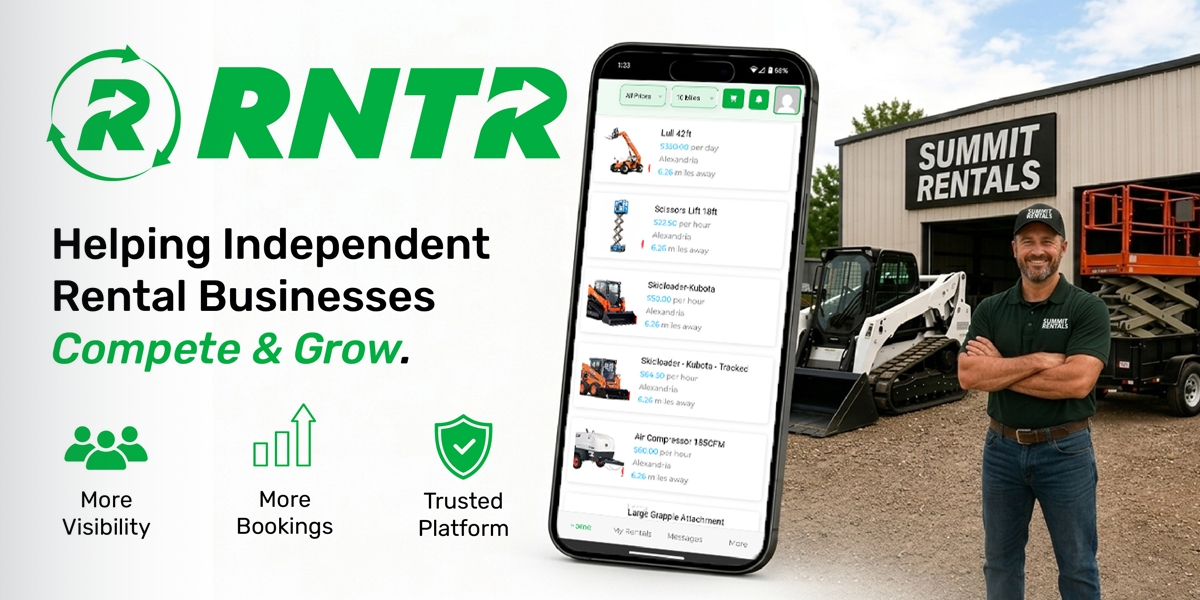
Joining RNTR and listing items is free, and the only charge comes when a rental actually goes through. Operators set their own pricing for each item, approve or deny any requests that come in, and can use their own store’s rental contract, running their listings the way they already run their business. Rather than a middle layer between a shop and its customers, the platform works as a marketing extension, putting a shop’s inventory in front of people who begin their search online.
What it does not require is abandoning the local relationships independents rely on. RNTR’s structure lets a shop keep its phone and walk-in business while treating the platform as an additional source of reservations. It also puts the shop on mobile, where independents have lagged: although many rental stores offer online booking, very few offer a mobile app of their own, a tool that until now has mostly belonged to the largest national chains, like Sunbelt Rentals and United Rentals.
Through RNTR’s app, available on iOS and Android, an independent’s listings reach customers who search, reserve, message, and pay from their phones. The company, based in Alexandria, Minnesota, reports it has grown to more than 38,000 listings in 40 states since launching in November 2024. The platform also says it belongs to the American Rental Association, the industry’s main trade group.
For an independent rental business, the strategic question is not whether to become a chain. The question is whether customers who now start online can find the shop at all. A marketplace listing is one of the cheaper ways to answer that question. For operators who have watched search-first customers drift toward national competitors, the appeal is less about technology than about being visible in the place the next reservation begins.