
Artificial intelligence has entered a new phase. For much of the past few years, organizations focused on what large language models could produce. Questions centered on content generation, search capabilities, summarization, and conversational interfaces. More recently, attention has begun to shift elsewhere. Businesses are increasingly exploring whether AI systems can move beyond answering questions and begin supporting real operational work.
The trend has fueled increased attention toward Agentic AI. While conventional AI systems operate on the principle of prompt-response mechanisms, agent-based solutions are intended for task completion, data retrieval, software interactions, and workflow assistance in different degrees of autonomy. The technology is still in its nascent stages of adoption; nevertheless, it is one of the most intriguing fields in corporate artificial intelligence. According to research conducted by McKinsey and published in 2025, more than half (62 percent) of businesses had been trying out AI agents despite being mostly at the pilot stage.
The enthusiasm surrounding AI agents is accompanied by caution.
Many organizations continue to face practical questions about governance, oversight, integration, and reliability. A 2026 Forrester analysis reported that while enterprise interest in Agentic AI remains high, many initiatives struggle to progress beyond experimentation because organizations lack the infrastructure, controls, and operational frameworks needed for deployment.
These realities help explain why many companies are moving away from generic AI implementations and toward more specialized systems designed around specific operational requirements.
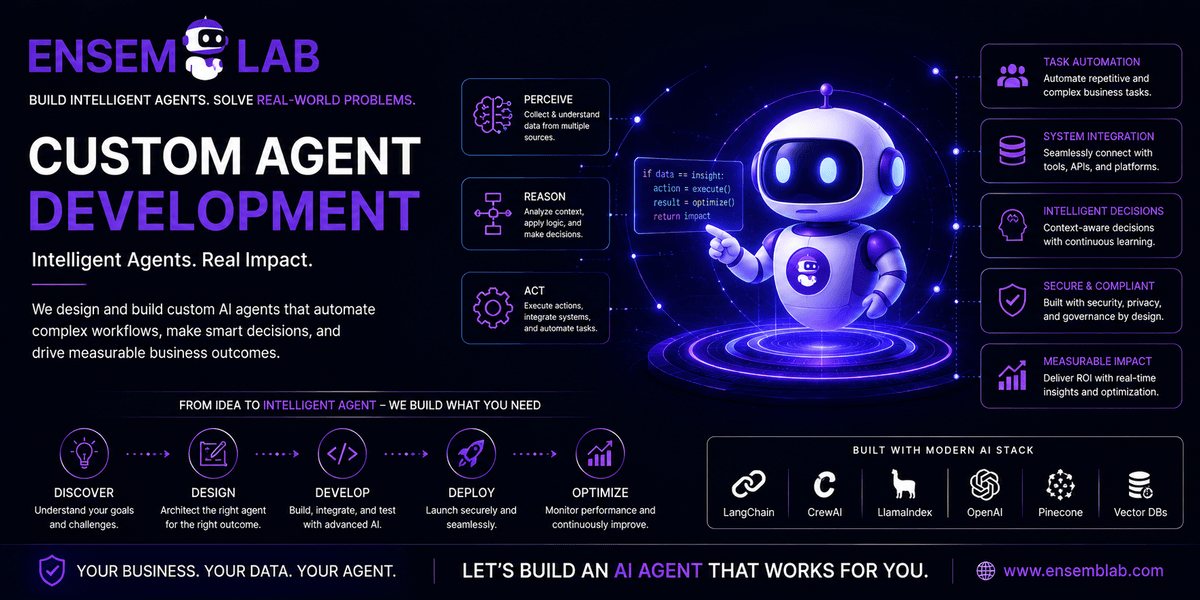
Established by a group of Pakistani entrepreneurs in 2024, Ensemblab operates within this emerging segment of the enterprise technology market. The company’s work spans artificial intelligence, enterprise automation, digital twins, governance technology, and knowledge management systems. Among these areas, custom AI agent development represents a distinct part of its product and services portfolio.
The growing demand for customized systems reflects a challenge faced by many organizations. Businesses rarely operate in identical ways. Workflows differ. Regulatory requirements vary. Internal knowledge structures are often unique. Organizations frequently require AI systems capable of functioning within their own operational environments rather than relying exclusively on standardized solutions.
This has become one of the defining characteristics of enterprise Agentic AI.
According to company information, Ensemblab develops custom AI agents intended to support organizational activities across research, planning, decision support, workflow management, knowledge retrieval, customer interactions, and operational processes. The emphasis is not simply on generating information. The objective is to build systems capable of interacting with existing workflows and business functions.
That distinction is increasingly important as organizations evaluate how AI fits into day-to-day operations.
The same McKinsey survey found that although AI adoption has become widespread, nearly two-thirds of organizations remain in experimentation or pilot phases when it comes to scaling AI across the enterprise. The findings suggest that moving from isolated use cases to operational deployment remains a significant challenge.
Part of that challenge involves context.
Large language models can process and generate information. However, enterprise environments often require access to proprietary documents, internal policies, operational records, and organizational knowledge. Without those resources, AI systems may struggle to provide responses that are relevant to specific business needs.
This is one reason Retrieval-Augmented Generation, commonly known as RAG, has become a recurring topic within enterprise AI discussions.
RAG systems combine information retrieval techniques with generative AI models, allowing responses to be grounded in available knowledge sources. According to company materials, Ensemblab develops RAG-based systems that can be integrated into enterprise environments and connected to organizational information repositories. Within customized AI agents, these capabilities can support knowledge retrieval, research activities, and information access functions.
The relationship between AI agents and organizational knowledge has become increasingly important as businesses seek to move beyond stand-alone chatbot deployments.
Several companies have begun looking into whether artificial intelligence could help workers find information, plan events, coordinate activities, or manage vast amounts of internal information. In such instances, the utility of the intelligent agent does not lie in its generation of language but rather in its interaction with the pertinent information.
Business data presents a similar challenge.
Enterprise operations typically involve information distributed across multiple systems, databases, applications, and workflows. Agent-based technologies are increasingly being designed to operate within these environments, drawing information from different sources while supporting specific operational objectives. Ensemblab’s approach, based on publicly available information, places particular emphasis on connecting AI capabilities with enterprise knowledge systems and business processes.
Yet the broader industry continues to face obstacles.
Forrester’s analysis also identified where those difficulties concentrate. Privacy, verification, governance, and the practical mechanics of running autonomous systems came up repeatedly as obstacles. Human supervision was often still needed even in organizations working with more advanced automation.
These findings align with a broader pattern visible across the sector.
There is growing evidence that organizations may be showing interest in AI agents; however, merely being interested is not enough to ensure that any AI agent will be put to use. It seems that a lot of organizations still consider issues of how autonomous or semi-autonomous AI systems might work in their business settings. These are important issues when discussing the application of AI agents.
In this context, the organizations that are developing customized AI agents have a certain market niche within the more general area of AI. According to UN Trade and Development, the global market for artificial intelligence could grow from $189 billion in 2023 to $4.8 trillion by 2033.
Ensemblab’s work in custom AI agent development sits within that larger trend. Through the development of enterprise-focused agents, RAG-integrated systems, workflow automation technologies, and organizational knowledge solutions, the company is participating in a growing effort across the technology sector to determine how AI can function within real operational environments. The long-term role of Agentic AI remains uncertain. However, the movement toward more specialized, context-aware systems suggests that the next stage of enterprise AI may depend as much on integration and organizational fit as on advances in the underlying models themselves.