
By: Kandice Vincent
Caleb Campbell did everything right. West Point graduate, Army officer, second player in the academy’s history selected in the NFL Draft, and the first ever given permission to play and serve simultaneously. Tens of millions of people watched Roger Goodell call his name at Radio City Music Hall. By every visible measure, he had arrived. The morning after the draft, alone in his dorm room at 1 a.m., all he felt was terror.
As he recalls it, he knew that if anyone saw what was actually going on inside him, the whole story would fall apart. The credentials were real. The fear underneath them was bigger.
That fear had been running the show since he was seven years old, when he scored a game-winning touchdown and looked up to find his mother beaming. The lesson his nervous system took from that moment was one that millions of high performers absorb without ever articulating it: performance is how you earn belonging. He spent the next two decades proving that belief correct, racking up credentials that looked like success and carrying a private terror that none of it would ever be enough.
It wasn’t.
When the Playbook Stops Working
Three hours before Campbell was scheduled to sign his first NFL contract, signing bonus check in hand, rookie season about to begin, the Department of Defense called. The policy permitting him to play and serve simultaneously had been quietly reversed. He was ordered back to active duty, effective immediately. He served for two and a half years before earning a new contract and making his way back to the league.
By the time Campbell reached the NFL, the gap between how his life looked and how it felt had grown too wide to ignore. He coped with pills and alcohol, missed practice, and woke up one morning staring at what was left on his bedside table, knowing his heart should have stopped at some point the night before. He walked away from professional football and found himself in his aunt’s basement when a series of tweets from a church in Canada stopped him cold.
Forty-eight hours later, he sold everything he owned on Facebook, packed what was left, and drove north. He walked into a church he had never set foot in, told a pastor he had never met that he needed help, and moved into the basement that night. The next morning, he started work as a janitor, cleaning bathrooms and sweeping floors in exchange for free therapy.
As he describes it, nobody there knew who he was, and for the first time in his life, there was no image to manage. That was exactly the point.
He stayed five years. The stillness he found there, the slow, unglamorous work of facing what he had spent decades running from, became the foundation for everything that followed. A blog he started to document the process caught the attention of a sales executive outside Toronto, who invited him to speak to his team. Campbell had never spoken publicly before. At the end of the talk, an 85-year-old woman pressed a folded piece of paper into his hand. It was a check for ten thousand dollars, with a note in the memo line: Don’t stop telling your story.
He hasn’t.
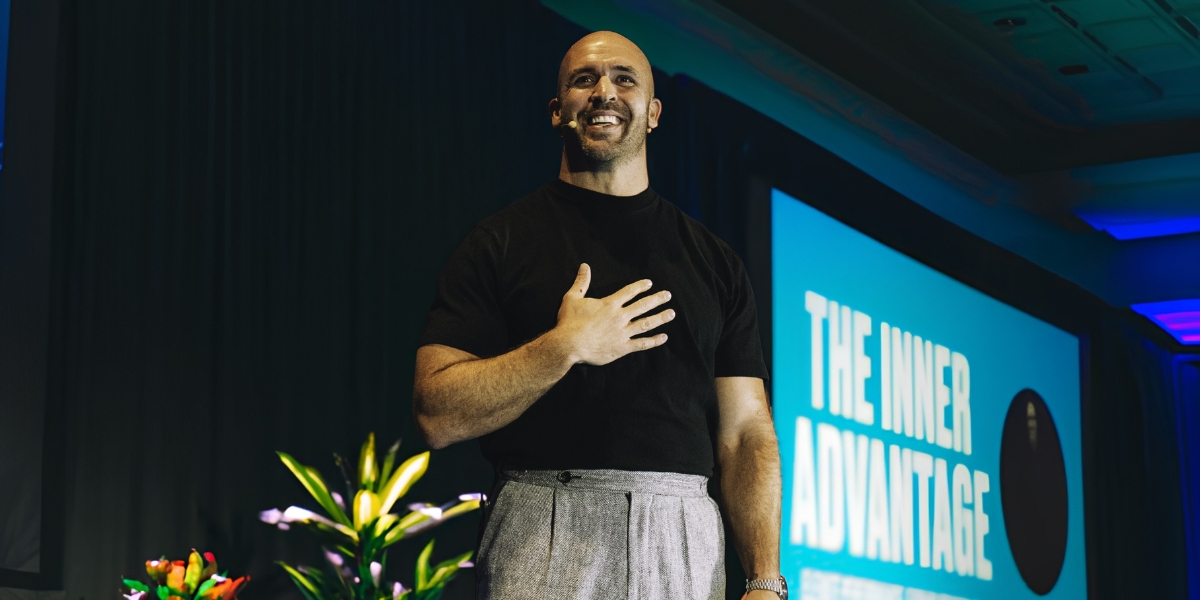
The Inner Advantage
Campbell is now a full-time keynote speaker and the author of Unstriving: 12 Lessons on Authentic Success from a Recovering Overachiever. He speaks 30 to 45 times a year at organizations including Google, Chase Bank, USAA, LinkedIn, and PlayStation, and organizations don’t bring him in to motivate people for an afternoon. They bring him in because their teams are operating under relentless pressure, and traditional advice around resilience and work-life balance isn’t producing lasting change.
His core argument is that the exhaustion leaders and teams are experiencing right now is not a scheduling problem or a workload problem. The pressure is not going away, and telling people to rest more or work smarter does not address what is actually happening. Campbell describes it as a capacity crisis: people waking up tired in a way that more sleep does not fix, their bodies and minds signaling that something more fundamental needs to change.
What he offers organizations is a way to meet that pressure differently. He calls it the Inner Advantage, a shift from fighting against mounting demands to learning how to work with them, building the internal capacity to stay present, clear, and performing without burning through everything you have. The framework draws on his own story, but the application is practical: how to lead under pressure without the pressure winning.
His keynotes blend authentic storytelling, practical frameworks, humor, and moments of reflection that leave audiences feeling connected and inspired long after the event ends. His credibility in that conversation comes from a combination that most speakers cannot replicate. A West Point ring and a 19-inch neck, combined with a willingness to ask a room full of executives how their hearts are doing. The contrast is the point. Audiences expect the grind speech. They get something they did not know they needed.
For leaders and teams running on fumes, that tends to land.
Caleb Campbell’s book Unstriving is available for pre-order now. Learn more about his speaking and coaching work at calebcampbell.me, or follow him on Instagram.