
Your hair has a natural texture. It’s been trying to show you for years. You’ve been drowning it in heat and blow dryer attachments and wondering why it never looks “right” without forty-five minutes of intervention every morning.
What if the forty-five minutes was the problem?
Air drying isn’t lazy. It’s a completely different approach that requires hair styling products designed to cooperate with whatever your hair does naturally rather than bullying it into a shape it has to be forced into daily. Most products on the shelf were formulated with heat tools in mind. They activate with heat. They set with heat. Take the heat away, and they just sit there being sticky and confused and doing roughly nothing useful.
The right products for air drying work differently.
Why Most Products Fail the Moment You Skip the Blow Dryer
Heat-activated ingredients are everywhere in styling products, and most people have no idea. Polymers that need thermal energy to form a flexible film. Silicones that spread evenly only when a blow dryer distributes them. Hold agents that stiffen properly at temperatures your bathroom air simply can’t provide.
Take the heat tool out, and these ingredients don’t adapt. They underperform. The hold is weaker. The definition is inconsistent. Which is why so many people try air drying once, hate it, and conclude their hair “needs” heat when really the product needed heat and the hair was just along for the ride.
Hair styling products built for air drying respond to moisture evaporation rather than thermal input, setting gradually as the hair dries and creating hold through film-forming agents that don’t need hot air to function.
What Air-Dry Products Should Actually Contain
The ingredient profile flips significantly when heat leaves the picture:
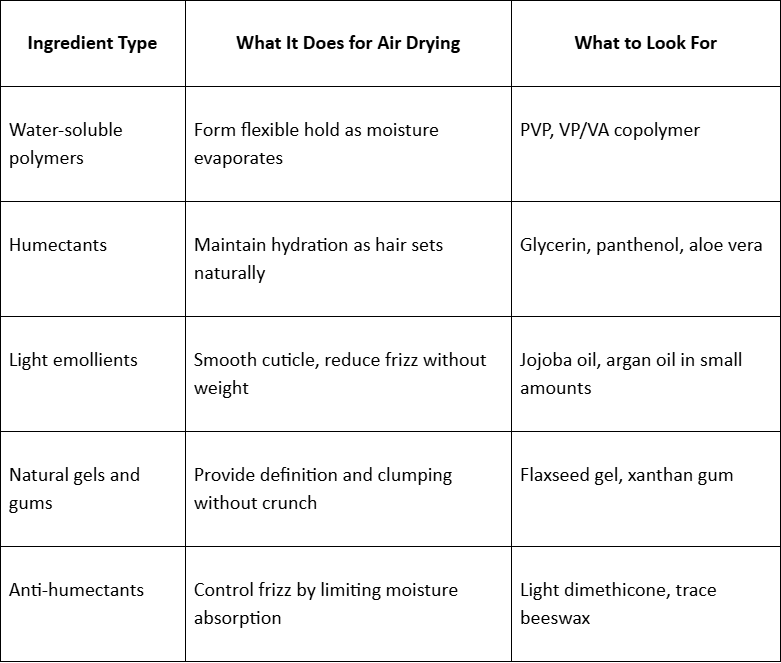
Hair styling products carrying three or more ingredients from this table were likely formulated with air drying as an intentional use case rather than an afterthought.
Matching the Product to Your Actual Texture
This is where most people get tripped up. They grab a generic “air dry cream” and expect it to work regardless of whether their hair is fine and wavy or thick and coily. Those are different engineering projects requiring different materials.
Fine hair that goes flat under product weight needs water-based mousses or lightweight foams for hold without heaviness, texturizing sprays with sea salt or rice starch for grip, and absolutely nothing containing heavy butter or thick oil concentrations.
Thick or coarse hair requires the opposite vocabulary entirely. Rich curl creams with shea butter. Oil-based serums that coat the wider strand properly. Gels with enough hold to keep definition locked in through a full day of gravity working against denser, heavier hair.
Wavy hair sits in an annoying middle ground where too much product kills the wave, and too little lets it frizz into oblivion. A lightweight hair styling product approach works best: a thin curl cream or leave-in spray applied to soaking wet hair and then left completely alone. No scrunching. No touching. Patience.
The Application Trick Nobody Emphasizes Enough
You can have the perfect air-dry product and still get mediocre results because application changes everything when heat tools aren’t redistributing product afterward.
Apply to soaking wet hair. Not damp. Not towel-dried. Dripping wet. Water dilutes and distributes product evenly in a way your hands alone cannot replicate on partially dry hair. This single technique difference separates air drying that works from air drying that makes you reach for the blow dryer out of frustration.
Then don’t touch it while it dries. Every scrunch, flip, or adjustment during drying breaks the cast the product is forming and introduces frizz at the exact moment the hair is most vulnerable to it.
Hair styling products designed for air drying need time, and they need you to leave them alone. That’s the trade. Less effort styling, more patience drying.
Why the Right Product Changes Everything
Air drying isn’t a downgrade. It’s a different system running on different hair styling products, different techniques, and a different relationship with patience than most people are used to.
The right product for your texture, applied to soaking wet hair, left undisturbed while it dries, produces results that look intentional rather than neglected. The wrong product, or the right one applied incorrectly, sends people running back to their flat iron convinced air drying “doesn’t work for my hair.”
It probably does. The product just hadn’t caught up yet.