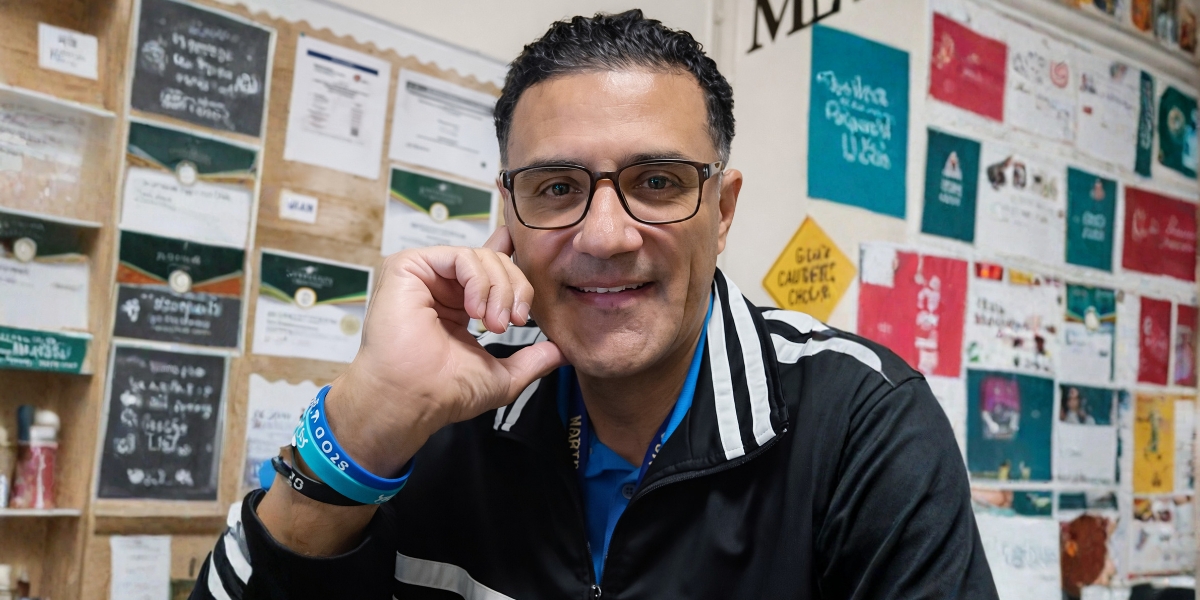


Roberto Torres, better known as Sabor Latino, has spent the last decade or so juggling a full-time job in education and social services with a growing career in Latin hip-hop. He was born on June 21, 1972, in Jamaica, Queens, to parents of Puerto Rican and Dominican descent. As a kid, he was already writing poems and rhymes about the things he saw around him: street life, family struggles, the ups and downs of growing up in the neighborhood.
He went on to study education. Torres graduated from Boricua College with a bachelor’s degree in education and a minor in psychology, then picked up a master’s in education (with a minor in administration) from Lehman College in 2017. Professionally, he has worked as a Substance Abuse Prevention Intervention Specialist counselor in a high school and previously served as Deputy Director of Social Services, coordinating preventive programs for youth in Queens. A lot of what he saw and did in those jobs ended up in his lyrics.
Music with a Purpose
He started releasing music in 2013 with the first volume of Observaciones de Mi Vida. The record mixed straight-up songs with spoken-word pieces, all aimed at teenagers who were dealing with the same kind of problems he handled every day at work. Volume 2 came out in 2021 and kept the same focus: getting through hard times, staying out of trouble, and taking responsibility for yourself. Songs like “Victoria” and “Esperanza” are basically pep talks set to beats.
In 2024, he dropped a short third project called Hacer La Vida Significativa (Make Life Meaningful), just four tracks. You get “La Escuela,” which is about the value of staying in school; “Princesa Dominicana,” a tribute to Dominican women and heritage; and “Querido Sobrinito,” a letter in song form to his young nephew. Same mission as always: give kids something positive to listen to.
Over the years, he’s also put out a string of singles, “Todo En La Vida Es Posible,” “Mi Padre,” “No Mas Racismo,” “Hip Hop Positivo,” each one built around the idea that you can turn your life around and that hip-hop doesn’t have to be only about negativity.
Media Recognition
The press started paying attention. In 2019, FOX 5 New York ran a segment on him, highlighting how a guidance counselor was using rap to promote education and good decision-making. Local Queens papers like TimesLedger and QNS wrote him up whenever a new album or book came out. Music sites such as CelebMix ran features on his work in Latin hip-hop and his focus on youth. Spanish-language papers like El Diario and La Prensa treated him as a community figure worth watching.
A Dual Career
What makes Roberto Torres different from many independent artists is that he never quit his day job. He still counsels high-school kids, still runs programs, still shows up to work every day, and then goes home and writes rhymes that come straight out of those experiences. Everything he releases, whether it’s an album, a single, or one of his books, circles back to the same handful of ideas: stay in school, respect where you come from, keep pushing forward, and help the next generation.
Final Thoughts
More than thirteen years in, Torres keeps doing both things at once, teaching by day, rhyming by night, and using music the same way he uses counseling: to give young people something solid to hold on to when everything else feels shaky.