
By: Marcy Paulson
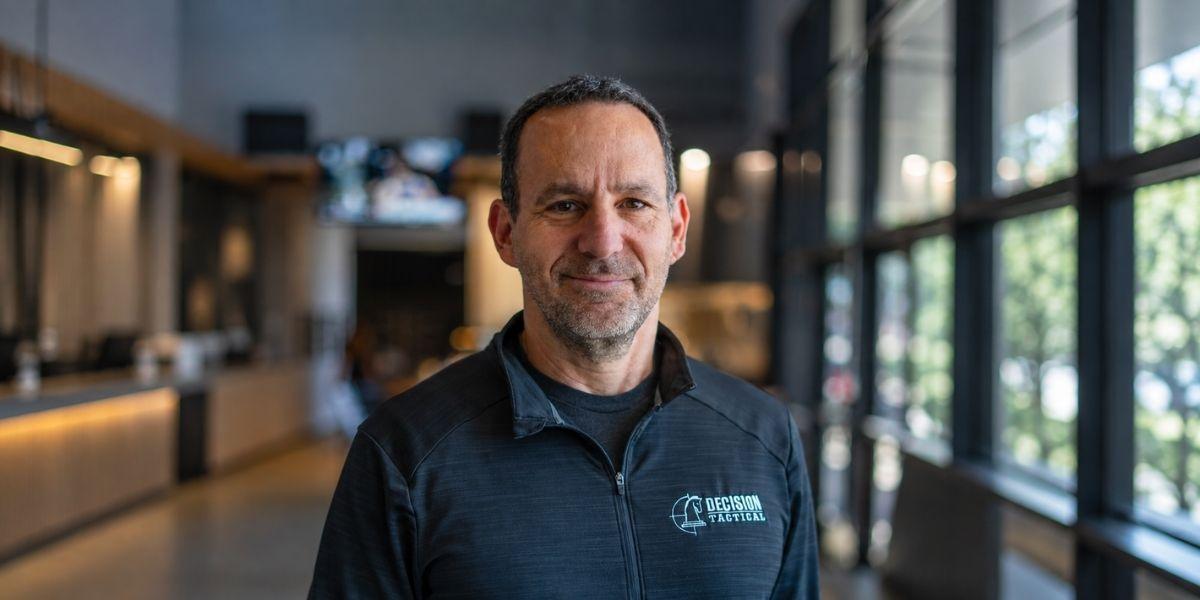
Remo Eyal’s path from practicing law in Washington, DC, to building Decision Tactical, a fully immersive training facility, is the story of a founder who can’t ignore friction. He’s the kind of person who sees a system people accept as good enough and feels compelled to make it outstanding.
“I’ve been entrepreneurial since I was a kid,” Eyal says. “When I see something that doesn’t work well, I have a hard time leaving it alone.”
What led Remo Eyal from a law practice to launching cutting-edge tactical training and a decision readiness company?
Eyal earned his J.D. magna cum laude from Georgetown University Law Center and began practicing regulatory and contract law. Those early legal years developed his knack for examining complex problems and building a case for change.
A few years into practicing law, Eyal’s father pulled him into the family’s solar distribution business to help scale and prepare it for sale. After the company sold, Eyal spotted an overlooked opportunity in large-scale solar and built a company to pursue it. He successfully grew and exited that business in 2018.
“Law gave me discipline in how I examine a problem,” he says. “Entrepreneurship taught me the importance of execution. I saw how much work comes between having an idea and delivering something people can actually use. I also saw how much your success depends on bringing the right people together.”
Eyal began looking for a new venture, but this time he wanted the chance to have a more direct impact on people’s lives. As the nation suddenly erupted in high-emotion debates around police encounters and public safety, he discovered one area where he could make a difference.
Eyal found himself stuck on a critical question: If we spend so much energy analyzing decisions after they happen, then what are we doing to prepare people before those moments?
Decision Tactical emerged from listening to the frustrations of officers and trainers tasked with enforcement and a public that had limited opportunities to understand the pressure and uncertainty embedded in fast-moving encounters.
His groundbreaking training facility grew out of a desire to address both issues with a single solution. “We help officers become better prepared, and we help the public understand the people and decisions behind the uniform. That became our mission. Save Lives. Bridge Divides.”
The inspiration behind Decision Tactical’s adaptive simulator approach
The company’s founding insight came from watching real training and noticing something the industry had normalized. In 2018, Eyal visited one of the largest law-enforcement agencies in Central Florida to observe a sophisticated 300-degree simulator the agency had purchased for $500,000. It looked advanced, but the behavior it produced told a different story.
“Some officers were treating the simulator like a game,” Eyal recalls. “When we asked why this was the case, we found that the limitations of the simulator were shaping the trainees’ behavior.”
Those limitations were important. Officers couldn’t move naturally. The camera moved while they stood still. If the scenario escalated, they couldn’t use cover or navigate space as they would in real life. And the on-screen characters had a limited set of responses.
Some officers even referred to the expensive simulator as “negative training.” They felt they were practicing behavior they would want to avoid in a real encounter.
“That really bothered me,” Eyal says. “We were asking officers to make good decisions while limiting their ability to act on those decisions.”
Eyal and his team searched for a platform that matched their vision for realism and interaction. They couldn’t find it, so they built it. Their primary goal? Suspension of disbelief.
“We paid enormous attention to physical surroundings, sounds, movements, and interactions,” remembers Eyal. “They all had to work together. We even asked, ‘What would Disney do?’ because creating a believable environment is something they understand exceptionally well. I love seeing someone arrive thinking they’ve seen shooting simulators before, then watching their expression change as they experience it.”
How Remo Eyal’s background contributes to the innovative tactical training at his all-new decision readiness company
Decision Tactical is a training company, but Eyal’s fingerprints are those of an inventor. He listens closely to officers and gets very persistent in the obstacles they describe. Then he finds talented software and hardware developers and gives them the support they need to solve those problems.
“I enjoy the moments when looking at a problem differently opens up a solution,” reflects Eyal. “When officers tell us they need to move, communicate naturally, or respond to something unexpected, we ask what is getting in the way and how we can help. Our facility has become a proving ground for those solutions.”
One example of such a solution is Decision Tactical’s green-room system. In this scenario, a live actor can appear on screen seamlessly alongside prerecorded characters, so when a trainee asks an unexpected question, the interaction can remain natural rather than breaking immersion. “Because trainees don’t know which characters are live,” Eyal says, “they have reason to take every interaction seriously.”
What’s the CEO of Decision Tactical planning next?
The next chapter in Decision Tactical’s innovation is Matrix. It’s a platform designed to take the brand’s adaptive approach beyond its walls.
“Lots of training simulators claim to be autonomous or responsive, yet still fail to meet expectations,” says Eyal. “We decided that a simulator should adapt to the training, not the trainee to the simulator. In other words, training shouldn’t require participants to unlearn realism in order to play along with the technology.
Matrix places responsive characters throughout actual buildings, without projectors, headsets, or glasses. It will enable scenario training in the environments where teams actually operate by allowing them to move through real rooms, around real obstacles, alongside real teammates while encounters run autonomously and reset quickly.
Eyal is planning an early viewing at IACP for industry leaders and invited guests, followed by a full reveal at SHOT Show. But he’s less focused on unveilings than on iteration. “I’m especially looking forward to having more trainers run it and tell us what they think,” he says. “Those conversations are how we improve.”
For Eyal, the best part of each day is seeing people’s reactions to the training. “We’ve had officers line up just to say thank you,” he says. “We’ve also heard from a civilian who drew on her experience with us to direct her friends to safety when she was caught in a shooting incident. The biggest reward for me is seeing the idea become something useful in someone else’s hands.”