
By: Dustin Villars
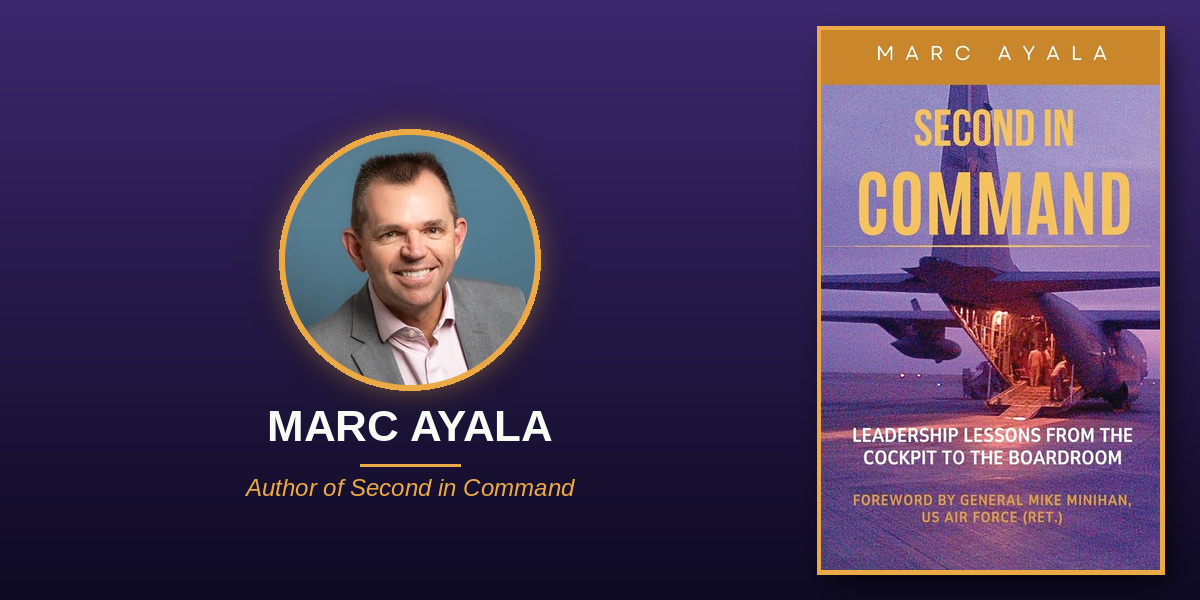
There is a specific kind of credibility that no conference keynote can manufacture and no MBA program can grant. It is the credibility of a person who has sat in a cockpit over Afghanistan at two in the morning, scanning the blackness below with night vision goggles while troops on the ground whisper into a radio because the Taliban is close enough to hear them speak. Marc Ayala has that credibility, and in Second in Command: Leadership Lessons from the Cockpit to the Boardroom, he uses it to build something genuinely worth the attention of anyone who leads people for a living.
Ayala spent years as a Pilot and Instructor Navigator aboard the C-130 Hercules, completing multiple combat deployments across Operation Enduring Freedom and Operation Iraqi Freedom. His book distills that experience through a structural lens that translates with surprising precision to civilian leadership: what does it mean to be the second in command? Not the top authority, not a passive follower, but the person positioned one step removed from ultimate decision-making who is simultaneously responsible for outcomes the leader above them may not fully see. It is a role that demands something rare, the combination of absolute loyalty and unflinching honesty that General Mike Minihan captures in his foreword when he describes the ideal Second in Command as someone with “confidence without ego, loyalty without silence, challenge without subversion, and execution without hesitation.”
The book moves through ten chapters, each built around a real mission story that Marc ties directly to one of ten leadership principles he calls The Copilot Leadership Checklist. The power of this architecture is that the lessons never feel abstract. When Ayala describes a simulated combat exercise at Nellis Air Force Base where his F-16 escort pilots abandoned their protection role to chase individual kill statistics, the leadership breakdown he unpacks is not a case study from a textbook. It happened. People’s lives would have depended on those fighters keeping their position. The debrief that followed, where a three-star general publicly dismantled a mission commander for celebrating personal performance metrics while his team failed its actual objective, carries the kind of weight that a hypothetical scenario simply cannot.
Each subsequent chapter layers a new dimension of leadership complexity. A mission to fly de-icing fluid to a base in Djibouti, which initially reads as an absurd waste of military resources, becomes a masterclass in trusting systems and resisting the arrogance of incomplete information. A night combat airdrop over Taliban-contested terrain in Afghanistan, executed with near silence from the troops on the ground because the enemy was meters away, shows what true communication breakdown costs and what composure under pressure actually looks like when lives are the stakes. And then there is the chapter that may be the book’s most morally demanding: the night Marc’s crew completed a combat drop for besieged soldiers and then turned around to evacuate a wounded Taliban fighter using the same aircraft, the same crew, the same commitment to professionalism. The honesty with which he describes his own rage and the theological reasoning he used to navigate it reveals a writer who is not packaging leadership for mass consumption but actually wrestling with its hardest implications.
The chapter on empowerment stands out for readers in corporate environments who have watched hierarchies calcify around seniority while the people with the clearest view of the problem sit in silence. Ayala tells the story of being a young instructor assigned to evaluate a newly arrived Lieutenant Colonel, “Buzz,” who outranked him significantly and had been “proficiency advanced” through portions of his training. The dilemma Marc faced, whether to hold a senior officer to the same standards he would hold a junior pilot, mirrors a challenge every professional encounters when rank and competence are not aligned. His decision to hold the standard, even when the interaction was uncomfortable and the student imperious, is the kind of case study in organizational courage that leadership books claim to offer but rarely deliver with this kind of firsthand texture.
What separates Second in Command from the broader category of military-to-business leadership books is the authenticity of its emotional register. Ayala does not present himself as a hero. He writes with the candor of someone who was young and sometimes wrong, sometimes confused, sometimes angry, and always learning. The combination of technical specificity, genuine moral complexity, and structural clarity around ten transferable principles makes this one of the more substantive contributions to the leadership genre in recent memory.
If you lead people and want a framework forged in conditions where leadership failure was never theoretical, Second in Command by Marc Ayala is available now on Amazon.