
Every struggling organization has a symptom list. Missed deadlines. Accountability gaps. Projects that stall mid-execution and require three escalations before anyone agrees on a next step. Teams that are talented on paper and confused in practice. Leaders buried in decisions their direct reports should be capable of owning. The symptoms get treated with new hires, new software, new frameworks, and new offsites. The problems return anyway, because the actual diagnosis never got made.
Todd Gross has spent more than three decades watching this cycle repeat. As an executive advisor, turnaround CEO, and leadership coach whose client list spans family-owned businesses to major corporations, he has watched organizations from the inside during moments of pressure that reveal what is actually wrong rather than what people prefer to believe. His conclusion: most organizational dysfunction traces back to the same source. The wrong people are making decisions. Or the right people are making the wrong decisions. Or nobody is sure who owns what, so nothing gets decided at all.
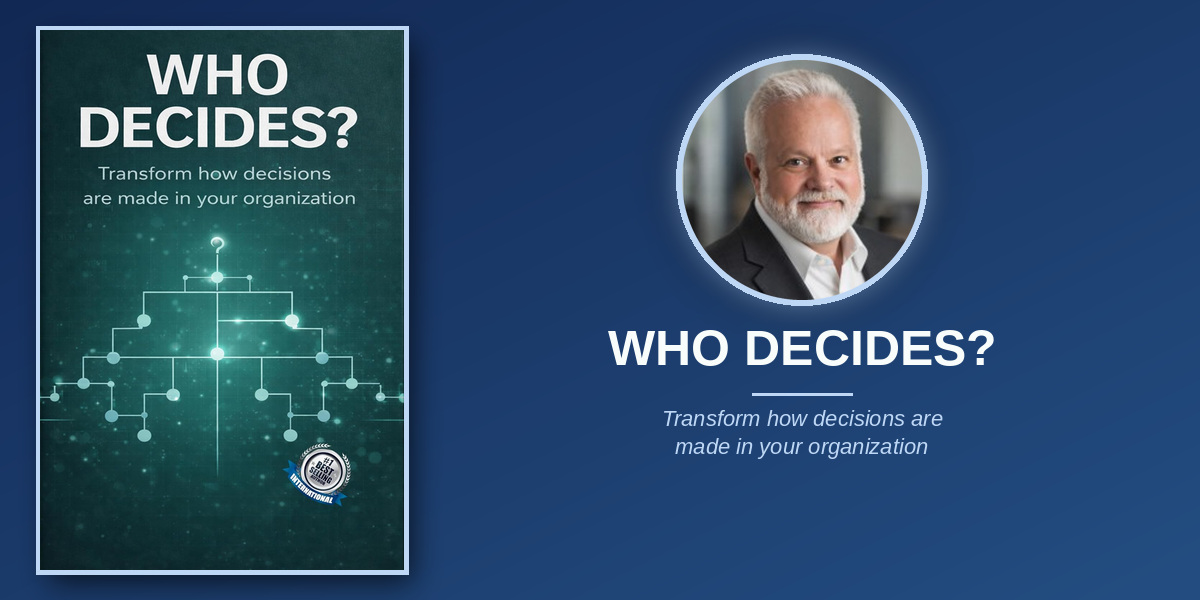
Who Decides? Transform How Decisions Are Made in Your Organization names that problem with precision and gives leaders the vocabulary and frameworks required to solve it.
Gross opens with what he calls the choke point: the place in an organizational system where work stacks up because a decision is waiting. Most leaders can identify their choke points the moment they are asked. What they cannot identify is the structural reason those choke points exist, or why they reconstitute themselves after being cleared. Choke points are not individual management failures. They are design failures. Organizations that lack shared clarity about who owns decisions at each level will always produce them, regardless of the quality of the people inside.
The Five Levels of Decision-Making framework is the book’s central contribution. Each level defines a distinct relationship between the decision-maker and the people around them: from decisions made and executed independently, through decisions made with gathered input, through collaborative choices, to recommendations forwarded for approval, to decisions delegated entirely downward. Most organizations operate without this vocabulary, which means leaders and their teams are perpetually negotiating the level of a decision without realizing that is the actual disagreement they are having. The Five Levels solve that negotiation by naming it. When a leader says “I need your recommendation” and a team member interprets that as permission to decide, the resulting confusion is a systems failure, not a communication failure between two people.
The chapters on decision severity address something leadership frameworks routinely skip: not all decisions carry equivalent weight. Applying the same deliberation to a vendor selection as to a strategic pivot exhausts organizations and produces neither speed nor rigor where each is actually needed. Gross builds a practical calibration approach that matches process to stakes, which is how both analysis paralysis and reckless speed get dismantled at the source.
The emotional pressure sections add honest grounding. Real decisions happen under uncertainty, time pressure, and interpersonal friction. Gross takes those conditions seriously and builds guidance that holds under them, which is what separates a practitioner’s framework from a seminar-room one.
What distinguishes this book is its precision about causality. Gross is not arguing that organizations should simply trust their people more or move faster. He is arguing that clarity about decision ownership, installed deliberately, is the specific structural change that makes everything else possible.
Pick up Who Decides? On Amazon and bring the clarity your organization has been missing to every room where a decision needs to be made.