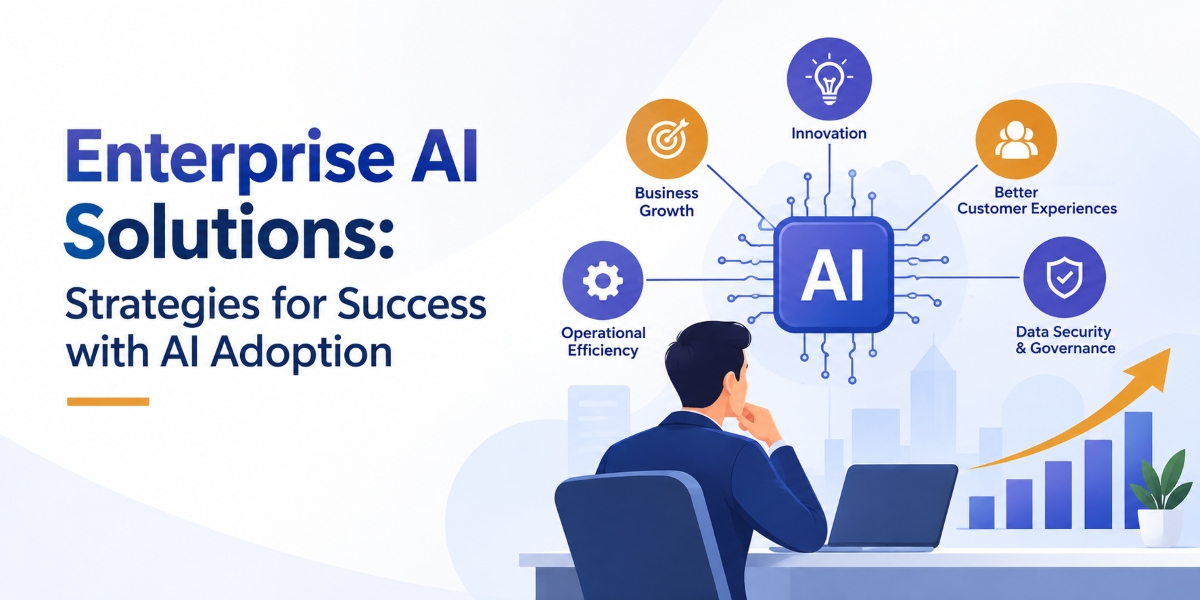

In all sectors, AI has gone from being a novelty to a necessity for staying relevant and growing. Boardrooms no longer debate whether to implement AI, but rather how fast and how effectively it can be scaled. There are a lot of generative tools, autonomous agents, and predictive machine learning models in the world of business. But there is a big disconnect between pilot projects and tangible business outcomes: almost 90% of businesses are using AI in at least one business unit, but only about 22% have scaled up their AI deployments across the organization.
Navigating this transition requires more than purchasing cutting-edge software; it demands a clear blueprint for organizational change, architectural stability, and risk management.
Defining Modern Enterprise AI Solutions
Modern Enterprise AI Solutions differ fundamentally from individual consumer AI tools or point solutions. They represent comprehensive platforms, models, and workflows integrated directly into an organization’s existing technology stack, data ecosystem, and daily operating procedures.
Where consumer applications focus on singular tasks, enterprise-grade AI must address complex requirements:
- Interoperability: Smooth integration with Enterprise Resource Planning (ERP), Customer Relationship Management (CRM), and Supply Chain Management (SCM).
- Enterprise-Grade Security: Compliance with data privacy, tokenization, zero-trust network access, and SOC 2, HIPAA, and GDPR.
- Scalability: The capacity to run high-throughput inference across thousands of parallel workflows without compromising performance or causing massive cost overruns.
- Auditability & Governance: Clear monitoring of model behavior, data lineage, guardrails against bias or hallucination, and clear operational logging.
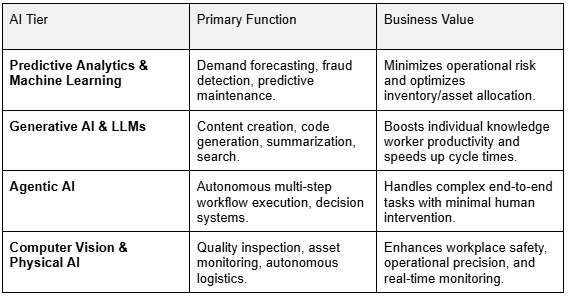
Key Architectural Tiers of Enterprise AI
The AI Adoption Paradox: Why Enterprise Initiatives Stall
While AI investment is on the rise, enterprise AI programs often face significant friction. The first step to creating a resilient strategy is to understand why these efforts are not succeeding. It is often not the models or tools that are available, but rather the ability to link these technologies and elements to enterprise data, workflows, systems, governance, and measurable business outcomes.
They will be able to identify common strategic and execution mistakes.
- The “Proof-of-Concept” (PoC) Trap: Organizations often build hundreds of isolated sandbox pilots that demonstrate technical feasibility but fail to integrate into real-world business operations or deliver clear ROI. The PoC should include a clear plan for production with integration requirements, security measures, scalability, and business goals that can be measured. Industries that collaborate with seasoned AI Development Services companies can set this stage in motion by creating prototypes taking into account the production environment.
- Unprepared Data Foundations: AI models depend completely on the quality of the data used to train them. Siloed repositories, metadata differences, uncurated data lakes, and lack of governance models slow down deployments when scaling up into production. However, AI applications can only consistently provide actionable outcomes if businesses have solid data pipelines, clear data ownership, secure access controls, and governance models. When it comes to applications like enterprise search and Retrieval-Augmented Generation (RAG), the quality and reach of organizational knowledge is particularly significant.
- Strained ROI Metrics: If AI is viewed as only an IT budget line item, then it has real implementation challenges. There are many companies investing millions of dollars in AI, but they aren’t measuring specific results, such as reduction in cost, cycle time, or generating new revenue. Measurable success criteria should be set before development of each AI project. They can be anything from faster processing times and lower operational costs to higher accuracy, more productive staff, more satisfied customers, or other revenue.
- Cultural Friction and Skills Gaps: Technological integration is often easier than organizational change. The adoption of AI tools often faces resistance from employees, concerns about job displacement, a lack of training, or user-friendliness issues. Adopting an AI application is only part of the equation; it’s also crucial for employees to receive training, clear workflows, and an understanding of how AI can augment their current work. Human-in-the-loop processes are also valuable for keeping organizations in check and ensuring employees are comfortable interacting with AI systems
- Legacy System Integration: Enterprise AI is not typically a standalone application; it’s also complex to integrate with other legacy systems. It must also interface with ERP, CRM, supply chain, data warehouse, collaboration, and other business systems. This can be challenging due to legacy architectures, disunified APIs, and lack of consistency with data formats. An AI Development Services strategy can guide companies to seamlessly integrate AI solutions with existing enterprise technology and ensure security, performance, and seamless operation.
- Security and Governance Gaps: Data privacy, model security, access control, auditability, and regulatory compliance are some of the new requirements that arise when moving AI from experimentation to production. Enterprises need to put in place guardrails as to how models access and process sensitive information, especially when working with public or third-party foundation models. Governance should be integrated into the AI lifecycle, starting from design and development to deployment and ongoing monitoring.
- Difficulty Scaling From Pilot to Production: If the AI solution is useful for a small dataset or few users, it could be a huge problem if implemented at an enterprise level. In a Production environment, you need to monitor the models, optimize them, scale the infrastructure, control the costs, and continuously improve their performance. To scale, organizations require repeatable practices for development and deployment, such as MLOps, LLMOps, automated testing, monitoring, and controlled release processes.
The challenges underscore the need for enterprise AI adoption to go beyond merely picking the most sophisticated model or successfully executing a PoC. The shift from experimentation to production is driven by the degree of alignment in the development of AI systems, data infrastructure, data governance frameworks, system and model integration, and workforce enablement, with measurable business goals. This foundation paves the way for the use case selection and modernization strategies, which are discussed in the next sections, that are driven by value.
Core Strategies for Successful AI Adoption
To move beyond fragmented pilots and build a high-performing AI enterprise, leadership teams must execute across five strategic pillars.
Strategy 1: Establish Value-Driven Use Case Selection
Avoid adopting AI simply for the sake of novelty. Group potential applications into a dynamic balance of short-term wins and long-term transformation:
- Quick-Win Efficiency (0–6 Months): High-volume, low-complexity tasks like internal document search, automated ticket triage, or code refactoring.
- Core Process Redesign (6–18 Months): Deep integrations into core business units, such as automated financial underwriting, personalized customer journey orchestration, or intelligent supply chain routing.
- Business Model Reimagination (18+ Months): Creating new AI-native products, services, or revenue streams that transform market position.
Strategy 2: Modernize the Data Infrastructure
AI capability is directly constrained by data quality. Successful adoption requires an active data strategy:
- Implement Data Mesh Architecture: Treat data as a product owned by domain teams rather than an isolated IT warehouse.
- Optimize for RAG (Retrieval-Augmented Generation): Combine frozen large language models with vector databases to feed domain-specific, real-time enterprise knowledge to your systems safely.
Strategy 3: Implement an Agile AI Governance Framework
Governance should act as an enabler, not a bottleneck. Establish an interdisciplinary AI Center of Excellence (CoE) featuring leaders from executive leadership, IT, legal, risk management, and business units.
Key governance duties include:
- Responsible AI Guardrails: Verifying model outputs for bias, toxicity, and accuracy before deployment.
- Data Sovereignty & Privacy: Ensuring data never leaks into public foundation models without permission.
- Agentic Oversight: Establishing clear boundaries and “human-in-the-loop” approval thresholds for autonomous AI agents.
Strategy 4: Adopt a Hybrid Architecture (Build vs. Buy vs. Fine-Tune)
Not every enterprise problem requires building a custom foundation model from scratch:
- Buy (SaaS / Off-the-Shelf): Best for standard, non-differentiating functions (e.g., HR service desks, basic email summarization).
- Wrap & Extend (APIs + RAG): Ideal for applying powerful public or open-source models to proprietary company data safely.
- Fine-Tune / Custom Build: Reserved for core IP and unique domain challenges where proprietary data provides a durable competitive advantage.
Strategy 5: People-Centric Workforce Enablement
Focus heavily on upskilling and organizational change:
- Focus on Fluency over Replacement: Train teams on prompt engineering, workflow augmentation, and critical evaluation of model outputs.
- Redesign Workflows around AI: Re-evaluate job functions so that employees focus on high-value strategic decision-making while AI handles repetitive execution.
Ecosystem Landscape: Navigating Enterprise AI Solutions Companies
Building enterprise-grade AI capabilities rarely happens in isolation. Top organizations work closely with specialized enterprise AI solutions companies to accelerate their maturity curve, bridge internal talent gaps, and integrate enterprise technologies safely.
Vendor Categories in the Enterprise Market
- Hyperscalers & Cloud Infrastructure Platforms: Companies like AWS, Microsoft Azure, and Google Cloud provide foundational compute infrastructure, model marketplaces, Microsoft Azure services, and essential data governance layers.
- Global Systems Integrators (GSIs): Firms like Accenture, Deloitte, PwC, and EY focus on enterprise-wide digital transformation, organizational change management, and strategy implementation.
- Dedicated Enterprise AI Platforms: Solutions from Palantir, C3.ai, DataRobot, and Databricks offer off-the-shelf data operationalization frameworks tailored for complex enterprise needs.
- Custom Software Development & Engineering Partners: Boutique firms like EffectiveSoft, LeewayHertz, and HatchWorks engineer bespoke models, fine-tuned agentic workflows, and direct integrations with legacy corporate IT platforms.
Key Criteria for Evaluating Vendor Partners
When selecting enterprise AI solutions companies, decision-makers should focus on four core evaluation dimensions:
- Security & Compliance Credentials: Verify SOC 2 Type II, ISO 27001, HIPAA, or industry-specific certifications alongside explicit data privacy policies.
- Legacy System Integration Capabilities: Ensure the partner has a proven record of connecting modern APIs and vector engines to traditional enterprise software setups.
- Outcome-Based Metrics: Choose vendors that tie success metrics directly to business outcomes like operational throughput or cost savings rather than basic technical delivery.
- Knowledge Transfer Commitment: Ensure the vendor actively upskills your in-house teams during implementation to prevent long-term external dependency.
Enterprise AI Roadmap: From Pilot to Production
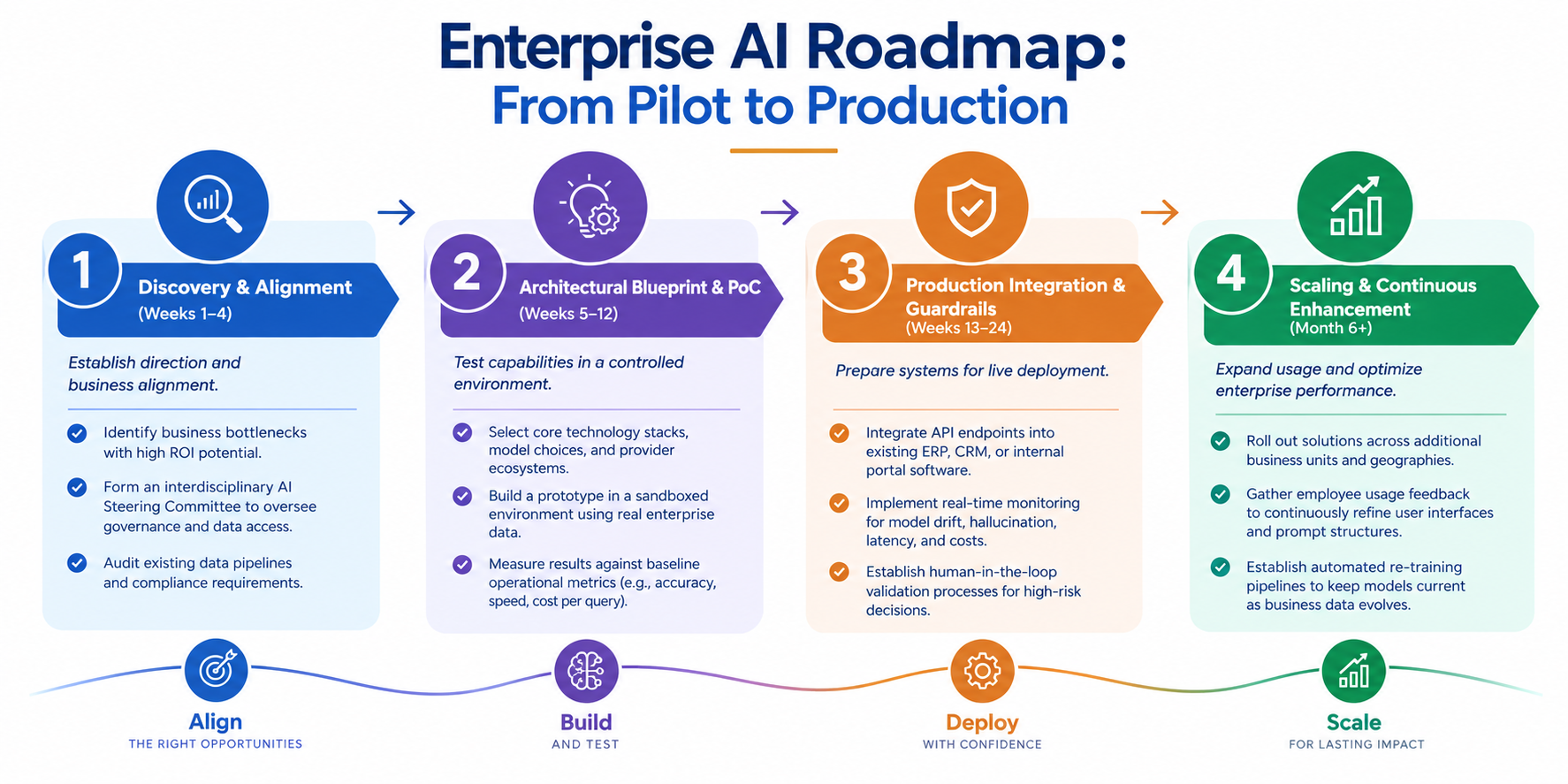
Step 1: Discovery & Alignment (Weeks 1–4)
Establish direction and business alignment.
- Identify business bottlenecks with high ROI potential.
- Form an interdisciplinary AI Steering Committee to oversee governance and data access.
- Audit existing data pipelines and compliance requirements.
Step 2: Architectural Blueprint & PoC (Weeks 5–12)
Test capabilities in a controlled environment
- Select core technology stacks, model choices, and provider ecosystems.
- Build a prototype in a sandboxed environment using real enterprise data.
- Measure results against baseline operational metrics (e.g., accuracy, speed, cost per query).
Step 3: Production Integration & Guardrails (Weeks 13–24)
Prepare systems for live deployment.
- Integrate API endpoints into existing ERP, CRM, or internal portal software.
- Implement real-time monitoring for model drift, hallucination, latency, and costs.
- Establish human-in-the-loop validation processes for high-risk decisions.
Step 4: Scaling & Continuous Enhancement (Month 6+)
Expand usage and optimize enterprise performance.
- Roll out solutions across additional business units and geographies.
- Gather employee usage feedback to continuously refine user interfaces and prompt structures.
- Establish automated re-training pipelines to keep models current as business data evolves.
The Path Forward
The defining challenge of enterprise AI adoption is no longer access to technology; it is operational execution. Organizations that succeed treat artificial intelligence not as a standalone software deployment but as a strategic business transformation that touches data, infrastructure, security, and culture.
By focusing on clear use cases, modernizing data pipelines, enforcing practical governance, and selecting experienced enterprise AI partners, business leaders can close the gap between pilot projects and sustained profit growth. The organizations that master this operational discipline today will set the benchmark for industry leadership tomorrow.