

By: Shawn Mars
No single day marked when Edmond Abramyan stopped running his own business and started marketing other people’s. No announcement, no clean break, and no moment he points to as the turning point. Instead, it was quieter: people kept asking him for help, and eventually the asking became the business.
Founder stories usually center on a decisive moment. His is more useful to other founders precisely because it wasn’t a single moment.
A Shift That Happened Gradually
Abramyan started his first business at 21 and ran it for years, learning the mechanics of online visibility because the company’s sales depended on them. Along the way, friends and other owners began bringing him their own marketing problems, and he helped where he could.
He later published his 2022 book, Wired for Success, which pairs entrepreneurship with personal philosophy, and began coaching founders afterward. In coaching, the same pattern kept appearing. Many of the owners he worked with had something worth buying and no dependable way to reach the people who would buy it.

When Other People’s Questions Become a Business
The decision to start an agency came less from a plan than from a pattern. The same questions kept coming: how to get found, why a website wasn’t bringing in calls, whether a particular ad budget made sense.
Abramyan, founder of Curious Fortune Media, says he wasn’t the first to notice it.
“It wasn’t me who realized I had a skill for this. It was other people constantly asking me questions,” Abramyan says. “If people keep coming to you with problems and you keep having answers, it means you’ve learned something worth offering.”
That gap between good businesses and the customers who never find them is the problem the agency he founded was built to solve. For a marketing agency founder, it also set the terms of the work: start from what owners actually struggle with, not from a menu of services.
A Business Reflects the Person Running It
Abramyan’s view of the work is shaped by what he believes about ownership itself. In his view, running a business is nothing like a regular job. An owner wears every hat at once, from sales to operations to marketing, and one person carries it all.
That concentration shows up in how small companies handle marketing. In a 2025 Intuit QuickBooks survey of more than 1,000 small business owners and marketing leaders, more than a third of small businesses had the owner personally make marketing decisions.
For Abramyan, that makes the owner the first place to look.
“Your business is a reflection of who you are. The things that are lacking in the business are usually lacking somewhere in the owner too,” Abramyan says. “That’s not a criticism. It’s just where useful advice has to start.”
In practice, conversations often start with how business owners make decisions, what they believe about marketing, and what they are willing to commit to, before anything changes on a website or in an ad account.
Knowing When to Say No
One of the clearest shifts from operator to advisor was learning what not to sell. Many agencies offer every service a client could buy. Abramyan’s approach is narrower. He recommends paid ads only when a client genuinely needs them and has the budget a competitive market demands, and in some industries, that budget is substantial. The agency declines or refers requests outside its focus, and some prospects are told plainly that they are not ready yet.
Honest expectations are part of the same discipline. Early progress, such as a business starting to appear for more searches, often comes well before that visibility turns into steady revenue. Owners are better served by hearing that distinction up front than by being promised quick returns.
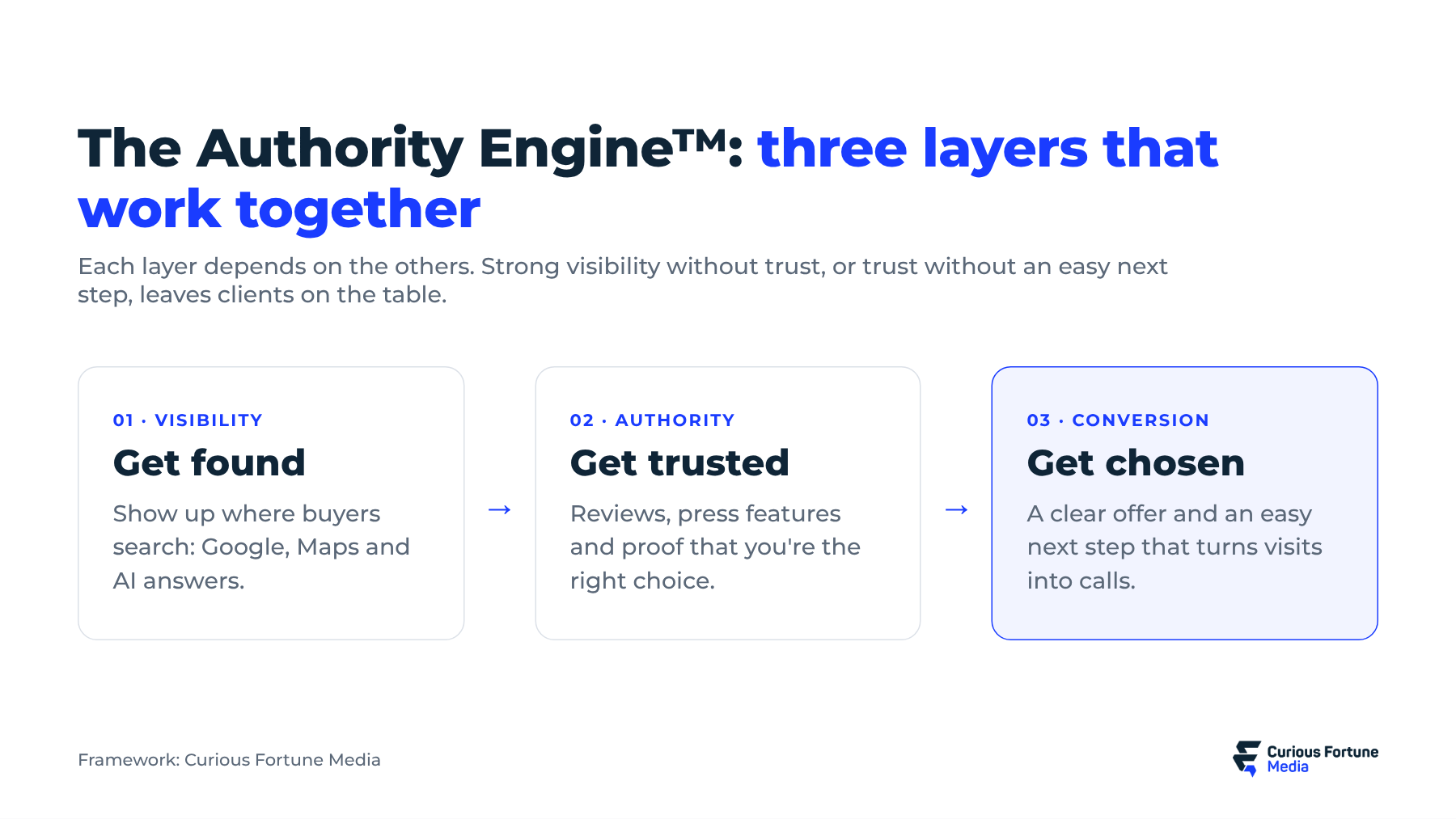
In place of that menu, Abramyan built the Authority Engine™ at Curious Fortune Media as one connected system with three layers in sequence: visibility, authority, and conversion. Each layer is there only if it moves a client toward the outcome they came for, which is why the system leaves out services a client doesn’t need.
What Other Founders Can Take From It
The lessons travel well beyond marketing. The questions people keep bringing to a founder often guide real expertise better than any business plan. A company’s constraints often trace back to its owner, so it’s worth examining them before reaching for a new tactic. Turning down work that doesn’t fit can be a form of service, not a lost sale. And any investment deserves to be judged on two clocks: when it starts showing progress, and when it starts paying off.
None of this argues that every founder should pivot. A service business has its own pressures, and success in one kind of company doesn’t guarantee it in another.
There was no single moment when Abramyan’s shift happened, and that is the useful part. It came from paying attention to what other people kept asking. The transition taught him that serving other businesses well starts with being honest about what they need, including when the answer isn’t him. For most founders, the questions people already bring them are worth writing down.