
By: Nicolas Mercado
There is a moment in Christopher Brown’s story that gets all the attention. June 1, 2016. A heart attack at the gym. Flatlined in front of his wife. Shocked back to life. It is the kind of event that stops a person cold and forces a reckoning with everything they have been taking for granted, every deferred moment, every postponed trip, every conversation that was going to happen later when things slowed down.
But Christopher will tell you that the month before the heart attack may have changed him even more.
Thirty days earlier, he and his wife Julie had completed a month-long cruise across the South Pacific. For the first time in his career, he truly unplugged. No emails answered. No decisions made from a ship cabin. No crises managed from a different time zone. He stepped away completely and waited to discover the chaos that would inevitably result from his absence.
The chaos never came.
His businesses kept running. His teams handled what needed handling. The whole operation, which he had spent three decades building in a way that required his constant presence to function, continued without him. That discovery shattered something he had believed so completely he hadn’t realized it was a belief. He thought everything depended on him. He had structured his entire professional identity around that assumption. He was wrong, and the proof arrived quietly, without drama, while he was watching the Pacific from a ship’s deck.
Then, thirty days after returning home, his heart stopped.
The Question That Wouldn’t Leave
Lying in the hospital bed in the aftermath of the heart attack, Christopher kept returning to the same question. What if they had never taken the trip? He had spent years deferring the things that mattered most, assuming that someday would arrive when the business was more stable, the calendar less full, the timing finally right. Someday had been the organizing fiction of his entrepreneurial life, the story he told himself that made the constant sacrifice feel temporary rather than permanent.
The trip proved that someday could be now. The heart attack proved that someday might not arrive at all.
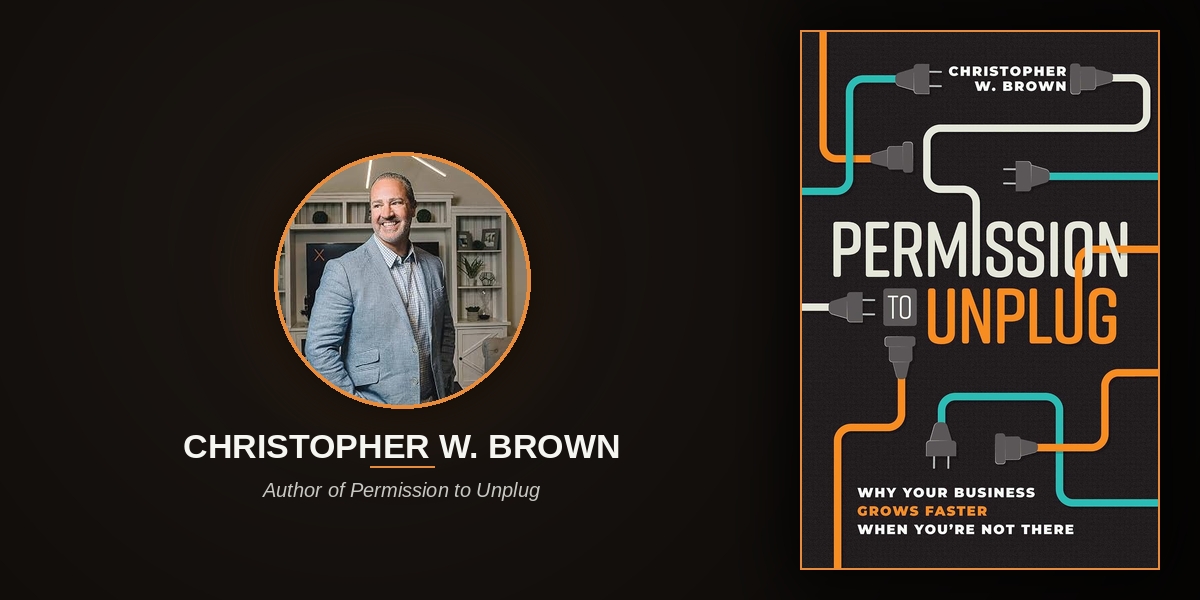
Those two experiences together, one a discovery and one a near death, became the foundation of Permission to Unplug: Why Your Business Grows Faster When You’re Not There. The book exists because too many entrepreneurs are living the same postponement Christopher was living, believing that success requires constant sacrifice, that the business needs them in every decision, that the life they started the company for can wait a little longer. The problem is that a little longer has a way of becoming the whole story.
What He Built After
The Christopher Brown who walked out of that hospital was not the same person who had walked into the gym. The businesses he runs today, NEXT New Homes Group, NEXT Real Estate Group, and NEXT Crafted, are built on an entirely different principle. They are designed to operate without him. Not as a contingency or a theoretical possibility but as the actual daily reality of how they function. The systems are real. The teams are empowered. The processes hold without his constant involvement.
The proof is visible and intentional and ongoing. He now spends extended stretches of the year traveling the world with Julie and their son Marcus while the companies run themselves. The book he wrote is the thesis of his life lived out in real time, which is the only kind of proof that actually matters in a business book.
He considers all of it research. The travels, the experiences, the time with family, and the heart attack. Especially the heart attack.
The Misconception That Keeps Leaders Trapped
The biggest misconception Christopher challenges in the book is one that his own career embodied for decades. The belief that the best leaders are the busiest leaders. That constant availability equals commitment. That answering emails from the beach is dedication rather than a signal that something structural is broken in how the business was built.
If a business can’t function without its founder, the founder hasn’t built a business. They’ve built a very demanding job for themselves, one with no sick days, no real vacations, and no clear exit from the operational detail that consumes every available hour. Great leadership means building people, systems, and cultures that continue to thrive when the leader steps away. That is what creates sustainable growth. That is what creates a business with real value. And it is what creates a life worth having built the business for in the first place.
The culture of entrepreneurship celebrates the opposite of this. It admires exhaustion. It treats busyness as evidence of commitment and rest as evidence of weakness. Christopher spent thirty years inside that culture before a month-long cruise and a heart attack gave him the data he needed to stop believing it.
If you’ve been postponing the trip, the time, or the life you started your business for, Permission to Unplug by Christopher Brown is available now on Amazon.